
On July 1, 1961, the U.S. Naval Communication Station, (NAVCOMMSTA) Iceland was established and assumed most of the island’s military communications requirements from the Airways and Air Communications Service Squadron (AACS/MATS). The NAVCOMMSTA’s responsibilities were wide-ranging with personnel assigned to operate communications equipment at a variety of remote sites: Inter-Island TROPO site at H-1; DYE-5 Transceiver site; transceiver sites at H-2 and H-3, the Special Communications
(SPECOMM) at H-2; and Naval Radio Transmitter Facility (NRTF) Grindavik. In 1968 the Receiver Site was relocated from the Garrity building, which had served as a receiver site since 1948. In late 1991, the Naval Communication Station was redesignated an U.S. Naval Computer and Telecommunications Station (NCTS).
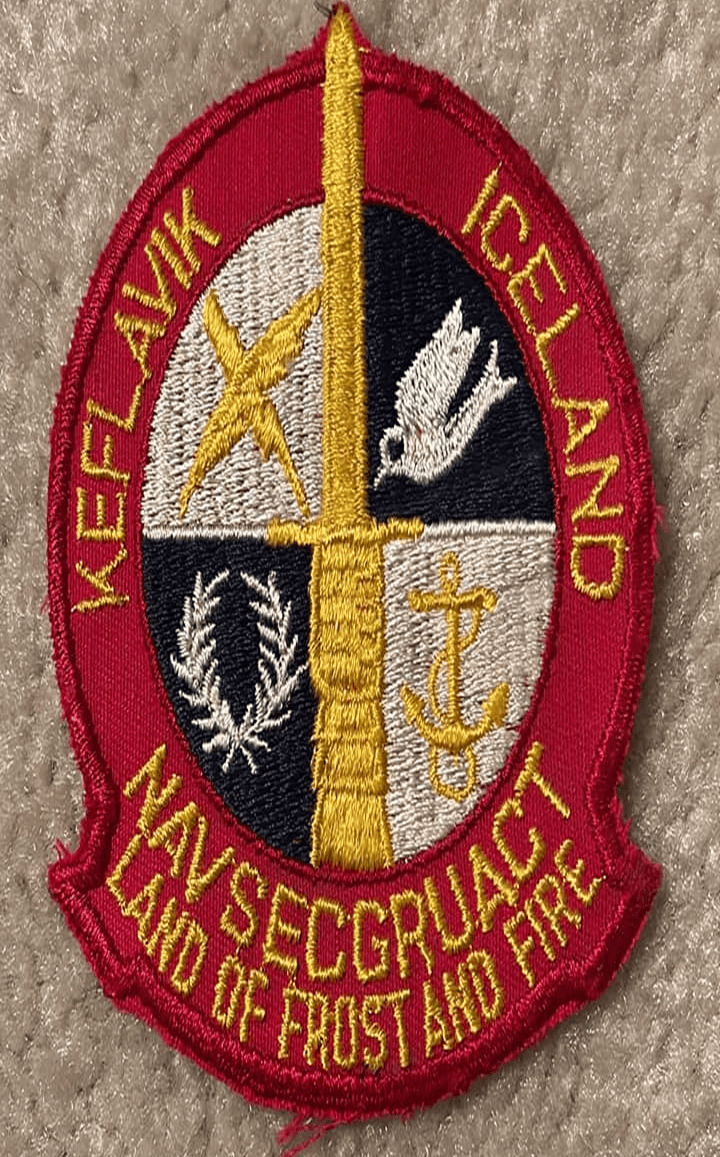
On March 18, 1959, an advance party arrived, and U.S. Naval Security Group Activity (NSGA) Keflavik was formally commissioned on April 25, 1959. The command was initially located in an Operations building near the village of Hafnir, Iceland. In November, 1967, the command assumed the function of a CRITICOMM relay station, using spaces in Hanger 831, onboard Naval Air Station Keflavik. The NSGA Special Operations building was completed in April, 1970 at the Rockville site.
The U.S. NSGA Keflavik maintained and operated a high frequency direction finding (HFDF) facility and provided communication support to Navy and other Department of Defense elements. NSGA Keflavik maintained an AN/AX-19 Pusher Wullenweber, which is a 2-band Circularly Disposed Dipole Array (CDDA) HFDF collection system, which was installed in the summer of 1979 at the Rockville site. The AN/AX-19 Pusher is a miniaturized version of the Navy’s AN/FRD-10 antenna. The outer ring of elements is about 400 feet in diamter, half the diameter of the AN/FRD-10 CDAA Wullenweber Antenna Array. The Operations Building was located approximately 500 yards distance from the CDDA. The CDDA has since been removed.
In the summer of 1979, after the AN/AX-19 Pusher antenna became operational, all of the operational, administrative, communications and facilities functions were consolidated at the Special Operations Building at the Rockville site. The Communications Center in Hanger 831 was turned over to Commander, Fleet Air Keflavik (CFK). The old Operations building at Hafnir was turned over to NAS Keflavik.
NAS Keflavik was the host Command for the NATO Base in Iceland. There were more than 25 different commands of various sizes and personnel from the Navy, Air Force, Marines, and Army in Iceland. Also present were representatives from Canada, the Netherlands, Norway, and Denmark. One of the largest commands was Naval Air Station (NAS) Keflavik, which was responsible for providing all support facilities, including the runways, housing, supply and recreational facilities, to name a few. NAS Keflavik employed approximately 900 Icelandic civilians, who worked with military personnel to provide the services necessary to operate the base. Twenty-four hours a day, seven days a week, the airfield was available for maritime patrol activities, air defense and for transiting aircraft between North America and Europe. The runways operated by NAS Keflavik were shared with the Keflavik International Airport.
The major commands stationed on the base were the Naval Air Station Keflavik; the Air Forces 85th (Fighter) Group; Commander, Fleet Air Keflavik; Commander, Iceland Defense Force; NCTS Keflavik, Naval Hospital Keflavik, and the Marine Corp Security Force Company, Keflavik.
The U.S. Air Force had about 2,000 active-duty airmen stationed with the 85th Group at NAS Keflavik. The air defense mission is carried out by F-15 Eagle fighter aircraft rotating every 90 days to Iceland. Using four ground-based radars and occasionally AWACS (Airborne Warning and Control System) aircraft, the 85th Group’s 932nd Air Control Squadron provided air surveillance of Iceland and the North Atlantic.
The NATO base offered a wide variety of recreational services, including: bowling, swimming, gymnasium, theater, social clubs, Wendy’s restaurant, and hobby centers.
Other services included a base exchange, commissary, bank, hospital, beauty shop, video rentals, USO, service clubs, tour office and morale flights. In the late 1980’s, before a Wendy’s was located on Keflavik, the USO sponsored an event, one day a year, when hundreds of McDonald’s Big Macs and Quarter Pounders were flown in from Norfolk, VA, and sold to Soldiers, Sailors, Airmen, Marines, and their families on base. The line to obtain this precious commodity stretched around the base. Proceeds went to the USO.
NSGA Keflavik was decommissioned and closed on June 30, 1994. NSGA was located approximately 8 miles from NAS Keflavik, one mile from the U.S. Air Force 932nd Air Defense Squadron facility, and adjacent to the Naval Computer and Telecommunications Station Keflavik, Rockville Receiver Site. The Rockville Receiver Site was fully remoted on March 14, 1997; and was closed in October, 1999.
Naval Air Station Keflavik (NAS) disestablished on September 8, 2006 during a ceremony officially ending its 45 years of operations, in support of the defense of Iceland. More than 100 Sailors attended the event, representing a majority of the forces that remained of a population that once exceeded 5,000 military and civilian personnel and family members. Special guests included the U.S. Ambassador to Iceland, Carol Van Voorst and special envoy for Iceland’s Minister of Foreign Affairs, Thorsteinn Ingolfsson. NAS Keflavik officially closed on September 30, 2006.
Source: CT History


18 May 2026 at 08:08
No mention of Rockville’s loyal mascot, GAF, who had the run of the place in the early 70s.
LikeLike
18 May 2026 at 15:57
Believe there is a typo for the CDAA at Rockville. It was an AX-19 Pusher, not an AX-16. After NSGD departed Rockville, the SPECOMM group still used that AX-19 antenna. I helped maintain it until we relocated SPECOMM to NAS Keflavik in an area of the base close to the main Receiver Site. We installed a refurbished AX-19
LikeLike
18 May 2026 at 16:03
Continue from previous post about the AX-19 Antenna. RMCS Dutch Stone refurbished the antenna. I provided technical support to SPECOMM. Respectfully Art Kluvo.
LikeLike
18 May 2026 at 16:37
Correction made. Thank you
LikeLike