
With a separate officer community now responsible for cyber warfare, the cryptologic warfare community must refocus officer develpment on signals intelligence and electronic warfare.
By Lieutenant Commander Enrique Galvez, U.S. Navy
January 2026 | Proceedings | Vol. 152/1/1,475
Cryptology plays a critical role in modern warfare. Conflicts in the Red Sea and Ukraine have reaffirmed that understanding and controlling what is in the radio frequency (RF) spectrum can be the difference between life and death. Paradoxically, this technology-heavy domain requires human experts more than ever. As technology advances at breakneck speed, the Navy requires distributed, tactical-level expertise to dynamically innovate, execute, and fight.
And yet, officers from the cryptologic warfare (CW) community are spread thin across competing requirements. They lack a career path structured to build the expertise the Navy requires. The CW community must develop officer proficiency to deliver relevant cryptologic capabilities to decision-makers, drive change, and bring innovative tactics, techniques, and procedures to the next fight.
The Challenge
Naval cryptology traces its origins to the legendary World War II Captain Joe Rochefort and his Station Hypo crew who decoded and analyzed Japanese radio traffic. They famously warned of the June 1942 attack on Midway Island.1 Since then, the CW community has retained a core focus on signals intelligence (SigInt) and electromagnetic warfare (EW) to support force protection, indications and warning, and theater and national intelligence requirements. However, over time, additional missions have been added, including cyber warfare and operations in the information environment. These missions place a heavy emphasis on military deception (MilDec), military information support operations (MISO), and special technical operations (STO), despite the Navy not considering these to be core CW disciplines.
Simultaneously, rapid advances in communications, weapons technology, and networked sensors have altered the character of naval warfare and challenged cryptology as a discipline. While the objective of targeting an adversary prior to being targeted is as old as warfare itself, the ranges at which this now occurs span the globe. Ships and aircraft can be detected, tracked, and targeted in increasingly sophisticated ways, including through their own RF emissions. The Navy’s freedom of maneuver will be severely limited, as assets struggle to remain outside adversary weapons engagement zones (WEZs).
Furthermore, the proliferation of encryption, satellite communications, and complex signal types has made tactical cryptology increasingly challenging, resulting in a diminishing ability to support operational decision-makers. This challenge will grow as cheaper and more readily available computing power, combined with machine learning and artificial intelligence, improves encryption and adds new protocols and signal types.
However, to fight and win, the Navy cannot afford to remain outside every WEZ to avoid detection, nor can leaders throw their hands up in the face of a difficult technical problem. In wartime, commanders will be forced to assume varying degrees of risk. As Captain Scott Tait and Commander Anthony LaVopa argued, in a hypothetical conflict with China, tactical commanders will need to find “small windows of opportunity in which the United States would have a fleeting tactical advantage to destroy PLAN ships.”2 Commanders will require timely information on adversary disposition, sensors, and targeting chains to make risk decisions about own-force emissions and maneuvering within WEZs. In restrictive emission control (EmCon) postures, units must be self-reliant to survive. The Navy needs experts at the tactical edge to apply CW disciplines in the next fight. The CW community must own this role, and this requires an urgent refocusing on developing a technically and tactically proficient officer corps.
Refocus the CW Officer Community
To drive this change, the CW community must refocus officer development and career progression to build proficiency in core SigInt and EW disciplines. The current “mile-wide, inch-deep” base of knowledge is insufficient. Currently, typical CW officers spend their first three to four tours in different job fields. Junior officers complete a tactical tour with a ship, submarine, aviation squadron, or special warfare unit, with most never again serving on tactical units. There are no formal career progressions, in which officers would start in a subordinate division officer role, then progress to department head and more-senior leadership roles, all within the context of a platform or warfare domain. This leaves CW officers unprepared to meet the plethora of complex challenges head-on. Talented officers excel in spite of the system, not because of it. It took an act of Congress to recognize this fact by mandating the Navy establish a specialized maritime cyber warfare officer (MCWO) community, separate from the CW community.3
With the cyber mission now removed from the CW community’s portfolio, the 2024 O-4 and O-5 milestone screening boards can more accurately evaluate what CW officers do. Navy Information Forces defines milestone jobs as “critical operational assignments (afloat and ashore) that have significant scope, complexity, leadership, and depth of expertise requirements.” In sum, milestone jobs are the backbone of CW leadership across the fleet with the greatest ability to leverage expertise to effect change. While SigInt-focused jobs are well-represented on both O-4 and O-5 milestone billet lists, EW is not and has not been for years, despite being a core discipline of ostensibly equal importance.
Using rough numbers, depending how one bins each billet, of 95 O-4 milestone billets, only 4 are strictly EW, none of which are on a combatant command, numbered fleet, or strike group staff. Conversely, there are 22 SigInt milestone billets across joint, operational, and tactical-level staffs. Of 49 O-5 milestone billets, none are exclusively EW billets, although EW does fall within the broad scope of responsibility for many of them. For example, while EW falls within the purview of a strike group N9 and fleet N39, not a single staff EW officer billet is a CW milestone billet. Conversely, the O-5 milestone billet list does contain three billets exclusively focused on MISO, MilDec, and STO, and the O-4 list has a whopping 14 such billets. The result is a CW career path that limits officers’ ability to develop core SigInt and EW expertise by shortening the time they work on these problems before moving to unrelated jobs.
To pick up the slack, the community used to rely on limited duty officers (LDOs), chief warrant officers, and prior-enlisted CW officers who have deep experience and expertise. Prior-enlisted CW officers have punched above their weight for years, serving as mentors and technical advisors to CW officers far senior to them. They have provided invaluable guidance, training, and wisdom to junior officers as they rose through the ranks. However, the dissolution of the LDO program and a five-year tenure cap on enlisted cryptologists applying for officer commissions has drastically cut their numbers.4 While these decisions were designed to offset community attrition at senior ranks, there have not been compensating changes to mitigate this loss of expertise.
The result is a community continually caught behind the curve, reacting to the latest technological advances instead of preparing for the next. There are plenty in the community ringing alarm bells about atrophy in cryptologic warfare core disciplines. With the movement of the cyber warfare mission to the new MCWO community, CW community leaders should seize the opportunity to refocus on core disciplines. The following are some recommendations on how to do so:
Master operational EW and SigInt. The next fight will demand a high level of technical and operational expertise in SigInt and EW at all ranks. These disciplines are intimately related and require years of practice to lead and conduct effectively. Furthermore, they enable critical fleet functions of electromagnetic maneuver warfare; counter–intelligence, surveillance, reconnaissance, and targeting; and electromagnetic spectrum operations. Mastering RF fundamentals, communication protocols, and electronic-attack techniques requires not just an understanding of complex theory, but also a practical, realistic grasp of the systems and platforms that collect and emit. Anyone who has conducted tactical-level SigInt or EW understands that systems do not always work as expected; understanding RF propagation in different environments is no simple matter; and a high level of operator training and proficiency is critical.
CW officers should build expertise through a combination of practical and theoretical training—and, most of all, operational experience. Officer training should include a portion of the same hands-on training with cryptologic systems that enlisted cryptologic technicians receive. Furthermore, tactical qualifications in cryptologic watches should be a prerequisite to standing non-cryptologic watches. While it is not an officer’s primary job to operate gear, they need an in-depth understanding of how it works to understand capabilities, limitations, and considerations as they make decisions and recommendations regarding when and how their systems and personnel are employed. This level of expertise cannot be gained through capabilities briefs or classroom lectures.
While qualification in non-cryptologic watches is necessary, professionally rewarding, and an invaluable way to integrate cryptology into operations, those qualifications should be pursued only after completing cryptologic watch qualifications. The CW community must incentivize cryptologic qualifications and additional qualification designators above all others in selection-board criteria.
Analysis, too, is a key, if often overlooked, component of cryptologic expertise. A firm grasp of adversary communications, protocols, and encryption methods, as well as the massive national U.S. SigInt infrastructure, takes years to develop. Analytical expertise is required to translate raw collected data into usable information, understand collection biases, provide meaningful recommendations to commanders, and drive operations. CW officers also must have an in-depth understanding of the adversary to inform collection priorities, system acquisitions, and training pipelines.
The CW community also must take a realistic approach to allocating resources toward MilDec, MISO, and STO. While cryptologists are often well-placed to inform niche or deceptive efforts, in the same way Rochefort’s team falsely reported a water supply issue on Midway to trick the Japanese into revealing that AF was their code for the island, they do not need to be the sole champions of Navy operations in the information environment. MilDec, MISO, and STO are as much operations and intelligence functions as they are cryptologic warfare functions. The CW community should either shed or convert billets unrelated to SigInt and EW, freeing bandwidth to focus on the most pressing requirements.
Finally, a focus on SigInt and EW does not entirely exclude cyber warfare. While the new MCWO community must own on-net operations, collection and exploitation of RF links remain inherently cryptologic functions. This implies a team effort whereby CW is responsible for exploiting the RF links required to collect and gain access to a network, and MCWO is responsible for the remote on-net exploitation of that network. The CW and MCWO communities must work together to best confront this challenge. Given the above-mentioned pace of encryption and technological innovation, cyber access should not be viewed solely as a vector for effects, but as a critical component of intelligence collection, providing actionable insights into adversary plans and intentions.
Expand operational tours to develop career progression. As the saying goes, “Sailors belong on ships and ships belong at sea.” Similarly, CW officers must have operational experience to gain expertise. Their career paths should be structured accordingly. A single junior officer tactical tour—a year of which is spent just learning the platform, organization, and doctrine—is not enough. Graduate education should augment—not replace—operational experience. The community must eliminate the all-too-common occurrence of officers in O-4 and O-5 milestone billets who have little or no operational experience, let alone expertise, in the domain in which they are responsible for leading.
One way to build this expertise would be to create subspecialties with specific career progressions within the CW community. CW officers would choose a domain (subsurface, surface, air, or expeditionary) as junior officers, then complete two tactical tours in that domain. For example, as some have suggested, a first tour as an afloat electronic warfare officer should be followed by a second tour as all-encompassing information warfare officer.5 Officers would then screen for and complete O-4 and O-5 milestone tours at strike group, task force, or other higher-echelon commands while remaining responsible for the same domain.
An expansion of tactical-level billets should not be limited to surface cryptology either. There are notably few CW officers at Naval Expeditionary Intelligence Command in Dam Neck, Virginia, despite that command having a heavy SigInt/EW mission. EA-18G Growler squadrons, which possess the greatest wealth of airborne EW knowledge in the Navy, also lack CW officers. At higher echelons, the community must seek to advocate for EW-focused billets on tactical, operational, and joint staffs. Well-versed officers could then drive change from within these staffs and supporting commands to optimize their alignment with the tactical-level warfighter.
Shore tours should allow officers to continue building expertise. Post-milestone tours should include shore-based analytical commands, such as fleet information operations centers (FIOCs) and NSA target offices of primary interest, which are designed to support fleet efforts yet are often short on the fleet experience required to provide that support most effectively. For example, who better to lead shore-based FIOC Hawaii support to the fleet than an officer who just completed several years of afloat cryptology in the Pacific?
Technology is rapidly changing, and the CW community must keep pace. This challenge is an exciting opportunity to develop and deliver real, meaningful warfighting contributions.
Fleet Admiral Ernest King famously said, “The minute you try to be strong everywhere . . . you will be weak everywhere.”6 This profound observation is as applicable to the CW community today as it was to force disposition in World War II. Cryptology is complex and not broadly understood. It occupies a niche, supporting role that, when done well, can buy seconds or even minutes of decision space during what may be brutal combat. The Navy needs CW officers to fill this role, but a technically proficient cryptologist cannot be built overnight. Waiting for the next conflict will be too late.
1. Neal Conan, “The Codebreaker Who Made Midway Victory Possible,” interview with author Elliot Carlson, NPR, 7 December 2011.
2. CAPT Scott Tait, USN (Ret.), and CDR Anthony LaVopa, USN, “It All Comes Down to Sea Control,” U.S. Naval Institute Proceedings 149, no. 12 (December 2023).
3. Kristy N. Kamarck and Catherine A. Theohary, FY2023 NDAA: Cyber Personnel Policies (Washington, DC: Congressional Research Service, 6 March 2023).
4. PO2 Jared Catlett, USN, “Cryptologic Warfare Limited Duty Officer Sundown,” DVIDS, 15 June 2022.
5. CWO Joshua M. Emery, USN, “Cryptologic Warfare Officers Can No Longer Be Generalists,” U.S. Naval Institute Proceedings 149, no. 7 (July 2023).
6. Walter R. Borneman, The Admirals: Nimitz, Halsey, Leahy, and King—The 5-Star Admirals Who Won the War at Sea (New York: Little, Brown & Company, 2012).
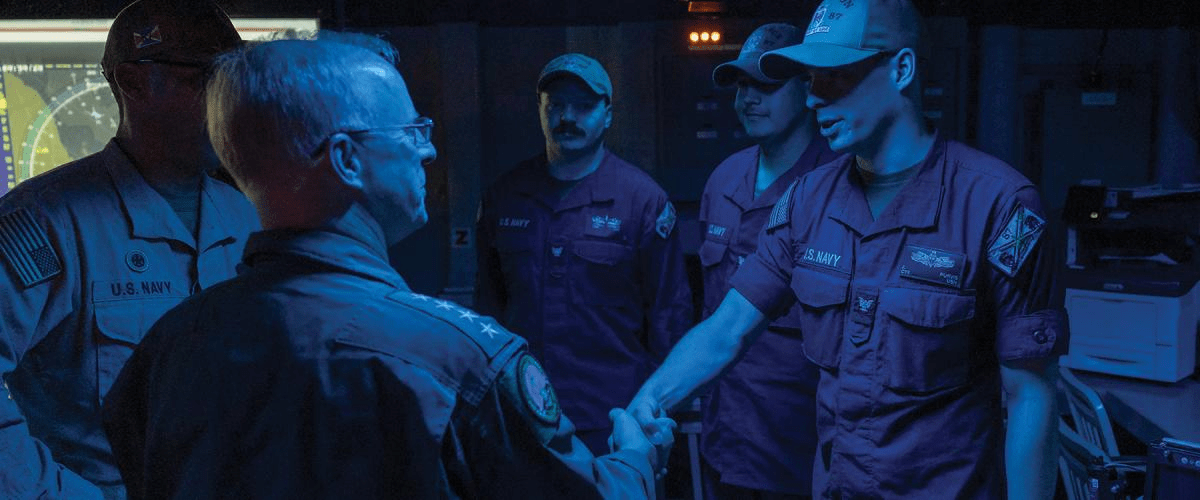
Featured image: Admiral Daryl Caudle, now Chief of Naval Operations but then Fleet Forces commander, left, gives a coin to a cryptologic technician (collections) on board the guided-missile destroyer USS Mason (DDG-87). U.S. Navy (Nathan T. Beard)
Lieutenant Commander Enrique Galvez, U.S. Navy
Lieutenant Commander Galvez is a cryptologic warfare officer assigned to U.S. Sixth Fleet in Naples, Italy. He previously led cryptologic operations while assigned to at-sea and special operations units.


1 January 2026 at 09:31
here here. Expertise makes a difference in combat, and cryptologists have a critical part to play. That is not hyperbole. Critical.
LikeLike
1 January 2026 at 11:07
Good morning Mario. Do they still use Morris Code as well as computer intercept? Happy New Year, always love your posts.
>
LikeLike
1 January 2026 at 11:38
Morris code is still used, but not as much as Cold War.
Happy New Year.
LikeLike
1 January 2026 at 11:43
Hmm, So maybe the admirals should kept the LDOs??
LikeLike
2 January 2026 at 17:25
We used to have a program which included training and provisions to provide timely intel to ship commanding officers. It was called the Naval Security Group and it was killed in 2005 when all the “brains” determined that no one would use radios anymore for communications; but everything would be sent via computers. N O T !
LikeLike
2 January 2026 at 23:30
nice article Rick
LikeLike
8 January 2026 at 00:29
The CW community continues to be a ‘choose your own adventure’ career path with a lot of OJT. Our challenge is that the CW community has taken on the role of tackling a warfare area that will continue to be on the bleeding edge of warfare. Sloughing off Cyber Warfare is a good start, but I don’t think the scope of our duties will decrease anytime soon.
Structuring a standard career path is very challenging in the context of so many diverse jobs, as you mentioned. Structuring a standardized training program is also very challenging, as curriculum will always trail behind the latest and greatest technology.
My response to white papers or Proceedings articles (I agree with all your points): why describe a problem when you could just put that effort into solving the problem? Our CW officers already have the brains and work ethic to tackle these issues: Take the helm.
LikeLike