
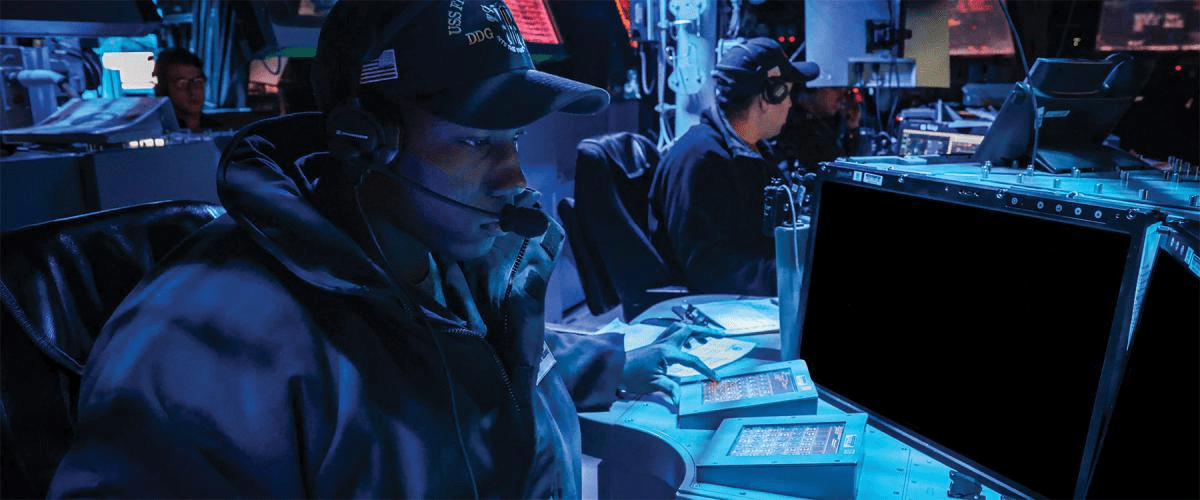
The Navy’s center of gravity is evolving toward the information domain—not because it replaces ships or aircraft, but because it has become the decisive enabler of lethality, survivability, and decision advantage at sea.
Carl von Clausewitz defined a center of gravity as “the hub of all power and movement, on which everything depends.”1 For centuries, navies around the world saw this hub as the fleet itself, with ships exerting dominance primarily through firepower and physical presence. Alfred Thayer Mahan’s theory of sea power influenced navies to build heavily armored ships and large fleets to maximize presence and control sea lines.2 In this paradigm, the center of gravity resided in the hulls, aircraft, and weapons that physically imposed maritime dominance.
Naval Warfare Publication 5-01: Navy Planning defines a center of gravity as “the source of power or strength that enables a military force to achieve its objective and is what an opposing force can orient its actions against that will lead to enemy failure.”3 Today, precision strikes, space-based surveillance, dispersed forces, and rapid decision-making rely on secure data links, electromagnetic spectrum control, and integrated sensing. If those systems are degraded or delayed, platforms may retain their kinetic capabilities but lose their operational effectiveness. Thus, adversaries increasingly are orienting their actions against the networks and information systems that connect platforms.
Information warfare enables the achievement of naval objectives while also presenting a target whose disruption can produce systemic failure. Control of and resilience in the information domain increasingly meet the criteria of a center of gravity.
Lethality
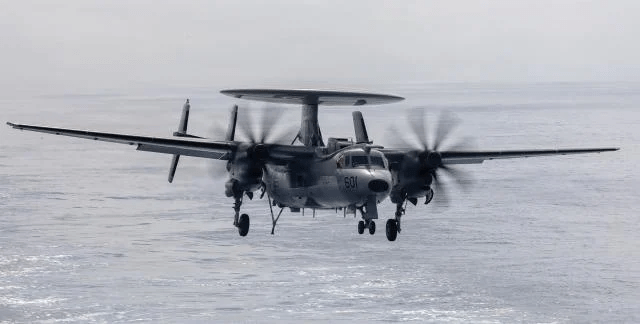
Naval combat power no longer is contained solely within individual platforms. Sensors, weapons, and commanders are now connected across domains through networks. The Navy’s distributed maritime operations concept reflects this shift. It emphasizes dispersed forces that maximize information—not just weapons and platforms—to mass effects
Under Naval Integrated Fire Control–Counter Air, for example, an Aegis destroyer could launch a missile using targeting data provided by an offboard sensor such as an E-2D Hawkeye or F-35.4 In such architectures, the lethality of the weapon system depends less on the ship’s organic radar and more on the integrity and efficiency of the network. A missile traveling hundreds of miles is only as useful as the data guiding it. Without accurate targeting data and secure communications, even the most advanced weapons become guesswork.
As the Navy transitions from platform-centric engagements to a distributed kill web, a reliable network that connects sensing, targeting, and fires is crucial to maintaining lethality.
Survivability
The modern battlespace increasingly features long-range precision weapons and persistent surveillance. Survivability in this environment does not depend purely on physical protection and presence. It includes controlling emission signatures and disrupting adversary targeting.
For the Navy’s 600-ship fleet during the Cold War, survivability was focused on redundancy and the ability to absorb and recover from damage through size and numbers.5 Today, it depends on emissions control, cyber defense, and electronic deception. China’s “systems destruction warfare” emphasizes attacking networks and information nodes rather than the platforms themselves.6 Incidents of jamming and spoofing in the Black Sea and Persian Gulf demonstrate how easily targeting data can be degraded.7
If adversaries can manipulate the data feeding combat systems, they can paralyze platforms without sinking them. Electronic warfare systems such as the Navy’s upgraded AN/SLQ-32 are therefore not purely defensive.8 By detecting, classifying, and jamming adversary emissions, these systems can corrupt targeting data before a missile is ever launched. In this battlespace, survivability depends on controlling information.
Decision Advantage
In a conflict today, much of the fight would begin before the first missile was launched. Forces continuously compete to disrupt, degrade, and outpace one another in the information domain. The Department of Defense’s Joint All-Domain Command and Control initiative reflects that victory will depend on integrating sensors and decision-makers into a unified data environment.9 Resilient networks and secure communications enable this.
The war in Ukraine continues to illustrate how forces that integrate intelligence, surveillance, and reconnaissance, electronic warfare, and rapid targeting can shape engagements before adversaries can respond effectively.10 The side that prioritizes initiative often holds the upper hand. Today, initiative often is measured in bandwidth and milliseconds.
Integration, Not Displacement
The growing centrality of the information domain does not diminish the importance of ships, submarines, aviation, or sailors and Marines. However, each depends on secure networks and reliable data to operate effectively. Information dominance does not replace traditional naval power; it enables that power to function and unites a force more reliant on data than ever before.
Risk and Resilience
As the information warfare community works to innovate and adapt to the challenges of modern conflict, network resilience is both a strength and a vulnerability. Cyber intrusions such as the SolarWinds breach demonstrate how adversaries can exploit digital supply chains.11 Growing reliance on satellite communications and GPS exposes maritime forces to space-based and electronic warfare. Redundancy and cyber hardening are required to preserve our decision-making advantage in a contested environment.
Naval warfare will always require physical presence and kinetic capabilities. However, in an environment defined by precision strikes and compressed timelines, the resilience and efficiency of networks increasingly determine whether that power can succeed. A ship cannot fight if it cannot see and communicate. Mastery of the information domain will not replace traditional naval power, but it will increasingly determine whether that power prevails. It will be the decisive enabler of lethality, survivability, and decision advantage at sea.
1. Carl von Clausewitz, On War, trans. Michael Howard and Peter Paret (Princeton, NJ: Princeton University Press, 1976), 595–96.
2. Alfred Thayer Mahan, The Influence of Sea Power upon History, 1660–1783 (Boston: Little, Brown, and Company, 1890).
3. U.S. Navy, Naval Warfare Publication 5-01: Navy Planning (Washington, DC: Department of the Navy, May 2021), appendix C.
4. Ronald O’Rourke, Navy Aegis Ballistic Missile Defense (BMD) Program: Background and Issues for Congress (Washington,
C: Congressional Research Service, updated 2023).
5. Joseph Sims, “Lessons from the 600-Ship Navy,” Naval History 36, no. 4 (August 2022).
6. Jeffrey Engstrom, Systems Confrontation and System Destruction Warfare: How the Chinese People’s Liberation Army Seeks to Wage Modern Warfare (Santa Monica, CA: RAND Corporation, 2018).
7. CSIS Defense and Security Program, “Extending the Battlespace to Space,” in War and the Modern Battlefield: Insights from Ukraine and the Middle East (Washington, DC: Center for Strategic and International Studies, 2025).
8. Northrop Grumman, “Surface Electronic Warfare Improvement,” in Mission Solutions: Electronic Warfare (Falls Church, VA: Northrop Grumman, n.d.).
9. U.S. Department of Defense, 2022 National Defense Strategy of the United States of America (Washington, DC: Department of Defense, 2022).
10. Jack Watling and Nick Reynolds, Meatgrinder: Russian Tactics in the Second Year of the Invasion (London: Royal United Services Institute, 2023).
11. U.S. Senate Select Committee on Intelligence, Report on the SolarWinds Cyberattack (Washington, DC: U.S. Senate, 2021).
Ensign Kevin H. Nguyen, U.S. Navy
Ensign Nguyen is a cryptologic warfare officer. He graduated from the U.S. Naval Academy in May 2026 with a bachelor of science degree in cyber operations.
The Navy’s Evolving Center of Gravity
U.S. Naval Academy Class of 2026 Capstone Essay Contest Winners
Sponsored by the Class of 1945 in honor of Commander Earl Fannin
Category: Information Warfare
By Ensign Kevin H. Nguyen, U.S. Navy
Featured image: The combat information center on board the guided-missile destroyer USS Frank E. Petersen Jr. Mastery of the information domain increasingly will determine whether naval power can succeed. A ship cannot fight if it cannot see and communicate. U.S. Navy (Christian Kibler)
Source: U.S. Naval Institute


Leave a Reply