
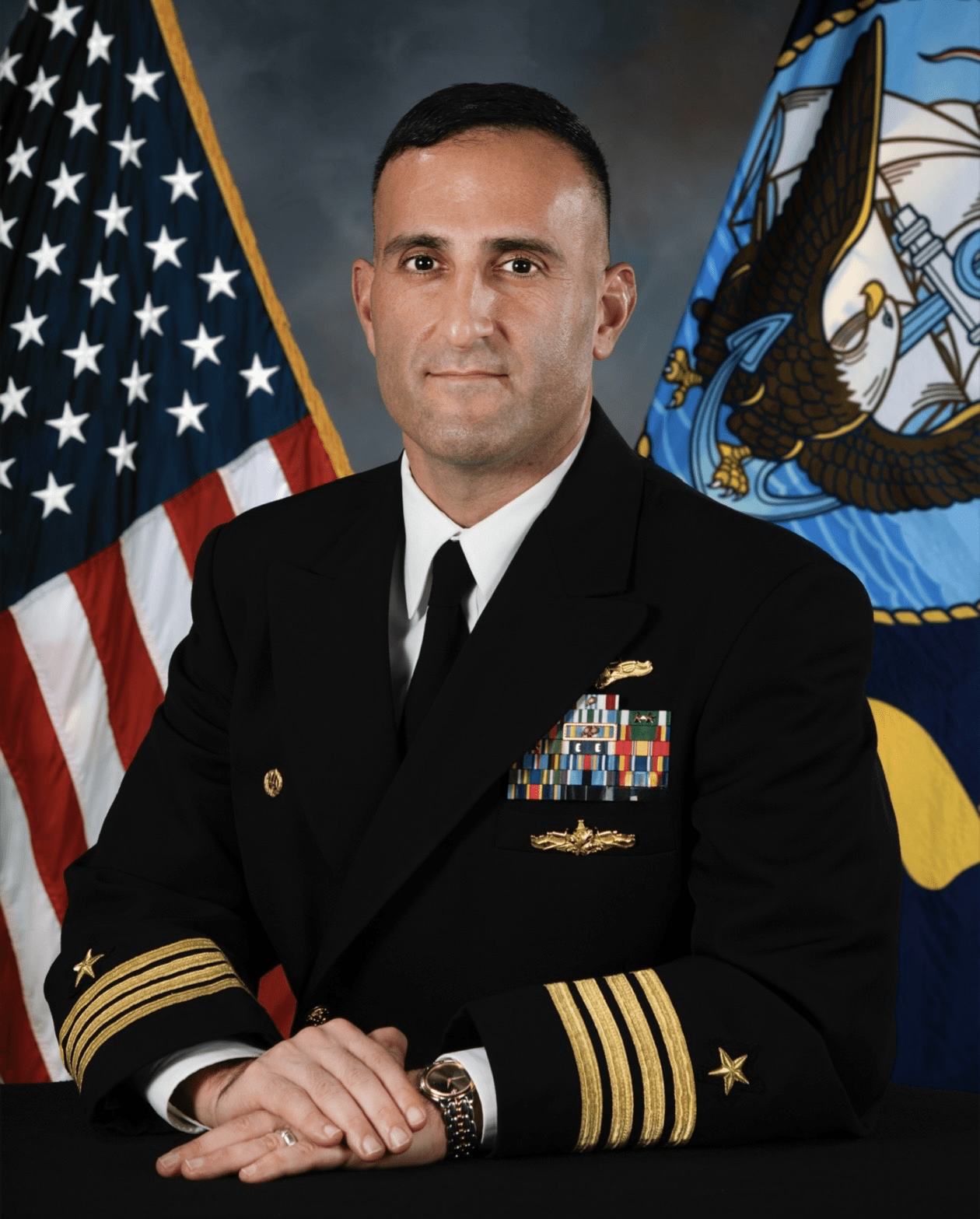
Some careers are shaped by careful planning. Others are shaped by history.
For CAPT Michael S. Salehi, the defining chapter of his Navy career began aboard USS Philippine Sea (CG 58). Just months before the attacks of September 11, 2001, he served as the ship’s Visit, Board, Search and Seizure (VBSS) Officer, leading boarding team operations during deployment in support of maritime security missions. On September 11, he was deployed with Philippine Sea as the United States came under attack. Just weeks later, the ship became the first to launch Tomahawk cruise missiles into Afghanistan during Operation Enduring Freedom. Like so many who served during that generation, the attacks reshaped not only the nation’s priorities, but the course of his own career.

Commissioned through the University of South Carolina in 1999 as a Student Naval Aviator, Mike’s path soon took an unexpected turn after being redesignated into the Supply Corps. As the Global War on Terror unfolded, he laterally transferred to the Cryptologic Warfare Community, where his Persian-Farsi language proficiency and growing operational experience positioned him to contribute where he believed he could make the greatest impact.

Over the next 27 years, that decision led him through assignments spanning counterterrorism, special operations, fleet operations, intelligence, cyber operations, communications, major command, and national-level leadership—reflecting the transformation of naval cryptology into today’s broader Information Warfare Community.

Early assignments at Naval Security Group Activity Fort Meade and the National Security Agency Georgia established the foundation of his cryptologic career. At NSA Georgia, he supported counterterrorism and counterinsurgency operations during the height of Operations Enduring Freedom and Iraqi Freedom. Those formative experiences prepared him for assignments as Deputy Director for Intelligence at Special Operations Command Pacific and later as Director for Intelligence for Joint Special Operations Task Force–Philippines, where he synchronized intelligence support for U.S. and Philippine special operations forces conducting counterterrorism operations against violent extremist organizations in Southeast Asia.

Building on those operational experiences, Mike transitioned to fleet leadership. As Deputy Branch Chief for Cyber, Cryptology, and Electronic Warfare at U.S. Pacific Fleet, Fleet Cryptologic Resource Coordinator for U.S. SEVENTH Fleet while permanently embarked aboard USS Blue Ridge (LCC 19), and later Operations Officer and Executive Officer at Navy Information Operations Command Hawaii, he helped integrate intelligence, cyber operations, and information-related capabilities supporting forward-deployed naval and joint forces throughout the Indo-Pacific.

One of Mike’s most meaningful assignments brought him back to where his cryptologic journey had begun. After attending the Defense Language Institute as a Persian-Farsi student early in his career, he returned years later to Monterey as Commanding Officer of Information Warfare Training Command Monterey. Leading the Navy’s premier Information Warfare training command carried special meaning for someone whose own journey had begun in those same classrooms. There, he led more than 600 military, civilian, and contract personnel responsible for educating prospective cryptologic linguists, Foreign Area Officers, and Information Warfare professionals, preparing the next generation of Information Warfare leaders for operational service around the world.

Mike was subsequently selected as Director for Operations at the Joint Intelligence Operations Center, U.S. Pacific Command, where he directed intelligence operations supporting theater-wide planning, analysis, and decision-making for the nation’s priority theater.

He later completed a cross-detail Major Command tour as Commanding Officer of Naval Computer and Telecommunications Area Master Station Pacific (NCTAMS PAC), leading the world’s largest naval communications station and a 1,500-person Task Group responsible for delivering secure global communications, cyber, and C5ISR capabilities in support of fleet, joint, and national missions throughout the Indo-Pacific.

His final active-duty assignment returned him to the National Security Agency, where his cryptologic career had begun decades earlier. As the Deputy National Security Agency Senior Representative to U.S. Pacific Command, he helped integrate cybersecurity and signals intelligence capabilities supporting one of America’s most strategically important theaters, bringing his professional journey full circle.
Committed to lifelong learning, Mike pursued graduate education and executive studies through the Defense Language Institute, Naval Postgraduate School, Joint Forces Staff College, Naval War College, and the Massachusetts Institute of Technology, completing executive education in management and artificial intelligence through the MIT Sloan School of Management and the Computer Science and Artificial Intelligence Laboratory (CSAIL).
Above all, Mike is grateful to God for the opportunities, challenges, mentors, teammates, friendships, and lessons that have shaped his life.

He and his wife, Gina, have shared every assignment, deployment, and transition together while raising their two sons. Their oldest son, Michael, is studying Mechanical Engineering at the University of Notre Dame on a Naval ROTC scholarship, where he is also a member of the iconic Notre Dame Marching Band. Upon graduation, he will continue the Salehi family’s tradition of naval service as a Navy officer. Their youngest son, Christian, is studying Applied Mathematics and Computer Science at Harvard University and is currently participating in the Harvard Program for Research in Science and Engineering (PRISE) Summer Fellowship, conducting undergraduate research.
As Mike prepares to conclude more than 27 years of active-duty service this fall, he looks forward to continuing to serve the national security community in Hawaii, helping organizations solve complex challenges, building high-performing teams, and mentoring the next generation of leaders.

Looking back, Mike hopes his career will be remembered not by the positions he held, but by the trust he earned, the people he developed, and the organizations he left stronger than he found them. For him, those have always been the true measures of a life dedicated to service.


29 June 2026 at 20:15
I knew Mike when he was
LikeLike
15 July 2026 at 18:31
Congratulations to Miichael on your retirement from the Navy!
I’ve known Mike since he was 16 years old, when I worked at his mother Mrs. Pat’s shop. Watching him grow and serve his country with dedication has been truly inspiring.
Wishing you all the very best as you begin this exciting new chapter of life. May your retirement be filled with happiness, good health, new adventures, and precious time with family and friends. Thank you for your years of service and commitment.
Warmest congratulations and best wishes for a wonderful future ahead!
Titi
LikeLike