
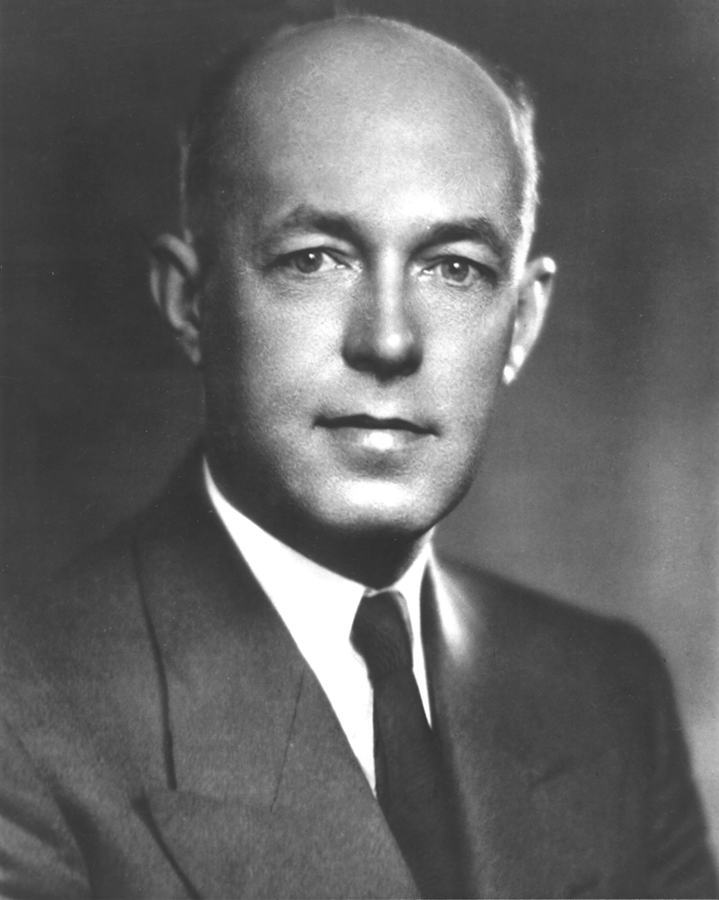
Herbert Osborn Yardley was born on April 13, 1889 in Worthington, Indiana. He learned telegraphy from his father, Robert Kirkbride Yardley, a railroad station master and telegrapher. His mother, Mary Emma Osborn Yardley, passed away when he was 13.
After graduating from high school in 1907, Yardley briefly attended the University of Chicago but left after a year and returned home to work as a railroad telegrapher. During this time, he developed a talent for poker, using his winnings to help fund further education. In 1912, after passing the civil service exam, he entered government service as a telegrapher.
Yardley began his federal career as a code clerk in the U.S. State Department. With the onset of World War I, he accepted a commission in the Signal Corps Reserve and served in France as a cryptologic officer with the American Expeditionary Forces.
His interest in cryptology deepened while working in the State Department code room, where he discovered that U.S. diplomatic codes were relatively weak and often easy to solve. He was particularly concerned to learn that Woodrow Wilson was using a code system that had been in place for over a decade. Alarmed by these vulnerabilities, Yardley wrote a detailed study in 1916 titled Solution of American Diplomatic Codes, which he submitted to his superiors.
This work led Yardley to consider the codes of foreign governments. After the United States entered the war, he successfully convinced Ralph Van Deman of the need for a dedicated codebreaking unit. In June 1917, Yardley was commissioned as a second lieutenant in the Signal Corps and placed in charge of MI-8, the Army’s newly formed cryptographic section.
One early success involved a coded message found on German agent Lothar Witzke after his arrest at the Mexican border in 1918, linking him to sabotage operations in the United States. Although MI-8 did not achieve dramatic battlefield breakthroughs, Yardley proved to be an effective administrator, building a capable and professional organization.
After the war, MI-8 continued as a joint Army–State Department operation known as the Cipher Bureau, headquartered in New York City for legal and operational reasons. Its primary focus became Japanese diplomatic communications. According to historian David Kahn, Japan was viewed as a critical intelligence target due to its expanding political, military, and economic influence in the Pacific.
By 1921, Yardley and his team had successfully broken key Japanese codes and were reading diplomatic traffic during the Washington Naval Conference. Intelligence from the Cipher Bureau helped the U.S. delegation understand Japan’s minimum acceptable naval limits, contributing to the agreement on a 5:3 battleship ratio between Japan and the United States (and parity with Britain at higher levels). This achievement marked the peak of Yardley’s career.
Over time, however, the Cipher Bureau’s effectiveness declined. Fewer intercepted messages were available, and private companies became less willing to cooperate with government intelligence efforts. Meanwhile, figures such as William Friedman were advancing more sophisticated cryptographic research within the Army.
In 1929, Secretary of State Henry L. Stimson, serving under Herbert Hoover, terminated funding for the Cipher Bureau. Stimson objected both on budgetary grounds and on principle, famously stating, “Gentlemen do not read each other’s mail.” With that decision, the Black Chamber—despite having broken the codes of roughly twenty nations—was shut down.


13 April 2026 at 11:43
Funny how it seems to never change…those professional politicians continue to be oblivious to who or what actually serve to protect and defend our nation. What “could have been”…instead was lost…disregarding early sigint may have prevented Pearl Harbor’s devastation?? Enough gets “gummed up” with “tradition” and it’s eventual over-ride by forces who’d studied how to defeat the “last war’s” big winners.
LikeLike
16 April 2026 at 11:53
With his funding terminated, Yardley found himself on the streets at the beginning of the Depression. Much to the dismay of those still working inside the wire, Yardley began a series of Saturday Evening Post articles detailing the exploits of his Black Chamber to support himself [1]. An embarrassed Japanese government quickly upgraded its codes, wiping out years of work by U.S. analysts. Unfortunately, there were no federal statutes covering Yardley’s actions at that time. Yardley later combined his series into his book “The American Black Chamber”. It sold thousands of copies, many of them to Japan. (Still in print today from USNI and others.)
1. “Edward Snowden’s Forgotten Predecessor”
The Saturday Evening Post (archives)
https://www.saturdayeveningpost.com/sep-keyword/herbert-o-yardley/
LikeLike