
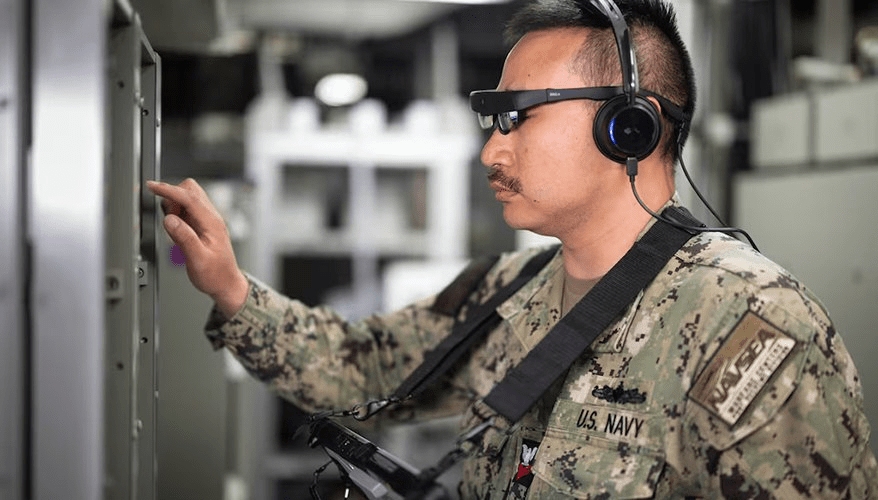
The Navy is looking to use virtual game engines and interactive team training for maintenance, a service official said Dec. 2.
Vice Adm. Robert Gaucher, commander of Naval Submarine Forces, Submarine Force Atlantic and Allied Submarine Command, said a significant problem the Navy faces is the surplus of submarines stuck in maintenance depots.
“We’ve had that issue ever since we’ve had submarines, but now, it’s magnified,” he said during a panel discussion at the National Training and Simulation Association’s Interservice/Industry Training, Simulation and Education Conference. “So many are offline as we run over in the time it takes to build new submarines” and fix existing submarines “because they still have crews even before their commission.”
Virtual reality provides an avenue through which the Navy can conduct maintenance training with lowered costs and more accessibility, but Gaucher said the service’s existing training capabilities only “scratch the surface.” He likened his maintenance training vision to an interactive video gaming environment.
“I look at kids that are playing Halo. I can have a kid on the East Coast, playing with a kid on the West Coast, playing with a kid in Australia, and they’re all in the same environment, so that if one kid does one thing, someone else can look through virtual reality and see their avatar executing that action,” he said. “I’d like to be able to do that with every submarine.”
“While that submarine is in maintenance, you can just take the crew, they can go to a building, they can all put their headsets on, and they can literally operate the submarine so that if someone in our machinery room touches a valve that’s going to make temperature go up and set off an alarm in the control room, the person who’s in the control room will actually see that alarm and have to respond to it. And they’ll communicate with each other just like they do on the submarine, so that I’m not just doing individual training, but I’m doing team training,” Gaucher said.
While virtual training will never fully replace the experience and knowledge gained at sea, it can raise proficiency levels and deepen sailors’ understanding of maintenance systems, “so that when we do get that precious time at sea, we’re that much further along,” he said.
“I just don’t see our submarines getting out of maintenance much faster anytime in the next decade, and we’re working on it,” Gaucher said. “That’s a top priority, but it just takes time to go fix the industrial base and our years of only building one submarine at a time. … I think that using virtual reality game engines and interactive team training is a way that I can really solve that problem.”
Brig. Damian Hill, director general of the Joint Collective Training Branch at Australia’s Joint Operations Command, said militaries should leverage similar technologies that children and younger people are using to bolster training.
“There are technologies out there that our kids are using that we need to embrace, because it’s teaching them how, potentially, to fight in the future, how to communicate in the future,” Hill said during the panel discussion. “And so, those of us who [are] stuck in the 1980s, we need to embrace them, the way that they think, because they’re going to be the next generation of people sitting at the table training with their force.”
Source: National Defense, 2 December 2025… by Allyson Park
 Station HYPO
Leave a comment