
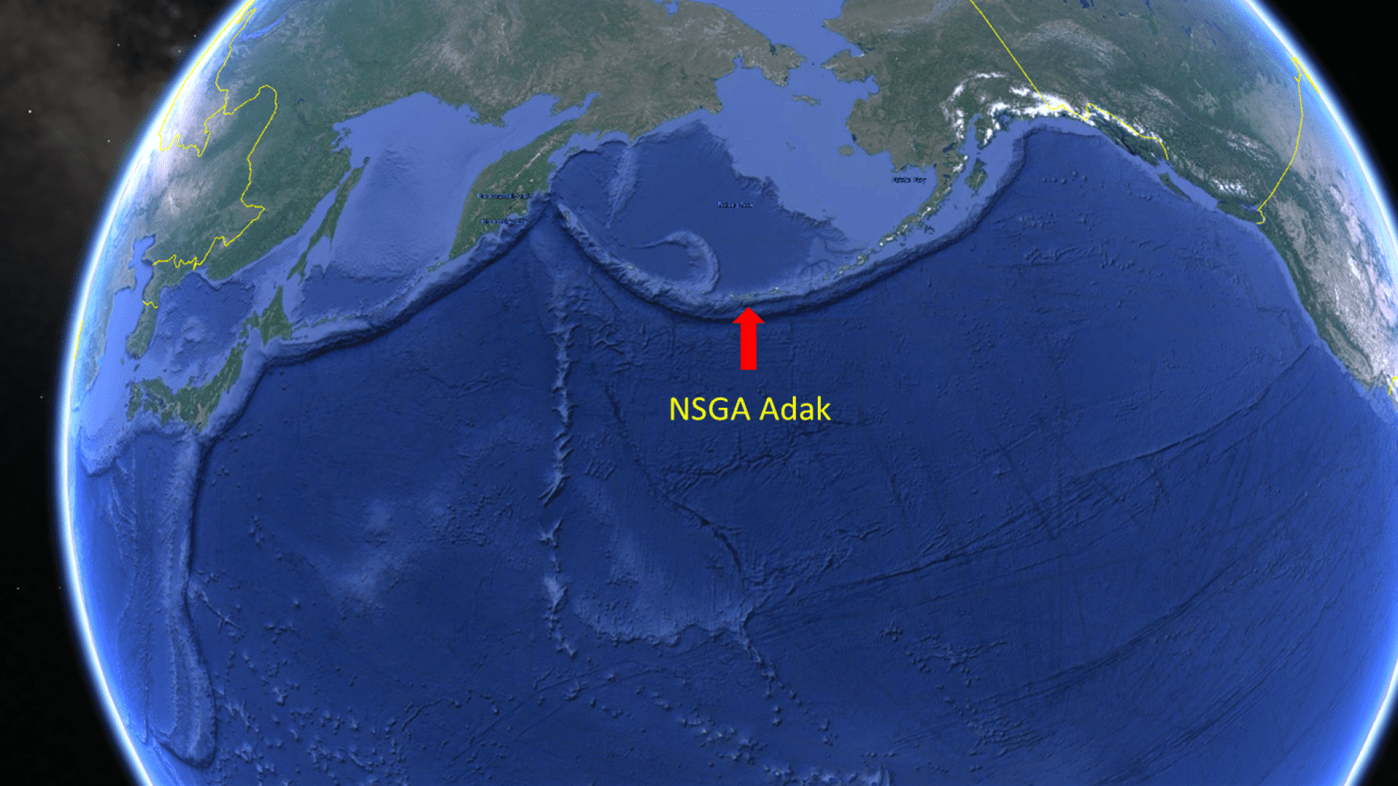
Should Naval Security Group Activity (NSGA) personnel be concerned that Adak Island is a Superfund site with a history of contamination, including unexploded ordnance and hazardous materials? Cleanup and monitoring efforts remain ongoing. Although certain areas have been declared safe for recreational use, restrictions are still in place due to potential hazards. Therefore, personnel should always follow established safety guidelines and remain aware of current site conditions.
PUBLIC HEALTH ASSESSMENT
NAVAL AIR FACILITY, ADAK
(a/k/a ADAK NAVAL AIR STATION)
ADAK, ALEUTIAN ISLANDS CENSUS, ALASKA
SUMMARY
Adak Island is located in the Andreanof Island group of the Aleutian Islands, the string of rugged, volcanic islands (archipelago) curving 1,200 mi (1,900 km) west from the tip of the Alaska Peninsula. These islands separate the Bering Sea from the Pacific Ocean. While the entire island of Adak is currently owned by the U.S. Fish and Wildlife Service of the Department of Interior, the former Naval Air Facility, (NAF) Adak, occupies land on the northern portion of Adak Island. The southern portion of Adak Island is uninhabited.
The base operationally closed in March 1997 and most Navy personnel left Adak by April 1997 (URS 1997a). The last Navy personnel left Adak in March 2002. The Adak Reuse Corporation is performing the infrastructure operation under lease from the Navy until the property is transferred. During its recent operating status, the Naval Air Facility was responsible for air operations, base management, utility and infrastructure operations. Other Navy operations on the island included conducting oceanographic research and communications functions.
Naval Air Facility, Adak was listed on the U.S. Environmental Protection Agency (EPA) Exiting ATSDR Website National Priorities List (Superfund List) in May 1994, based on indications that there was contamination in multiple areas on-base which could affect people, wildlife, and the environment. Since 1942, military operations at Adak have resulted in municipal and industrial waste generation and disposal. Wartime and post wartime preparedness training exercises, invasion deterrent tactics, hazardous materials handling and storage, and ordnance demilitarization have lead to additional environmental contamination and physical hazards that were present on Adak Island.
Since ATSDR’s initial involvement in 1994, The Navy has done a remarkable job removing or reducing the numerous hazards on the former military reservation at Adak Island. With the institutional controls in place, people can now safely inhabit and work on the island.
From the data and information ATSDR has gathered from site visits, document reviews, and discussions with stakeholders, we identified 12 situations where people could be exposed to chemical contamination or physical hazards; three of those present a public health hazard, one lacks enough data or information to assess the hazard, and eight present no public health hazard.
Public Health Hazards: Three exposure situations pose a public health hazard and require intervention in order to reduce the hazard. They are (1) exposure to lead in the tap water in Sandy Cove and Eagle Bay homes containing lead plumbing, and (2) physical hazards posed by debris, Rommel stakes, and possible unexploded ordnance throughout the downtown area and (3) the remote areas.
Lead released from plumbing or solder into tap water at Sandy Cove and Eagle Bay could pose a hazard to children and the fetuses of pregnant women. Education that recommends flushing the tap water lines and using cold water for cooking and infant formula could considerably reduce the hazard. Educational material is given to all adults coming on base when they receive the key to their quarters. ATSDR would like the currently distributed educational material to include recommendations to only use cold water for making formula and reconstituting juices and cooking. This is most applicable for families with potentially pregnant women and children.
Although the likelihood is extremely low that people could be injured or killed by physical hazards posed by debris, Rommel stakes, and possible unexploded ordnance during routine daily activities potential current and future hazards still exist and cannot be entirely eliminated for people recreating in the downtown and remote areas. The Navy has thoroughly investigated and removed all known Rommel stakes and unexploded ordnance from the downtown areas, and many in the remote areas and greatly reduced the hazards to people walking, hiking, fishing, playing, and digging. To reduce the likelihood even more of people handing explosive and physical hazards, the Navy initiated and continues to educate people on the possible appearance of hazardous and explosive item and the procedure for notifying the correct officials.
Indeterminate Public Health Hazards: One human exposure situation poses an indeterminate public health hazard due to suspected contamination and lack of data and information presented for ATSDR to assess whether or not there is a hazard.
Indoor air sampling for JP-5 related contaminants has not been conducted in certain Sandy Cove Housing Area homes located above JP-5 fuel leaks that have saturated the soils and seeped into underground water. The groundwater table is very shallow in this area and homes are located just a few feet above these soils and water. JP-5 vapors may have migrated into the homes and could potentially pose a public health hazard to people living in the homes. Indoor air sampling for components known to be present in JP-5 such as total petroleum hydrocarbons, and n-alkanes used to “fingerprint” the JP-5, is needed to determine if the air inside homes is safe. Children, especially those exposed in utero, could develop neurological impairment if exposed to JP-5 in indoor air over long periods of time.
No Public Health Hazard: From the data ATSDR has reviewed, six human exposure situations pose no public health hazard because, although people are or can be exposed to contaminants, the levels are too low to result in adverse health effects. They are as follows: (1) children exposed to soil in yards and neighborhood playgrounds in Sandy Cove, Eagle Bay, and Moffett View, (2) workers and residents exposed to asbestos in building materials in schools, homes, and workplaces, (3) residents, workers, and visitors participating in recreational activities at or near Metals Landfill, (4) people eating resident fish and shellfish from Kuluk Bay, (5) people eating resident fish and shellfish fillets from Sweeper Cove and Sweeper Creek, (6) children exposed to sediments in Helmet Creek, 7) workers and residents exposed to lead-based paint and asbestos from recycling scavenged materials found in unused structures and 8) people eating fish and shellfish from Clam Lagoon, Andre Lake and Finger Bay.
 Station HYPO
24 October 2025 at 13:11
92-93 I was Cryptologic Comms Department Head there. While they were taking core samples near the airfield searching for JP-5 deposits, the auger contacted the main fiber line from the SATCOM station and stretched it 28 feet. They chartered a flight and flew in a team and special tools from then I think NAVELEX Charleston to do the repair. We had to go to backup copper and microwave links to run all the comms for NSGA including some very critical, high speed lines. Ordnance was often uncovered or washed up, even out in the remote areas where we hunted and fished. Adak was a beautiful place with some of the most brutal weather, but an incredible experience that my family and I will forever cherish.
LikeLike
24 October 2025 at 15:28
Should Naval Security Group Activity (NSGA) personnel be concerned that Adak Island is a Superfund site with a history of contamination, including unexploded ordnance and hazardous materials? No.
LikeLike