
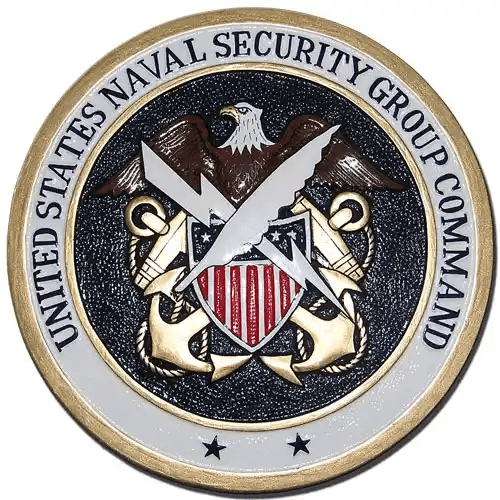
On September 30, 2005, the Naval Security Group Command (NAVSECGRU / Naval Security Group) was formally disestablished. Twenty years later—on September 30, 2025—that date stands as a milestone for reflection on one of the U.S. Navy’s most consequential signals-intelligence and cryptologic organizations. This article traces NAVSECGRU’s origins, evolution through wartime and the Cold War, its transition into the information-age Navy, and the legacy that followed its 2005 disestablishment.
From code rooms to a national cryptologic force (1916–1945)
The Navy’s organized cryptologic and radio-intelligence activities grew from small beginnings. As early as 1916 the Office of the Chief of Naval Operations had a Code and Signal Section, over the interwar years the Navy formalized radio intelligence functions. By 1935 the functions that matured into naval cryptology were organized under what became the Naval Security Group’s predecessors (Op-20G / Communication Security Group). The work done by naval cryptologists and radio-intelligence specialists exploded in scale and impact during World War II—by the height of the war thousands of specialists supported fleet operations and direction-finding, codebreaking, and cryptanalysis efforts that directly influenced naval campaigns. Iconic figures associated with early naval cryptology, such as Joseph Rochefort, are part of that lineage.
Postwar institutionalization and the birth of NAVSECGRU (1950s–1968)
World War II’s lessons—particularly the value of a standing, trained cryptologic force—led to postwar institutional changes. In 1950 the Naval Security Group was formally designated as a distinct organization, and through the 1950s and 1960s it consolidated detachments, stations, and shipboard elements providing signals intelligence (SIGINT), communications security (COMSEC), and direction-finding. On 1 July 1968 the Naval Security Group Command was established under a flag officer to give the community a single, elevated command structure within the Navy, reflecting its importance to fleet operations and national intelligence.
Cold War expansion: global stations and mission diversity
Throughout the Cold War the Naval Security Group operated a global network of stations, detachments, and departments—on Pacific islands, in Europe, at forward naval bases, and at shore activities in the United States—tasked with intercepting and exploiting foreign communications, protecting U.S. naval communications, and supporting tactical and operational commanders. The mission set expanded beyond pure codebreaking to include direction finding, electronic surveillance, cryptologic training, and close coordination with the National Security Agency’s Central Security Service (the interagency partnership that binds service cryptologic elements to NSA). This global footprint and technical breadth made NAVSECGRU a linchpin of naval intelligence and information advantage.
Technology, transformation, and the move toward information warfare (1990s–2000s)
The end of the Cold War and the rise of digital communications transformed signals exploitation and cryptologic operations. NAVSECGRU reorganized many times through the 1990s and early 2000s as tasks moved from HF radio and analog systems to fiber-optic, satellite, and networked digital signals. Throughout the 1990s and into the 2000s NAVSECGRU created, merged, or disestablished more than forty separate command elements as part of adapting to new missions and technologies. The community was migrating from traditional SIGINT to broader information operations and defensive/offensive information-age capabilities.
The disestablishment: September 30, 2005
As the Navy reorganized to better align cryptologic and networked information functions with emerging cyberspace and information-operations demands, NAVSECGRU was disestablished at a ceremony held at its headquarters on 30 September 2005. The command’s personnel, capabilities, and many shore and afloat elements were realigned under the newly formed Naval Network Warfare Command (NETWARCOM) and other Navy information organizations; many field activities were renamed or absorbed into Navy Information Operations Commands (NIOCs) and later into Fleet Cyber / U.S. 10th Fleet structures. NAVSECGRU’s final commander at the disestablishment ceremony was Rear Admiral Andrew Singer. The disestablishment was presented as both a recognition of what the command had achieved and a transition into a new operational era for naval information warfare.
Afterlife and lineage: how NAVSECGRU shaped modern naval cyber/cryptologic forces
The missions and people of the Naval Security Group did not disappear—rather, they were folded into modern commands that now shoulder naval cryptologic, SIGINT, and cyber responsibilities. The organizational lineage extends into Naval Network Warfare Command (which later evolved into aspects of Fleet Cyber Command/U.S. 10th Fleet and the Navy’s information-dominance organizations). The training, doctrinal innovations, technical knowledge, and institutional memory NAVSECGRU created helped propel the Navy into an era that treats information and cyberspace as operational domains alongside sea, air, and land.
People and places — the human dimension
NAVSECGRU’s history is not only hardware and headquarters; it’s thousands of enlisted sailors, officers, civilian analysts, linguists, technicians, and support personnel stationed around the world. NSG stations (NSGAs), detachments, and shipboard cryptologic units supported combatant commanders, carrier strike groups, and joint operations across multiple conflicts and crises. The community’s veterans and historians have worked to preserve that history through reunion associations, historical writeups, and decommissioning booklets that document the command’s ceremonies, artifacts, and oral histories.
Legacy, commemoration, and the 20-year mark (September 30, 2025)
By marking September 30, 2025, as the twentieth anniversary of NAVSECGRU’s disestablishment, the cryptologic community and interested publics have an opportunity to reflect on several themes:
- Continuity of mission: The cryptologic functions—SIGINT, communications security, analysis, and support to tactical commanders—persist in successor organizations.
- Institutional learning: NAVSECGRU’s decades of experience shaped doctrine, training, and technical capability that undergird today’s naval information operations and cyber forces.
- People and memory: Remembering sailors, civilians, and leaders who served preserves lessons learned across wars, crises, and technological revolutions.
- Commemoration as education: Anniversaries are a practical moment to educate newer generations of sailors and policymakers about how cryptologic work supported operations across a century.
The Naval Security Group Command’s arc—from early 20th-century code sections through World War II expansion, Cold War global deployments, and into the information-age reorganizations—reflects the Navy’s changing relationship with information, technology, and strategic intelligence. Disestablished on September 30, 2005, NAVSECGRU’s missions and people carried forward into new commands built for networked and cyber warfare. On September 30, 2025, the twentieth anniversary of that disestablishment invites the Navy, veterans, historians, and the public to honor NAVSECGRU’s service, preserve its history, and consider how past lessons continue to shape maritime information dominance.
United States Naval Academy
Further reading
“A Brief History for the Naval Security Group Command Disestablishment Ceremony,” Information Warfare history page. United States Naval Academy: https://www.usna.edu/InformationWarfare/history/NSGD.php?
Naval Security Group Command Decommissioning Booklet — Decommissioning ceremony, 30 September 2005: https://www.navycthistory.com/cnsg_decom_book.html
“Naval Security Group” historical overview (Op-20G origins and postwar development). Cold War C4I: https://coldwar-c4i.net/NSG/NAVSECGRU-history.html
Press and Navy public affairs reporting on NAVSECGRU alignment with NETWARCOM (October 2005): https://coldwar-c4i.net/NSG/NNS051005-04.html
Naval Information Forces historical pages on realignments of NSGA/NIOC/Pensacola and other stations after 2005: https://www.navifor.usff.navy.mil/Organization/Operational-Support/NCWDG/Organization/NIOC-Pensacola/About-Us/History/


30 September 2025 at 06:12
What a History…!
Spent 33 years with SecGru, ‘in the spaces’, as a civilian.
Travelled to a lot of sites, worked with a lot of good people, CTM’s/CTR’s/CTT’s…
Brings back some super memories…!
Dennis Skiffington
BULLSEYE Rep
1966-2000
LikeLiked by 1 person
1 October 2025 at 05:45
was a proud CT 69-73 from school in Pensacola to Winter Harbor, San Miguel, Phu Bai. God bless all who i served with richard steiger
LikeLiked by 1 person
1 October 2025 at 06:54
duty stations NSGA Ft. Meade, NCS Rota Spain, NSGA Misawa Japan, NSGA Winter Harbor, and NSGA Galeta Island Panama (76 – 95) active duty CTT/R1
LikeLiked by 1 person
1 October 2025 at 16:02
I trained with Navy operators in Pensacola, going through the DLI in Monterey Ca then with 1st Marine Radio Battalion in Vietnam closing my operator duties after a few years in Edzell Scotland with my Company B in the elephant cages along with NavSecGroup teams. I’m most Proud of the efforts and intelligence we gathered and consistently put to use for tactical uses, constantly focused on protecting US forces against both hot war and Cold War enemies
LikeLiked by 1 person
2 October 2025 at 19:28
Thank you for capturing the history and intent of those actions culminating on that day 20 years ago. Yours truly, Andy Singer
LikeLiked by 1 person
9 January 2026 at 09:01
I served there at Massachusetts and Nebraska from 56 to.59.great place to work.
LikeLiked by 1 person