
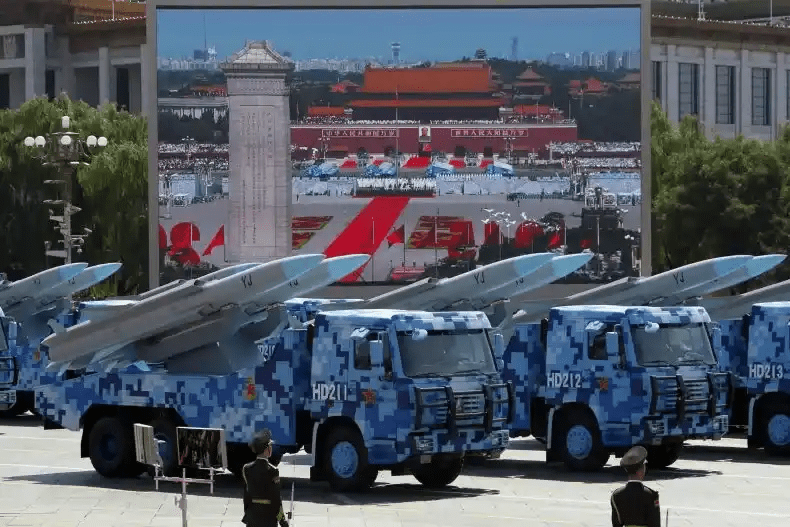
China is expected to officially reveal four new missiles designed to sink enemy warships during an upcoming military parade, as part of its efforts to challenge the United States’ naval dominance.
The Pentagon declined to comment when reached by Newsweek.
Newsweek has also contacted China’s Foreign Ministry for comment via email.
Why It Matters
The military parade is scheduled for September 3 in Tiananmen Square, Beijing, marking the 80th anniversary of what China calls the “victory in the Chinese People’s War of Resistance Against Japanese Aggression and the World Anti-Fascist War,” its term for World War II.
China, undergoing a rapid military buildup and modernization, has built a large long-range missile arsenal capable of targeting U.S. forces and bases across the Western Pacific region.
Missiles are central to China’s anti-access and area denial strategy, which seeks to prevent or restrict an enemy from entering and operating in a given area, serving as a countermeasure against possible U.S. intervention in a potential conflict over Taiwan or the South China Sea.
What To Know
The second “comprehensive rehearsal” for the upcoming Chinese military parade—expected to reveal new weapons—was held from Saturday evening to early Sunday morning local time, the state-run Xinhua News Agency reported, and involved about 40,000 participants.
Photos circulated on social media show new missiles marked YJ-15, YJ-17, YJ-19, and YJ-20 being carried by vehicles during the rehearsal. “YJ” is the abbreviation of Ying Ji, meaning “Eagle Strike” in Chinese, and is used for a range of Chinese anti-ship missiles, which can be launched from ships or aircraft.
Rick Joe, a longtime observer of Chinese military developments, suggested that the YJ-15 could be a supersonic missile, flying faster than the speed of sound—768 miles per hour.
The YJ-17 and YJ-19 could be hypersonic missiles, capable of flying over five times the speed of sound and maneuvering in flight, making them difficult to intercept.
Joe suggested the YJ-20 could be a highly maneuverable aeroballistic missile. According to the U.S. Defense Intelligence Agency, this type of hypersonic missile can be launched from different platforms and combines aerodynamic maneuvers with ballistic loft phases to extend its range.
In addition to their supposed ship-sinking role, these missiles could plausibly serve a dual role in both anti-ship and land-attack strikes, Australia-based naval analyst Alex Luck noted.
Threats To US Navy
The reveal of the new Chinese anti-ship missiles will come after the U.S. used a significant portion of its missile interceptors defending Israel against Iran’s missile attacks in June, as well as during earlier Red Sea operations against Yemen’s Houthi attacks on vessels.
“American operations in the Red Sea and elsewhere have shown good intercept capability against threats presented,” Luck told Newsweek. “However, the Chinese capabilities may be both more sophisticated and draw on deeper stockpiles [of U.S. missile interceptors].”
According to Luck, China already operates a wide range of anti-ship missiles, deployed on smaller vessels like missile boats, corvettes, and frigates, as well as larger, newer destroyers. It therefore makes sense to develop successor designs to replace various legacy weapons.
Meanwhile, developing different types of missiles can enhance China’s threat posture against enemy warships by overwhelming and complicating their anti-missile defenses, allowing what he described as “leakers” to get through and hit their targets, such as aircraft carriers.
A Chinese military observer, who requested anonymity because of the topic’s sensitivity, told Newsweek that the new missiles reflect China’s view of U.S. defense capabilities, suggesting it has moved away from relying on low-observable technology for penetration.
Low-observable technology, also known as stealth, is used to make missiles harder to detect.
The observer said the U.S. Navy has equipped its warships with advanced air defense sensors capable of detecting slow-flying, low-observable missiles, enabling interceptions.
In comparison, supersonic and hypersonic missiles are preferred by China for penetrating American ship-based defense systems, as they are difficult to intercept even if detected.

What People Are Saying
Australia-based naval analyst Alex Luck told Newsweek: “The [Chinese] missile threat is comprehensive and long-established. The [U.S. Navy] takes this threat very seriously, and is in the process of addressing it through a variety of means, both in terms of missile defense, but also intercepting or neutralizing carrier platforms and launchers by offensive means.”
Tom Shugart, an adjunct senior fellow at the Center for a New American Security, told Newsweek: “While we know very little about what in this case looks like a new series of anti-ship missiles, it could be that China is developing them in part to project power further afield with its growing fleet of aircraft carriers.”
What Happens Next
It remains to be seen whether Chinese authorities will reveal details of the new anti-ship missiles during the military parade, including payload, speed, range and launch platforms.
Featured image: Chinese military vehicles carry YJ anti-ship cruise missiles during a parade commemorating the 70th anniversary of Japan’s surrender during World War II held in front of Tiananmen Gate in Beijing on September 3, 2015. Ng Han Guan/AP Photo
Source: Newsweek, 18 August 2025… by Ryan Chan
 Station HYPO
Leave a comment