
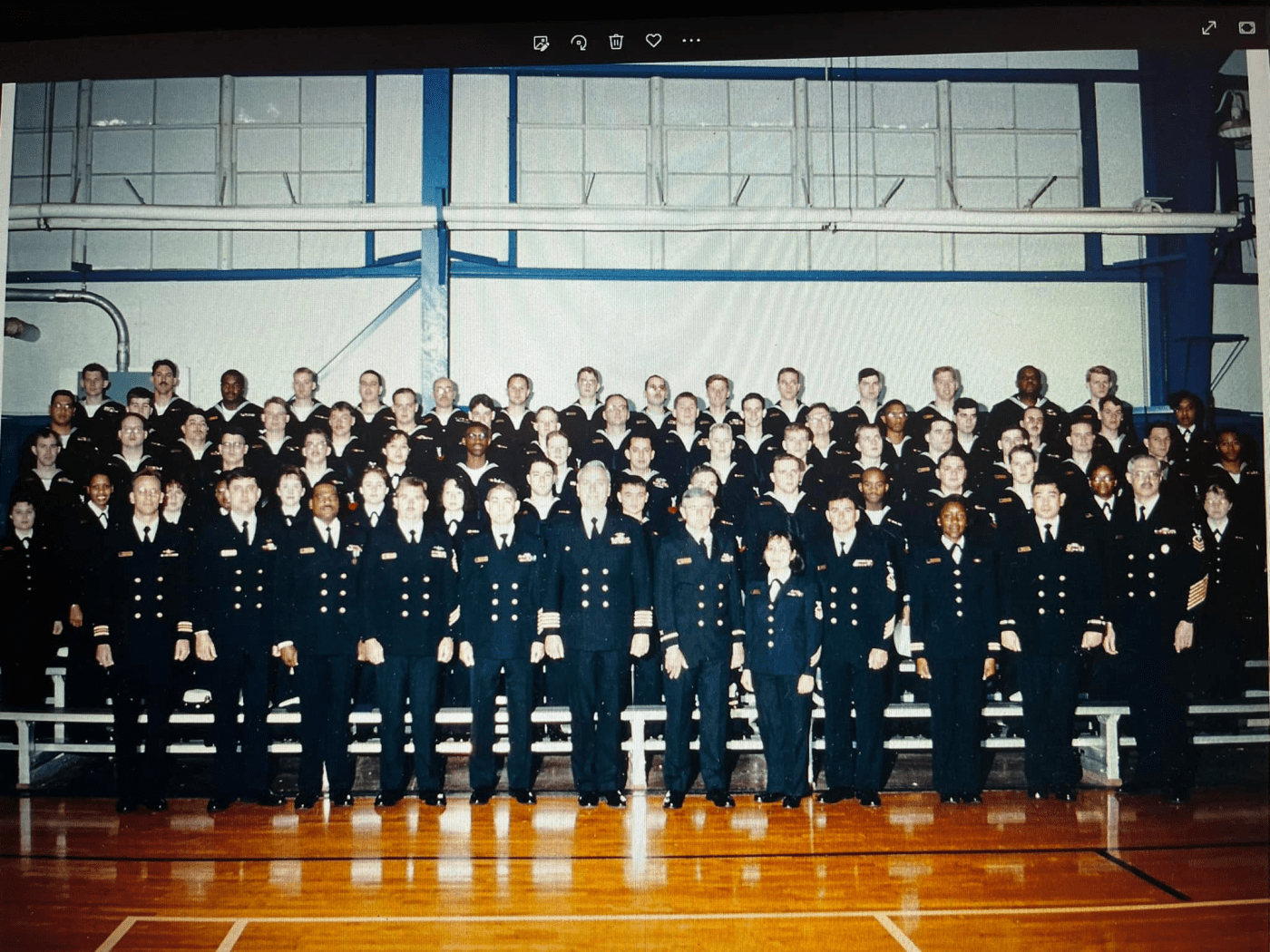
Officers and Sailors in the picture are listed at the bottom of this post.
By the end of 1950, it was apparent that expansion of the facilities at Yokosuka was no longer possible. With project growth of NAVSECGRU operations envisioned, sites were surveyed, and the optimal choice was a site near the Atsugi Naval Air Station. Land was acquired under Procurement Demand JPNR 5307, dated March 15, 1951. The location of the site was to the north of a village named Seya. The new site came to be known as Kami Seya.
At Kami Seya, commencing in 1951, the first 22 buildings were constructed, several of which were still in use in 1995. They included the CPO Barracks, (Building 2), originally constructed as the BOQ; the Administration Building (Building 4), originally the Medical and Dental facility; the Fire Station (Building 14), and the Exchange/Barber Shop/Library (Building 12). Down at “the tunnel”, antennas were rigged, cables run, air conditioning was installed and equipment racks were filled. Additional buildings were connected to the original tunnel, creating an Operations Complex, which, for the most part, remain standing to the present day. The base at Kami Seya opened in December, 1952. NAVSECGRU operations at Yokosuka began to move to Kami Seya during the latter half of 1951.
In December, 1952, operations from NAVCOMMFAC Yokosuka were relocated to Kami Seya, Japan with CDR Thomas R. Mackie as head of the NAVSECGRU Department.
The Naval Radio Facility (Special) (NAVRADFAC (S)), Naval Communications Facility (NAVCOMMFAC), Naval Communications Station (NAVCOMMSTA) Kami Seya, Japan was the host command; and the Naval Security Group element functioned as a Department of the command. When the base opened in December, 1952, there were six open bay barracks and the BOQ (Building 2) which provided living quarters; and no on-base housing. By August, 1957, 68 units of family housing were built. These units were still in use when the station closed in June, 1995. One of the few on-base recreational activates was the Ham Shack, which was a renovated trailer, parked between the tennis courts and the Satellite Inn All-Hands Club. Later, the Ham Shack moved to a more permanent location in a Butler Hut, next to the Bowling Alley. The Ham station callsign was “KA2KS”.
On January 15, 1960, the NSG Dept was commissioned as the U.S. Naval Security Group Activity, Kami Seya, under the command of CAPT Edward. W. Knepper. The NAVCOMMFAC at Kami Seya relocated back to Yokosuka; and later, in 1961 emerged as the Naval Communications Station (NCS), Yokosuka, Japan. The NAVRADFAC remained at Kami Seya, becoming a tenant activity on the base. NSGA became the host command of the Kami Seya station.
The U.S. Marine Corps came aboard the Kami Seya Station in April, 1958. Company E, Marine Support Battalion, with three officers and 40 enlisted Marines arrived. These were not “guard force” marines, they were “CT Marines”, who worked in the tunnel, alon side the Sailors. The U.S. Coast Guard was also present on Kami Seya; commencing in May 1963, operating a Loran Monitoring Station in the Kami Seya Operations Complex.
On September 24, 1965 a fire broke out in one of the operational buildings. Twelve men stationed at NSGA Kami Seya perished in the tragic fire. Most of the deaths occurred because the men were unable to escape through a locked exit, and were overcome by the smoke. Although the official investigation listed faulty electrical circuitry as the cause of the fire, some eyewitness accounts attributed it to failure in a recently-installed incinerator, which had been improperly vented through the wall and subsequently caused the wall to ignite. The fire forever changed the way that the Naval Security Group viewed fire prevention. Each year until closing, Kami Seya personnel officially remembered the victims of the fire, on the anniversary of the event.
On August 1, 1969, all NAVSECGRU elements at Yokosuka were consolidated under one command structure, Naval Security Group Detachment, Yokosuka, Japan was established; a Detachment of NSGA Kami Seya; to better serve the needs of the U.S. Seventh Fleet.
NSGA Kami Seya remained on the Kanto Plain until March, 1971, when most functions were moved to NSG Detachment Misawa, Japan. On June 30, 1971, NSGA Kami Seya was reduced in size, and on July 1, 1971, was redesignated as NSG Detachment Kami Seya. On the same date, July 1, 1971, NSG Det Misawa was commissioned as the U.S. Naval Security Group Activity, Misawa, Japan; and Kami Seya became a Detachment of NSGA Misawa. In addition to most of the NSG mission and functions being transferred to Misawa, the HFDF mission and Company E, Marine Support Battalion also moved to Misawa. The Naval Radio Receiving Facility (NAVRADRECFAC or NRRF) assumed the Kami Seya host command functions on the base.
On February 15, 1972, the Fleet Ocean Surveillance Information Facility Western Pacific (FOSIF WestPac) was established, and was co-located in the NSG Det Kami Seya Operations Complex. In 1972, Commander Task Force 72 (CTF 72) moved into the Kami Seya Operations Complex from Okinawa. In June, 1973, the Cryptologic Support Group (CSG) Seventh Fleet was established at Kami Seya.
By May of 1977, the last three WWII era warehouses that survived the fire of 1965 were demolished. The only WWII era structure remaining at that time, was “the tunnel,” originally the hardened concrete bunker. In February 1978, the HFDF Operations Building was demolished to make room for a helo pad.
NSG Det Kami Seya had grown substantially since being redesignated as a Detachment in June, 1971. In 1984, the Commander, Naval Security Group Command announced that Kami Seya would once again be commissioned as an NSGA. On May 23, 1984, NSG Det Kami Seya was recommissioned as the U.S. Naval Security Group Activity Kami Seya, Japan. Company E, Marine Support Battalion moved back to Kami Seya from Misawa; to rejoin the NSGA Operations Complex, along with FOSIF WestPac, CTF-72 and CSG Seventh Fleet. The HFDF mission remained at NSGA Misawa. The host command functions were transferred from the NAVRADRECFAC, back to NSGA Kami Seya.
In January, 1989, the Detachment at Yokosuka (which had been subordinate to NSGA Misawa), was administratively transferred from NSGA Misawa, and became a Detachment of NSGA Kami Seya. In July, 1989, the NSG Detachment at Atsugi was also re-subordinated to NSGA Kami Seya. By the summer of 1989, NSGA Kami Seya was the senior and largest Security Group Activity on the Kanto Plain.
In August, 1991, Fleet Air Reconnaissance Squadron One (VQ-1) closed its permanent detachment in Atsugi, Japan after 30 years, and moved it to Misawa, Japan. The Naval Security Group Detachment at Atsugi was disestablished on August 1, 1991. NSG Det
Atsugi’s support mission, functions and direct support personnel were transferred to the Naval Reconnaissance Support Detachment (VQ-1 Det), a Detachment of VQ-1 Det Misawa. VQ-1 Det Atsugi activated on August 1, 1991. VQ-1 Det remained at Atsugi until September 30, 1994; when the parent VQ-1 squadron moved its homeport from NAS Agana, Guam to NAS Whidbey Island. The VQ-1 Detachments at Atsugi and Misawa were disestablished.
On October 1, 1993, FOSIF WestPac, Kami Seya, Japan was redesignated as J-Det; and CSG Seventh Fleet was redesignated as CSG Japan. In February, 1994; the command was notified that NSGA Kami Seya would be closed in 1995. In January, 1995, CSG Japan was re-established as a separate command, under an Officer-in-Charge; and no longer subordinate to NSGA Kami Seya. The U.S. Naval Security Group Activity Kami Seya, Japan was disestablished and closed on June 1, 1995. Joint Intelligence Command Pacific (JICPAC) Detachment, and Company E, Marine Support Battalion also departed from Kami Seya in June, 1995.
During the two periods that Kami Seya was commissioned as an NSGA (January, 1960 thru June, 1971; and May, 1984 thru Jun 1995), NSGA Kami Seya was parent command to a number of Detachments; including Misawa, Yokosuka, Sasebo, Hakata, Chitose and Wakkanai in Japan, and Pyong Taek in South Korea. Two of those former Detachments became full-fledged NSGA’s; NSGA Misawa in July, 1971, and NSGA Yokosuka was commissioned on June 1, 1995, the same day Kami Seya closed.
Naval Security Group Activity, Kami Seya, Japan, December 1, 1994. Back row (L-R): CTO1 Lowell Jackson, CTM2 Steven Fazio, SK2 Phillip Williams, CTOSN Timothy Ruchert. CTO1 Brian Austin, CTO1 Eddy Brown, CTM2 Christopher Richerson, CTOSN Steven Reed, CTO1 Eric Gouchenour, CTM1 (SS) Daniel Bourassa, CTO3 Clinton Comer, CTT1(AW) Jeffrey Prophet, CTM1 Karl Sitler, CTO1 Derbert Dilworth, CTT2 Shawn O’Grady.
Second row (L-R): CTO2 Gary Derner, CTM3 Eric Rux, CTO2 Stephen Kiser, CTM3 Christopher Grogg, CTO2 Reed Smith, CTM1 Charles Breshears, CTO2(NAC) Christopher Miller, CTA3 Andrew Binder, CTO1 Thomas Cunnignham, CTTSN Arthur Edmonson, CTO3 Lionel McCormick, CTO3 Christopher Rempe, CTTSN Shawn Bingham, CTA2 Kimberly Word.
Third row (L-R): CTO2 Timothy Gardiner, CTO2 Joseph Hoffman, CTOSN David Spell, CTO2 Brian Cantleberry, CTO3 Jenny Underwood, CTO3 d’Juan Moss, CTO2 Scott Simoneaux, CTO2(SW) Joe Tovar, CTO3 Conrad Brekke, CTOSN Michael Leek, CTOSN Timothy Harrison, CTOSN Brian Wright, CTOSN Richard Tudor, CTOSN William Timberlake, CTO3 Thomas Ciccarelli, CTT1 Ronald Highsmith.
Fourth row (L-R): CTOSN Michelle Finley, CTA2 Yvette Reilly, CTM2 Paula McGee, CTA3 Pamela Diaz, CTASN Margaret Puch, CTM3 Carolyn Yeats, CTO2 Diana Binder, CTO3 Richard Nagy, CTTSN Samuel Stephens, CTO3 Douglas Clayton, CTO3 Brian Pratt, CTO3 Cedric Chestine, CTT3 Lester Lewis, CTTSN Michael Dockery, CTA2 Sharon Lockett, CTO3 Christine Root.
Front row (L-R): LCDR Divid Stender, CTTC(NAC) Bart Burgin, SKC Larry Baldwin, CTOC(SW) Michael Donohoe, CTOCM James Lollis, CAPT Robert Dimuzio, CWO4 Garland Wall, CTOC Dolores Mondragon, CTACM Reynaldo Limon, LT Mana Adae, CWO2 Michael Crabtree, CTMCM Jay Browne.


1 June 2026 at 09:42
Good morning. Thanks for posting this and all of your posts. I was assigned to Kami Seya as a Marine, there were a few of us Marines and I loved it there. I lived
LikeLike
2 June 2026 at 12:06
Great duty, looking back. But still have nightmares of escaping the fire there that killed 12 of our shipmates. Sad to learn that it’s closed and we’re living today under a presidential administration that has alienated our democracy defending allies and is personally exploiting ties with the authoritarian enemies we stood watch against for so many decades after WWII.
Jack Jones, CT2, Kamiseya, Japan 1963-1966
jackjones@frontiernet.net
LikeLike