
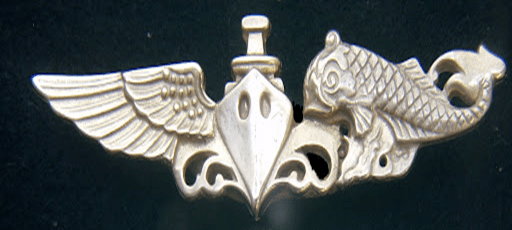
“Spooks-At-Sea”
By: CAPT Harvey S “Scotty” Parrish, Jr. (Ret.)
In 2005, the Naval Security Group (NAVSECGRU) became part of a General Service command, marking the integration exactly fifty years after the initial assignment of a NAVSECGRU detachment to a fleet command. The process leading to this integration took an indirect route during the years 1954-56. As experience was acquired, it became evident that this integration should have occurred earlier and through direct action. This evolution took place in the Mediterranean rather than the Pacific area, which had a history of direct support detachments temporary additional duty (TEMADD) to fleet commanders, particularly during World War II.
The role of cryptologic personnel and later teams, from area shore stations, in direct support operations aboard ships before and during World War II in the Pacific theatre is now well documented. It is surprising to note, therefore, that the formation of the first permanently assigned detachment afloat occurred in the Sixth Fleet, in the Mediterranean, during the period 1954-56. And it happened, although not quite by accident, at least in a roundabout manner, originating with difficulty in relief of the Officer-in-Charge (OIC) of the Naval Communication Unit (NAVCOMMU) 32 team, LCDR Paul B. Phillips, aboard the U.S. Sixth Fleet flagship. Although ordered to the Commander-in-Chief, U.S. Naval Forces Eastern Atlantic and Mediterranean (CINCNELM) headquarters in London, England, LCDR Phillips was on detached duty to the Commander, Sixth Fleet (a two-year assignment). He coordinated operations and received reports from Hal Keasler, “Red” Fuller, Floyd Heindl and other Chief Petty Officers-in-Charge of NAVCOMMU 32 teams on destroyers in the Sixth Fleet.
Also operating in the Sixth Fleet at this time were two NAVSECGRU direct support detachments from Bremerhaven, Germany on TEMADD assignment one to the Sixth Fleet flagship, headed by LT William D. Howard, and the other to the Carrier Division flag, under LT G. Patrick March (later RADM, Commander NAVSECGRU Command). Both the NAVCOMMU and NAVSECGRU detachment functions carne under the purview of NAVSECGRU headquarters in Washington, D.C., including responsibility for NAVCOMMU 32 and 38 (Yokosuka, Japan) personnel training and assignment.
Several months after the scheduled turnover date, a relief for the OIC of the Sixth Fleet NAVCOMMU 32 team was finally provided from the NAVSECGRU headquarters staff, LT H. Scott Parrish, who had previous communications, ship Combat Information Center (CIC) and NAVSECGRU operations duty. The head of the NAVSECGRU Operations Department, CDR J. Watson, arranged that he would also relieve LT Howard upon completion of his TEMADD tour as OIC of the NAVSECGRU Detachment Sixth Fleet – in effect, merging the two billets. The NAVCOMMU 32 team OIC billet, however, was still assigned to CINCNELM, with the relief first reporting to London for further assignment (and later dependents’ travel via the same route).
While the NAVSECGRU detachment manned the Supplementary Radio, a separate space aboard ship, the NAVCOMMU teams were integrated with ship’s company in the CIC spaces. It was recommended that NAVCOMMU 3 (and 38) personnel would be more effective in their direct support and training missions if assigned to fleet type/training commanders stateside, rather than embark aboard ships (as “spook” strangers) after deployment to the Sixth (and Seventh) Fleet. This was accomplished subsequently. On the other hand, the two-year assignment of the OIC NAVSECGRU detachment to the Sixth Fleet staff proved very beneficial, and a permanent billet was added to the flag personnel allowance (in conjunction with the departure of the NAVCOMMU 32 team responsibility). The Fleet Operations and Intelligence Officers and other senior staff officers benefited from this permanent structure (in place of a new junior officer “face” every ten months). In addition to standing staff duty officer (SDO) watches, the OIC had additional duty as Fleet Electronic Warfare Officer. (As a side benefit, flag allowance personnel were allowed dependents’ travel direct to Villefranche, France, the staff’s “home port”).
The Sixth Fleet NAVSECGRU Detachment complement had an Assistant OlC with four other “day-worker” personnel and sixteen watchstanders. As experience was gained on various flagships (ships rotated every six months), the four dayworker billets – R-Branch Chief, O-Branch, I-Branch and A-Branch Petty Officers – were converted to permanent change-of-station (PCS) also. This provided much needed continuity to support the fleet commander; the Assistant OIC and watchstanders were continued on ten-month TEMADD rotation to provide more junior officers and operators with experience in fleet operations. Original PCS personnel were M.L. Thompson, lrv Newman, Phil Jacobsen and John McLaughlin/John Korn.
The preparation work for this turnover was done by the last group of dayworker TEMADD personnel, including Leading Chief Sweeney, Phil Mazzara, Ken Wilson, Bob Oakes, Herschel Goode, J.N. Simpson and, in particular, LT March, with his senior petty officers from the Carrier Division NAVSECGRU Detachment, Martel Harrison, Bruce Platz and Paul Hargrave – all from Bremerhaven. Standard Operating Procedures (SOPs) were developed, including even a “Transfer-At-Sea” Bill; better antennae and space layouts were arranged; and organization material was sent to counterpart OlC NAVSECGRU Detachment Seventh Fleet (which became a PCS tour next).
These initial PCS afloat moves were made despite growing shore based requirements placed upon the NAVSECGRU and the unknown effect of permanent shipboard duty tours on the cryptologic personnel structure based upon these requirements. But, building upon experience with TEMADD assignments to fleet units over the years, the NAVSECGRU began to join the “sea-going” Navy in the mid-fifties. The importance and success of this effort is now well recognized, in the mid-nineties, with approximately ten-percent of PCS cryptologic billets dedicated to Direct Support!
Biography
Captain Harvey Scott Parrish, Jr., was born on 12 July 1924 in Lakeland, Florida. He entered U.S. Navy service as a midshipman in July 1942. He served aboard USS COFER (APD-62) and USS SPANGEBERG (DE-223) in gunnery, communication, combat-information-center, navigation and OOD underway. CIC School for 6 months.
Parrish began his Cryptologic Service in July 1948 and ended in August 1972. His duty stations include Destroyer Escorts (2), Reserve COMMSUPACT6-6, COMMSUPACT, Guam, OPNAV(DNC) Washington, D.C., NAVCOMMU-32B (OIC), NAVSECGRUDET COMSIXTHFLEET, NAVSECGRU Headquarters, Washington, D.C., NAVSECGRUACT Kami Seya, Japan, NAVCOMMSTA Washington, D.C., NATIONAL SECURITY AGENCY, Fort George G. Meade, Maryland, NAVSECGRUCOM, Washington, D.C. Captain Parrish served on the Navy Military Construction Review Board as Head, NAVSECGRU Engineering and Material Department.
Parrish was entitled to wear area service ribbons, Navy Unit Commendation, Joint Service Commendation Medal and Legion of Merit.
He received a Bachelor of Science degree at the United States Naval Academy, class of 1946 and a Master of Science degree at George Washington University. He completed a senior course at the Naval War College and graduate studies in Education at Florida Southern College.
He was married to Jean Woodall. They had 3 children, 6 grandchildren and 16 great-grandchildren. Civilian employment includes Vice President of Allied Van Lines Agency in Lakeland, Florida and Real Estate Licensee in Tarpon Springs, Florida, self-employed real estate management. Member American Legion, National Exchange Club, U.S. Chess Federation, NCVA, U.S. Naval Academy Alumni Association, Retired Officers Association, local civic and church offices.


Leave a Reply