
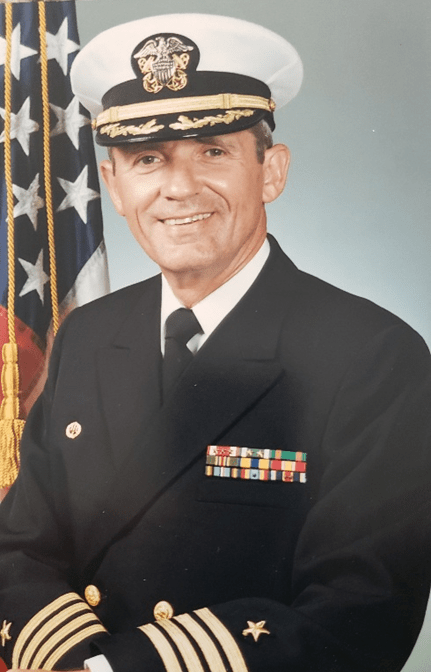
Captain Ivan Dunn, USN (ret) retired in 1998 after 31 years active duty. After his first tour as an Ensign Communications Officer at NAS Point Mugu, CA. (67-68), he volunteered for a special mission squadron, VQ-3 at NAS Agana, Guam. He served two years there flying as an Airborne Communications Officer in specially-configured C-130 aircraft designed to provide a survivable airborne component of Navy support to SSBNs (68-70).
Newly-promoted LT Dunn was accepted for duty with the Naval Security Group and ordered to DLI (71-72). Following Russian language school, he volunteered for a special operations program involving deployments in fast-attack nuclear-powered submarines (72-75).
From there he was assigned as the Executive Officer of Naval Security Group Activity, Karamursel, Turkey (TUSLOG Det 28) (75-77).
Afterwards he was assigned as the Direct Support Officer, NAVSECGRU DEPARTMENT Rota, Spain (77-79). There he also served as the SIGINT Processing and Reporting Officer.
He was then selected for early transfer to the Pentagon’s newly-formed OP-009H staff (79-82).
After selection for Commander he was ordered to the Naval War College, Newport, RI. (82-83). Afterwards, he was assigned to COMSIXFLEET Staff in Gaeta, Italy as Fleet Cryptologist (83-85). Next, CDR Dunn transferred to the Cryptologic element of CINCPACFLT staff in Hawaii as the Operations Officer for one year and then fleeted up to the Deputy for DIRNAVSECGRU Pacific (85-88). After selection to Captain, he was assigned to head the Cryptologic Officer Assignment and Community Management office at NMPC (88-90).
His next tour was Commanding Officer Navy Technical Training Command, Corry Station, FL for three years (90-93). Following his command tour, he was selected to serve as the Flag Officer Executive Assistant for N2C in the Pentagon and was dual-hatted as the head of Training (G-10) on the Commander Naval Security Group Staff (93-96).
Captain Dunn was then selected to serve as the Director of Naval Security Group Pacific in Hawaii where he retired in 1998.
During his career, Captain Dunn was awarded the Legion of Merit Medal (3 awards), the Meritorious Service Medal (4 Awards), Navy and Marine Corps Commendation Medal (3 Awards), Navy and Marine Crops Achievement Medal and a variety of unit awards and campaign ribbons. Captain Dunn and his wife Katie reside in Coronado, California.
Interview with CAPT Dunn
Editor’s note: Captain Ivan M. Dunn assumed command of Naval Technical Training Center, Corry Station July 9, 1990. Recently the Corry Log had the opportunity to speak with CAPT Dunn and find out some of his view and opinions concerning Corry.
Q. Thus far, what has impressed you most about Corry Station?
A. The quality of the people impressed me from the outset. I heard before I came here that it’s the
“cream of the crop.” Everything that I’ve seen and heard has reaffirmed that, both on the officer and enlisted sides. I couldn’t be happier with the staff we have. The students that we have coming through here are high-qualify folks wanting to serve their country and go into the fleet and field and do the best job that they can.
I guess the other thing that I would like to highlight is the interaction with the community. This command’s fantastic array of community support… volunteer work and projects such as Special Olympics and Meals on Wheels and so on … is one of the most impressive things that I have ever seen.
Q. What are some of the goals that you have set for yourself while you’re station here?
A. Number one is to be the best commanding officer that I can be, and that entails a lot. And also to be as accessible as I can be to everyone in this command and its detachments. That’s going to involve me being up and about and out from behind this desk and visiting different facilities on the base … classrooms, the galley and every place that I can, as of then as I can. Related to that also is the goal of being the best possible role mode that I can be in terms of an example being set for the entire command. I feel very strongly about the role modeling that all of us do to support out students. Those folds coming in here for a short period of time prior to going out in the field are being influenced by us both academically and otherwise, and I think that it’s important that we provide the most positive role models that we can.
Q. What goals have you set for Corry Station?
A. I guess that number one would be to maintain and improve upon the impeccable reputation that the command already has. Everything that I heard prior to arriving here told me loud and clear that this command enjoys a tremendous reputation. Another thing is to promote unity of command, the idea that we are on command and not various departments. It is such a large place that we have to continually hammer away that we are one command and we need to work together as a team to produce that best possible students that we can.
Q. What message do you have for both staff and students on board Corry?
A. The message is to reaffirm that our mission here is to produce the best possible student we can and to support combat readiness in the fleet by putting disciplined, trained and motivated people in the fleet as well as the field. I think that needs to be reinforced every time we have a staff indoc or an IT course. That point needs to be driven home.
Q. What could be done to help break the barriers between the commanding officer and the students?
A. You’re probably talking about the large number of people between me and the students. I think that getting out from behind this desk and being visible and being accessible probably will go further that anything to breaking down the distance or barriers between me and the students. One thing that I am going to institute soon is an expanded student call whereby I will meet with students from each of the three schoolhouses. It will be the students and me, no additional staff members. Hopefully, that will go a long way toward getting their candid views about life at Corry, their training, and how their treatment here is going
Q. What is the most difficult part of your job?
A. Finding the time to do everting that I want to do. Trying to get around all the classrooms, trying to meet people, and becoming exposed to every facet of this command’s mission as quickly as possible, as well as all the meetings, visits and other things that I have to do. There’s just not enough time in the day to get it all done.
Q. Corry has a lot of young students just staring out in the Navy. What do you feel are the biggest Navy benefit available to them?
A. The monetary benefits, educational benefits, the exchanges, the commissary and some of those types of services that don’t of then get publicized. We have three have already seen some fantastic things that they have done for some people that need help from time to time. I think the services from counselors and the people that are willing to lend a helping hand are a great asset. These services don’t cost any money and they are available to anyone that needs them. I think that if you tried to replicate that support in the civilian world you would find that it coasts an awful lot of money. I strongly encourage people to take advantage of these services anytime that they can.
Q. What’s the most personal challenge that you feel Corry will present you?
A. The most personal challenge is going to be associated with being the best commanding officer that I can me. And, on a family side, it’s going to be a challenge to try to blend being a CO with trying to be a father and a husband and take time with my family while I’m here in this beautiful city.
 Station HYPO
Leave a comment