
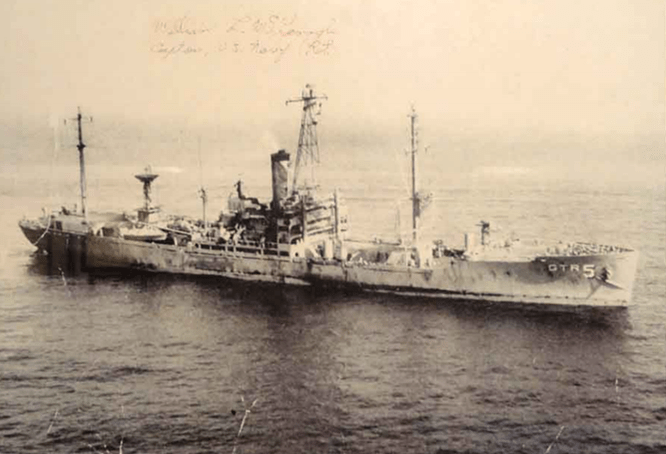
The Deck Log Book of the USS LIBERTY (AGTR-5) from June 1, 1967 – June 9, 1967
The Attack on USS Liberty (AGTR-5)
On June 8, 1967, during the Arab-Israeli Six-Day War, the USS Liberty (AGTR-5), a U.S. Navy technical research ship conducting a classified signals intelligence collection mission, was deliberately attacked by Israeli aircraft and motor torpedo boats while operating in international waters in the eastern Mediterranean Sea, approximately 15–25 nautical miles north of the Sinai Peninsula.
The Liberty had departed Rota, Spain, on June 2 and proceeded toward the eastern Mediterranean as tensions between Israel and its Arab neighbors escalated. Her mission was to collect intelligence concerning military communications and activity associated with the conflict. Although the ship was officially designated an Auxiliary General Technical Research vessel, her intelligence-collection mission was classified. The crew included Navy cryptologic personnel, Marines, and National Security Agency civilians, as well as linguists capable of monitoring Arabic and Russian communications.
The Attack
At approximately 2:00 p.m. local time on June 8, Israeli aircraft approached and began attacking the Liberty. The ship was subjected to multiple strafing runs by Israeli fighter aircraft. The aircraft used cannon fire and rockets, causing extensive damage, starting fires, destroying communications equipment, and killing and wounding members of the crew. The ship was lightly armed with only four .50-caliber machine guns and was not equipped to defend itself against a coordinated air and surface attack.
Approximately 20–25 minutes later, three Israeli Navy motor torpedo boats approached the crippled ship. They opened fire and launched torpedoes. One torpedo struck the Liberty on the starboard side, creating a massive hole in the hull and causing the ship to list severely. The torpedo explosion killed many crewmen in the ship’s research spaces and caused catastrophic structural and internal damage.
Despite the devastating attack, the crew fought fires, treated the wounded, restored emergency communications, and worked to keep the ship afloat. Members of the crew also took extraordinary measures to protect classified cryptologic material and equipment. Declassified National Security Agency records document the destruction and potential compromise of classified material during the attack and its aftermath.
Casualties and Damage
Of the 293 U.S. personnel aboard, 34 were killed and approximately 170–171 were wounded. The dead included 31 Sailors, two Marines, and one NSA civilian. The Liberty suffered severe damage, including the large torpedo hole in her starboard hull, extensive damage to her superstructure, communications systems, and internal spaces.
The ship’s commanding officer, Commander William L. McGonagle, remained aboard and directed the crew’s efforts to save the ship and care for the wounded. For his leadership and heroism, McGonagle was subsequently awarded the Medal of Honor.
The Rescue
As reports of the attack reached U.S. Navy command authorities, the Sixth Fleet ordered aircraft from the aircraft carriers USS America (CVA-66) and USS Saratoga (CV-60) to assist the Liberty. The crisis generated considerable confusion because of communications difficulties and the rapidly changing situation in the Mediterranean.
After the attack, Israeli forces recognized that the ship was American. Israel expressed regret, apologized, and offered assistance. The United States subsequently conducted an investigation, while Israel conducted its own inquiries. The official Israeli explanation was that the attack was a tragic case of mistaken identity during the confusion of the Six-Day War.
The Liberty, escorted by USS Little Rock (CLG-4), eventually proceeded to Valletta, Malta, where temporary repairs were made. The ship was later repaired in the United States and returned to service.
The Controversy
The circumstances surrounding the attack have remained controversial for decades. The U.S. Navy’s official historical account describes the incident as a mistaken attack, while acknowledging that the controversy over whether the attack was accidental or deliberate has never completely disappeared. Survivors of the Liberty and some researchers have disputed the Israeli explanation and have argued that the ship was identifiable as American and that the attack was deliberate. Israel has consistently maintained that the attack was an accident resulting from mistaken identification and the confusion of wartime conditions.
Another important aspect of the tragedy was the series of U.S. communications failures surrounding the ship. Several messages directing the Liberty to remain farther from the combat zone were reportedly misrouted, delayed, or never received before the attack. The Naval History and Heritage Command has noted that these communications failures became a significant embarrassment and contributed to subsequent changes in Navy communications systems and procedures.
Legacy
The attack on USS Liberty remains one of the most tragic and controversial episodes in the history of U.S. naval intelligence. The crew’s actions under fire demonstrated exceptional courage, discipline, and commitment to protecting their shipmates and classified information.
The National Security Agency has subsequently released a substantial collection of formerly classified documents concerning the Liberty, including operational reports, casualty reports, communications, intelligence documents, investigations, and a 1981 U.S. cryptologic history titled “Attack on a SIGINT Collector, the USS Liberty.”
For the 34 Americans who lost their lives and the 170-plus who were wounded, the attack was far more than a historical controversy. It was a devastating combat experience endured by a U.S. Navy intelligence-collection crew while performing a classified national mission during one of the most dangerous periods of the Cold War-era Middle East.


14 August 2026 at 10:03
Talk about a “sugar coated” rendition of what really happened (according to crew and since released reports)…but, again, I guess “I’ll not embarrass an ally” or something to that affect coming from LBJ’s total disregard for U.S. service members (as well as his seeming awareness of just which ally could be responsible for the attack) will continue to “molder” wherever the actual “truth” is hidden.
LikeLike
14 August 2026 at 14:03
My personal belief is that Israel attacked the Liberty in an effort to sink it because the intelligence collected would have proven embarrassing to Israel. It would have conclusively shown that Israel was the aggressor and struck while Egyptian and Jordanian aircraft were still on the ground.
The orders sent to the Sixth Fleet ordering that no aircraft were to be launched in support of the Liberty came directly from National Command Authorities! Thank you, LBJ and Mac the Knife!
LikeLike