
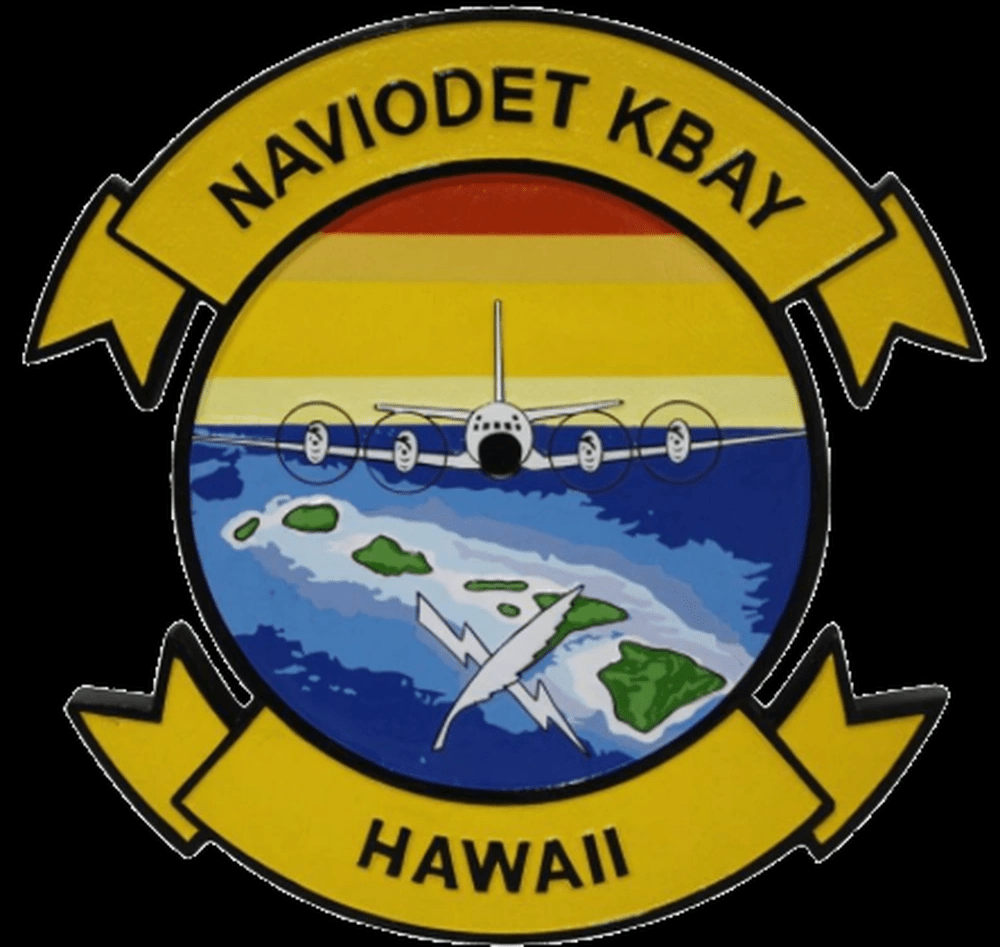
On July 31, 2020, Navy Information Operations Detachment (NIOD) Kaneohe Bay, HI was disestablished. Dating back prior to World War Two, NIOC Kaneohe Bay has a long history of supporting the fleet.
In 1939, the Kuwaaohe Military Reservation was reactivated, subjected to many name changes to include Camp Ulupa’u, and was eventually named Fort Hase.
Prior to and during World War II, Fort Hase grew from a humble beginning as a defense battalion, into a major unit of the Windward Costal Artillery Command. Navy planners began to eye the peninsula in 1939 as the home of a strategic seaplane base. They liked the isolated location, the flat plains for an airfield and the probability of flights into prevailing trade winds. In 1939, the Navy acquired 464 acres of the peninsula for use of the PBY Catalina Patrol seaplanes used for long-range reconnaissance flights. One year later, the Navy owned all of the Mokapu Peninsula, except for Fort Hase. The Navy built a small seaplane base. Upon its completion, on February 15, 1941, Naval Air Station, Kaneohe Bay was established and its role was expanded to include the administration of the Kaneohe Bay Naval Defense Sea Area.
On December 7, 1941, Pearl Harbor was attacked. However, it’s a little known fact the Japanese first attacked Naval Air Station, Kaneohe Bay minutes prior to Pearl Harbor, killing ten sailors and destroying 27 of the 36 Catalinas stationed there. The first Japanese aircraft was shot down at Kaneohe. During the attack, a Kaneohe based Sailor was cited for his heroic actions. Aviation Ordnanceman Chief Petty Officer John Finn was awarded a Medal of Honor (MOH) for valor on that day, one of the first MOH recipients during World War II. After the war, Fort Hase had become a skeleton outpost and NAS Kaneohe Bay activities consisted of limited air operations, a small security detachment, and a federal communications center.
In 1949, the Navy decommissioned NAS Kaneohe Bay, and relocated to the Naval Air Station Barbers Point. In 1951, the U.S. Marine Corp assumed control of the former Naval Air Station at Kaneohe Bay. The idle airfield seemed to be an ideal site for a combined air-ground team, and on January 15, 1952, Marine Corps Air Station (MCAS) Kaneohe Bay was commissioned. The Station Operations and Headquarters Squadron supported flight operations until June 30, 1972, when the Station Operations and Maintenance Squadron was commissioned in its place.
Naval Security Group Detachment (NSGD) Barbers Point, HI, was commissioned in July, 1983.
The end of the cold war eventually brought about the closure of NAS Barbers Point. Congress accepted the recommendation of the 1993 Base Realignment and Closure Commission that Barbers Point be closed. Naval aviation still maintains a formidable presence in Hawaii. Commander Patrol and Reconnaissance Force, Pacific and the last five Navy squadrons at Barbers Point, Helicopter Antisubmarine Squadron Light 37 (HSL-37); Special Projects Patrol Squadron 2 (VPU-2), and Patrol Squadrons VP-4, VP-9, and VP-47 were transferred in early 1999 to Marine Corps Air Facility (MCAF) Kaneohe Bay, part of Marine Corps Base Hawaii, located on the windward side of Oahu. The return to Kaneohe is a homecoming of sorts for the patrol squadrons. Kaneohe was a prominent patrol aviation base before and during World War II.
The Navy’s last Naval Air Station in the Hawaiian Islands was disestablished during a July 1, 1999 ceremony, closing out 57 years of service. NAS Barbers Point, the “Crossroads of the Pacific”, carved out of brush and coral on the leeward side of Oahu early in World War II, has been turned over to the state of Hawaii.
In July, 1999, the Detachment moved, and was recommissioned the NSG Detachment Kaneohe Bay, HI.
On September 30, 2005, NSGD Kaneohe Bay was administratively closed and was re-established on October 1, 2005 as the Navy Information Operations Detachment (NIOD) Kaneohe Bay, HI., subordinated to NIOC Hawaii, Schofield Barracks, HI. On July 31, 2020 NIOC Kaneohe Bay was disestablished.


3 August 2026 at 07:53
Very fortunate to serve 3 tours at this unique duty station, as a plankowner, command CPO and OIC. Iserved under then LT Lambert, and the other OICs before me. Each made good sailors better through teaching, training and supporting the arduous mission schedule we were fortunate to be called to perform!
LikeLike