
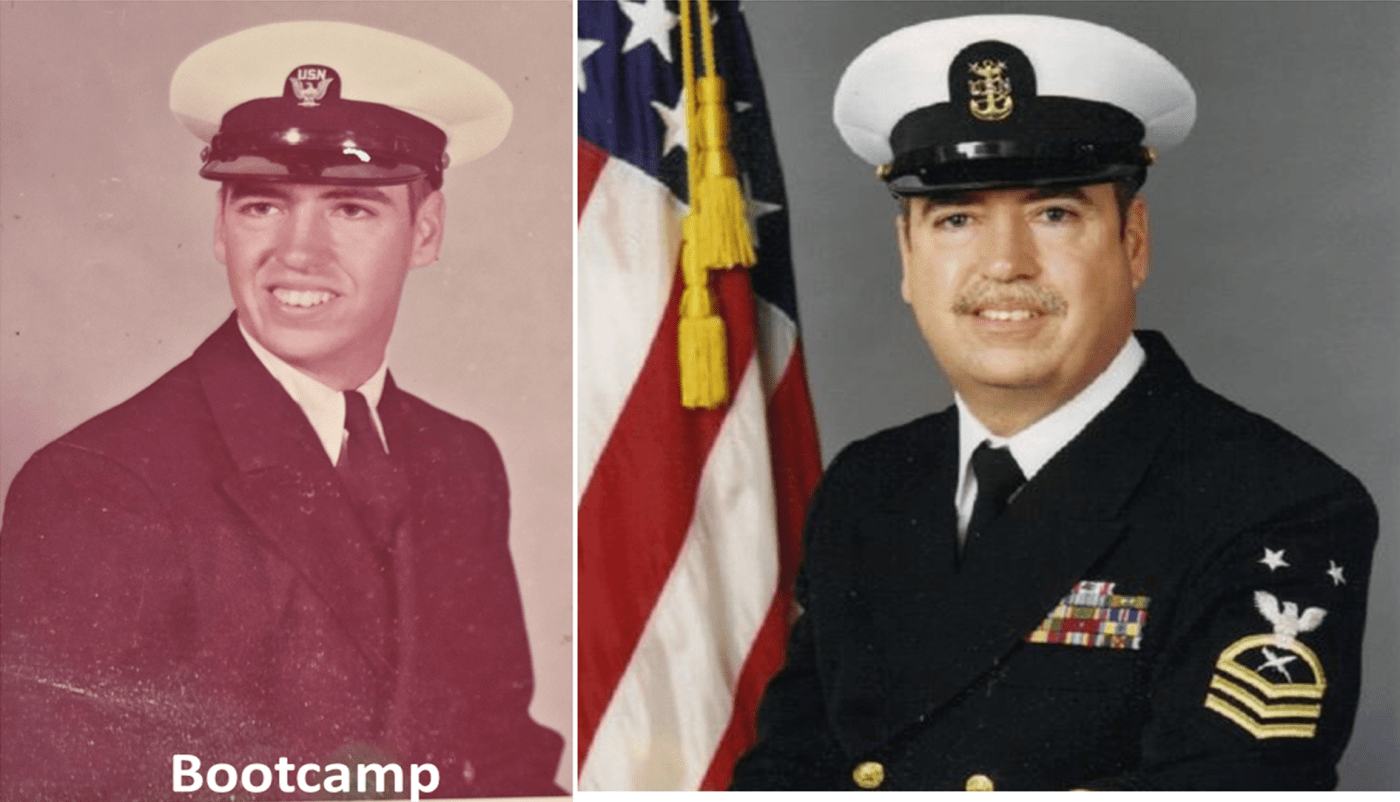
Master Chief Carragher is a native of West Nyack, New York. He enlisted in the Navy as a Cryptologic Collection Technician in 1976, advanced to the rank of Master Chief Petty Officer in 1998, and served until retirement in 2005.
He has an Associate of Arts Degree from the University of Phoenix, a Bachelor of Science in Liberal Arts Degree from Excelsior College, is a designated Navy Master Training Specialist, a Microsoft Certified Professional (Operating System), A+ Certified Professional, Network+ Certified Professional, and Security+ Certified Professional.
Duty Station Assignments and Achievements:
– Class “A” Cryptologic Technician (Collection) School, Naval Technical Training Center (NTTC) Pensacola, Florida from 6 May to 12 November 1976.
– Naval Security Group Activity (NSGA), Northwest, VA from 10 December 1976 to 7 June 1980.
During this tour, CTRSA Carragher was initially assigned to the Fleet Support Division as a manual Morse Operator. With a strong desire to go to sea, he attended the division’s basic manual Morse training program, graduating 1 in a class of 4. He diligently applied himself to developing a thorough understanding of Cryptologic Direct Support Element (CDSE) operations and associated equipment. He subsequently deployed on five surface ships in support of Commander-in-Chief, Atlantic Fleet for a total of 246 days, and became a “BLUENOSE” and a “TRUSTY SHELLBACK.” He learned to operate the OUTBOARD and TACINTEL communications systems, and OUTLAW SHARK system. He participated in exercises NORTHERN WEDDING-78, OCEAN SAFARI, and AGGRESSIVE KNIGHT. In recognition of his efforts, he was selected as the Operations Department’s “Operator of the Month” for January 1980.
– AFEES Station Miami, FL and Navy Administrative Command, Orlando, FL from 24 July 1980 to 2 October 1980. After a short departure from the Navy, CTR3 Carragher reenlisted and returned to active duty.
– NSGA Misawa, Japan from 3 October 1980 to 2 October 1983.
CTR3 Carragher was assigned to the Fleet Support Division. He deployed as a CDSE Senior manual Morse Operator/Analyst on nine Direct Support missions in support of Commander-in-Chief, Pacific Fleet for a total of 352 days at sea. On each of these missions, he worked an arduous port and starboard watch rotation. While ashore, he was formally recognized for making a unique intelligence discovery as a Technical Research Analyst. This was followed by his selection to be the CTR-branch Training Petty Officer. He developed 18 training scenarios and patiently taught them to newly arrived personnel. Based on his vast experience, he attained a level of technical knowledge that was without peer and went on to become the Command’s best CTR2.
– Naval Submarine Training Center Pacific, Pearl Harbor, HI from 3 October 1983 to 15 January 1986.
CTR2 Carragher was assigned to the Submarine Support Equipment Program (SSEP) Department, Electronic Warfare Support Measures (ESM) Training Division as an AN/WLQ-4(V) SEA NYMPH instructor. During this tour, he began by immediately displaying extraordinary instructional skills and professional competence in teaching the AN/WLQ-4(V) course of instruction (COI). He voluntarily attended and became a Lead Instructor for the AN/WLR-6(V) Tactical Basic Operator course, eliminating an existing shortage of instructors. He then assumed the task for writing an instructor guide for AN/WLR-6(V) Update-4 equipment and modifications. He diligently performed liaison with various commands and collected additional training material to enhance the completeness and authenticity of the AN/WLR-6(V) COI. Throughout his tour, he instructed 8 classes graduating 34 Direct Support Supervisors / Operators. He also provided personalized training to qualify 7 new WLQ-4(V) and AN/WLR-6(V) instructors. This included instructor guide preparation and personalization, teaching techniques, testing procedures, and overall course certification. In addition, he was heavily relied upon for his seasoned Direct Support experience and equipment knowledge proficiency. He assisted in the final Submarine Advanced Signal Training System (SASITS) 7B3 acceptance testing. He was twice handpicked to represent the command as curriculum material expert/monitor for the highly successful AN/WLQ-4(V) SEA NYMPH Direct Support / Team Trainer pilot course at Naval Submarine School, Groton, CT. He most capably provided the needed technical expertise to vastly improve this new pipeline COI. Subsequently, drawing on his formal Japanese language and AN/WLR-1G ESM Basic Operator training, then CTR1 Carragher skillfully applied his Japanese proficiency by assisting in the instruction of this course for Japanese Maritime Self Defense Force (JMSDF) students, which markedly improved their comprehension of the curriculum. Petty Officer Carragher’s stellar professionalism and hard work resulted in him being designated as a “Master Training Specialist,” selected as “Instructor of the Quarter” for the period ending March 31, 1984, and nominated for Command “Shore Sailor of the Year” 1984.
– NSGA Fort George G. Meade, MD from 31 January 1986 to 31 December 1987.
During this tour, CTR1 Carragher served on a handpicked CDSE team as the senior manual Morse Operator / Analyst, Section Supervisor, ESM Operator, and Communications Operator on a jointly sponsored NSA/CNO Special Project SIERRA of great importance to the intelligence community. While deployed as a CDSE Supervisor and Operator / Analyst on several Direct Support missions for a total of 182 days, he contributed immensely to mission success by providing precise, time-sensitive Cryptologic support directly to the on-board Tactical Commander in a dynamic operating environment. His efforts directly augmented the successful employment of specialized equipment and systems under uniquely difficult conditions of high personal stress, professional risk, and environmental adversity. While ashore, he served as a Department of Defense representative with high-level federal agencies and civilian contractors. Most notably, he provided senior Navy officials and civilian contractors with highly detailed oral and written assessments on a unique computer enhanced SIGINT suite, resulting in a significant system renovation and upgrade. His dedicated efforts helped them to successfully debug the equipment prior to mission deployment. In addition, he painstakingly researched and routinely provided NSA, CNO and other Naval authorities with well-researched mission support requirements, immensely enhancing tailored support to mission platforms. He also processed massive project related files into an easily accessible database for the CNO.
– NSGA Misawa, Japan from 24 June 1988 to 6 June 1991.
During this tour, CTRC Carragher first served as a Processing and Reporting (PANDR) Division Watch Chief, then Day Staff Chief, and ultimately the Operations Chief. Upon arrival he instantly established himself as a premier Chief Petty Officer and front-runner in all respects. He provided firm and impartial leadership to over 120 Navy and Marine Corps personnel in 5 analytic work centers. In each capacity, his diligent efforts resulted in increasingly greater improvement in the quality and timeliness of Cryptologic support to Pacific Fleet commanders and national authorities. NSA formally cited his analysts for reporting excellence and several of these reports later appeared in “NSA Technical analytic Quarterly reports.” He personally chaired 52 Job Qualification Requirements (JQR) qualification boards ensuring only operationally ready, highly motivated personnel were certified. His personal involvement ensured the integrity of the qualification process. In addition, he authored 17 tailored working aids and innumerable technical reports, and scripted scenarios in support of two large-scale command post exercises. He coordinated the research and preparation of over 100 analytic topics for group presentation at three highly successful NSA-sponsored international analytic conferences and performed flawlessly as Requisition Action Officer for a special CNO-directed Navy alert program of vital importance to national security. He was also handpicked to attend the Conventional Signals Upgrade GROUNDLINE instruction and evaluation at NSGA Fort George G. Meade, MD. For 2 weeks, he learned and thoroughly tested GROUNDLINE prior to its acceptance for installation at field sites. In September 1990, he was ranked as the best of 7 CTRCs and 2 of 22 CPOs in the Command. His top-notch professionalism and initiative resulted in his selection for advancement to CTRCS.
– Cryptologic Support Group Japan (formerly CSG SEVENTH Fleet), Kamiseya, Japan from 7 June 1991 to 3 August 1994.
CTRCS Carragher served as the CSG Operations / Training Chief, LCPO, and Command Senior Chief for 18 senior analysts. He expertly liaised with every cryptologic and intelligence organization in the Pacific Fleet as well as cognizant national agencies. His close coordination with counterparts resulted in key insights, which often identified important emerging issues. In addition, he aggressively revitalized the CSG training program, which produced 22 qualified CSG Watch Officers; deployed with COMSEVENTHFLT (C7F) staff aboard USS BLUE RIDGE (LCC 19) for 39 days and conducted high-level and key liaison with allied Naval Officers; and, flawlessly served as the Top-Secret Control Officer, USSID Manager, and Assistant Naval Activities Control Officer for three CNO-directed special access programs. He was the CSG representative to Joint Intelligence Center Pacific Detachment (JDET) analyst certification boards where his expertise was the key ingredient in qualifying 32 JDET analysts. He brilliantly managed the preparations of analysts who deployed on short-notice to augment CSG CENTCOM Forward detachments in Riyadh, Saudi Arabia and Bahrain. He led key discussions on myriad time-sensitive cryptologic support subjects during two CSG worldwide conferences and on C7F Signals Search and Development conference. He was recognized by C7F and Commander, Battle Force SEVENTH Fleet WESTPAC for pre-deployment briefings and operational “hot scrubs” for Commanding Officers and cryptologists in Yokosuka. Additionally, he reviewed and validated COIs supporting C7F cryptologists. He thoroughly revised the cryptologic assets portion of C7F/C3F/C5F’s OPORD 201 Annex Sierra providing afloat cryptologists with critical collection and reporting guidance. He successfully resolved circuit loading and auto-route table deficiencies associated with the WESTPAC Special Intelligence broadcast, standardizing time-critical cryptologic support to C7F and C3F subscribers. A leader in bilateral operations, he spearheaded a high-level analytic conference for 25 allied Naval officers, which was used as the template for future exchanges. In the local community, as President of the Kamiseya CPO Association from February 1992 to March 1993, he completely transformed a declining organization into a cohesive group of Chiefs from 6 commands. As Command Senior Chief, he achieved a 100-percent retention rate through first-hand involvement and sincere concern for the career planning of his shipmates, reenlisting or extending 8 personnel.
– NSGA Misawa, Japan / Misawa Cryptologic Operations Center (MCOC) from 4 August 1994 to 26 September 1997.
He served as MCOC Section Operations Superintendent/LCPO, superbly managing 173 multi-service personnel and assisted the Section Commander in both cryptologic and military matters associated with 8 diverse work centers. Further, he served as the Joint Analysis and Reporting Division (JARD) Superintendent / LCPO and managed 52 multi-service personnel in 2 work centers with oversight of Command analysis and reporting efforts of more than 500 analysts in 8 work centers. He spearheaded efforts in designing a joint Watch Reporting Center (WRC), which consolidated cryptologic reporting assets within the MCOC, and expertly managed the transition of Program-II Cryptologic Shore Support Activity reporting functions into Program-III MCOC WRC architecture. He developed, directed and implemented a Processing and Reporting Supervisor’s training course, acclaimed throughout the Command. Oversaw 838-hours of planning and coordination of the 4-day curriculum that immediately enhanced on-floor training and expedited the qualification process. He consistently demonstrated outstanding leadership, analytic prowess, technical expertise and training skills during real-world events as Assistant Action Officer for CNO-directed Navy special access programs. He took the lead in coordination of two highly technical international analytic conferences. Through direction of staff analysts, compiled a 122-page technical reference document that significantly contributed to the presentations. Chief, Tokyo Liaison Officer, and senior Naval officers and CNSG representatives lauded his impressive Cryptologic insights and flawless representation of NSGA Misawa, the MCOC, and the Navy. He flawlessly directed cryptologic assets, and drafted comprehensive reports to CNO and Fleet CINCs. He also directed all aspects of site participation in the highly successful test of a new digital SATCOM link with EP-3 aircraft. His efforts were cited by USCINCPAC for his vision in determining critically needed airborne communications upgrades. His outstanding performance as LCPO of a 16-member multi-service interpreter team aboard USS BELLEAU WOOD (LHA 3) during port visit to Vladivostok and in exercise COOPERATION FROM THE SEA ‘96 was specifically cited by CTF 76 as vital to the operation’s success.
He superbly served as representative of NSGA Misawa to the Misawa AB and Japanese communities as President of the Misawa CPO Association, comprised of nine Navy commands. As such, he performed as Master of Ceremony for the CPOA-sponsored SOY/Marine NCO of the Year banquet, sponsored the 95 CPO Initiation for 11 newly selected Sailors and Chaired the 97 CPO Initiation of 15 Selectees from 8 commands. He also Chaired the Misawa AB Navy Ball Decoration Committee, and chaired numerous fundraising initiatives for both command and community, raising over $2,100. Further, he was the NSGA Misawa CPO Mess Coordinator for a local community “Red Feather” charity campaign, and was the Command’s representative for a subsequent awards presentation hosted by Misawa City’s Mayor. Cited by the Mayor of Gonohe for his dedicated participation in the Japanese Home-Stay Program.
– NTTC Pensacola, from 29 September 1997 to 30 November 2000.
Senior Chief Carragher served as Division Chief of the Fleet Advanced Systems Training Division for over 80 U.S. and U.K. staff members, to include, 20 CPOs, 47 Instructors and 17 support staff. He directly oversaw and guided the efforts of 650 new accession Sailors attending Fleet Cryptologic training courses. His extraordinary organizational and managerial skills were critical to ensuring school curriculum was current with the constantly changing disciplines within the Navy cryptologic claimancy. In July 1998, Senior Chief Carragher was advanced to Master Chief Petty Officer. As such, he served as Division Chief of the Advanced Shore Systems Training Division where he superbly managed and directed 119 U.S./U.K. multi-service staff in the training of over 1,200 (E1-E8) multi-service students annually. Ultimately, he served as Cryptologic Training Department Master Chief, and consistently demonstrated unsurpassed resourcefulness and dynamic leadership in the management of over 300 multi-service staff and over 6,000 (E1-O3) multi-service students annually in the largest enlisted school in the Command. His unparalleled ability to mentor contributed to a 92-percent reduction in annual NJP cases; previously, 600+ NJP cases annually. He was the driving force behind a 50-percent qualification increase in the command’s Master Training designation program.
– NSGA Pensacola from 1 December 2000 to 2005.
Master Chief Carragher served as the Administrative Department Head supporting more than 240 Officers, Sailors and Civilians comprising the Command. During this tour he was conferred an Associate of Arts Degree, and certification as Microsoft Certified Systems Administrator. He was the Acting CMC when the incumbent was absent, and he led and managed with confidence in this key Command leadership role. As Administrative Department Head, he was the CO’s trusted advisor and a superb example of senior enlisted leadership! He expertly managed a 29-person department comprised of Special Security Officer, Command Career Counselor, Command Web Development / Database Cell, Command Mailroom, and Command executive / department-level administrative support for 240+ Officers/Sailors and Civilians. He adroitly balanced personnel concerns with demanding Command commitments.
He was a masterful writer and meticulous staffer. Tirelessly managed the endless flow of correspondence, processed and revised evaluations and fitness reports and awards for 240+ Command members. He produced the Command’s 2001 Junior Sailor of the Year, 2002 Sailor of the Year, two Sailors of the Quarter, one Civilian of the Quarter, and the Navy League’s Civic Award winner. His direct guidance of the Command Career Counselor’s efforts produced superb results in Command retention statistics: from 73% to 83%.
As Command Public Affairs Officer, he was essential to publication of the Command’s first-ever newsletter. His articles on Command events and recognition ceremonies were published virtually unchanged by local news agencies.
He was awarded the Navy & Marine Corps Achievement Medal for his superior performance of duty while serving as Assistant Change-of-Command Coordinator of 11 sub-committees.
As Strategic Plans & Readiness Department Head, normally filled by a Lieutenant Commander, he revitalized the Command Strategic Implementation Plan (SIP) effort. Further, he brilliantly directed the efforts of five Sailors and one Civilian in all aspects of the Command’s SIP, Command Readiness, Process Improvement Program, and ITEMPO reporting efforts. He conceptualized and implemented far-reaching initiatives that innovatively applied computer technology and total quality management techniques to form an active Command SIP Team effort. He conducted extensive coordination with ISIC and Command ESC membership in review/revision of every aspect of the Command’s SIP, Mission/Functions & Tasks, and Command Readiness Assessment Program. Facilitated twice-monthly ESC meetings. Renewed focus on CNSG compliance requirements. Raised the SIP and other Command assessment programs from the development stage into robust and productive programs.
Meticulously maintained a Command Readiness Assessment Program that provided the Area Director / ISIC with a micro-level assessment of key Command function areas. Measured and reported the Command’s ability to meet mission readiness requirements. Identified significant shortfalls in the Command’s Personnel function area and developed in-depth Action Plans to correct the deficiencies. Results: Command overcame deficiencies and improved mission effectiveness from C-3 to C-2 Rating.
Masterfully led the expansion effort of the Command Readiness Program to include programmed reviews of CNSG special interest and regulatory compliance requirements. His exceptional organizational skills provided accurate assessments through constant review of 26 checklists comprised of more than 1,500 line-items, critical in maintaining personnel and mission readiness and contributed significantly to the Command’s overall performance evaluation of ‘Satisfactory’ by CNSG Inspector General during the February 2002 inspection.
Instituted local ITEMPO management process to track and report deployable events for 240+ Sailors and Civilians. The ESC used this data for comparison/manpower study of military versus civilian deployment events.
Post Active Duty Navy Career and Civil Servant:
JimBob Carragher joined the CID Corry Station, Pensacola team as a Civil Servant. He continued his service to the country, the Navy, and Service Members as a Knowledge Transfer and Research Engineer, Navy Knowledge Online Community Administrator, and Communities of Practice Coordinator in the Knowledge Management Directorate, and then transferred into the Functional Integration/Plans & Programs Directorate and was integral to the merger of Integrated Battle Force Training Center into the CID Waterfront Training initiative. Subsequently, he was hired as Assistant Program Manager (IT/ITS/ET/IP) at Center for Information Warfare Training supporting the training needs of 14,000+ Information Warfare Work Force personnel Navy-wide until his retirement in 2022. JimBob Carragher completed a total of 47.5 years military and civil service to our great nation. JimBob Carragher now enjoys retired life and grandchildren. He is also President, Naval Cryptologic Veterans Association Gulf Coast Chapter, supporting more than 150 members.
JimBob Carragher is married to the former Mayumi Hasegawa of Wakkanai, Hokkaido, Japan and they have two sons, Shingo and Chuck, and two wonderful daughters-in-law, along with grandsons, Elias (4yo), Kenji (4yo), Elio (9 mos), and granddaughter (princess) Maki (2yo).


23 July 2026 at 09:43
JimBob! Was a “pleasure” surviving Chief’s initiation with you! Chuck Keplinger, LT, USN, ret.
LikeLike
23 July 2026 at 10:42
Well Done Shipmate.
R// CWO4 Brian Ashpole, USN-Retired
LikeLike
23 July 2026 at 11:40
There’s never a problem finding JimBob. He’s always in the lead out front. Thanks for all the work you and others do in organizing NCVA Gulf Coast activities.
Rusty Smith
LikeLike