
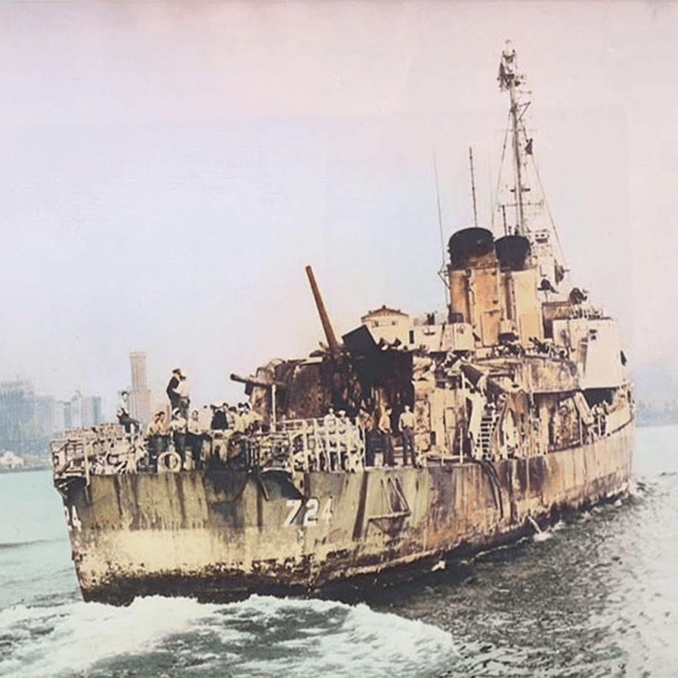
The image shows that on April 16, 1945, in the waters off Okinawa, the United States Navy destroyer USS Laffey (DD-724) underwent one of the most brutal tests of combat in the history of modern naval warfare. Photographed from the escort carrier USS PCE-851, Laffey appears badly damaged but remains at Okinawa Radar Picket Station Number One, the most dangerous position serving as an early warning system for Japanese air attacks.
In less than an hour, USS Laffey was subjected to a relentless and coordinated wave of kamikaze attacks. The ship received direct hits from five kamikaze aircraft, followed by two aerial bombs, and numerous gunfire and near misses, enveloping the ship in explosions, flames, and metal fragments. The impact is clearly visible on the ship’s bridge, deck, and superstructure, which were charred, chipped, and riddled with holes from the explosions and intense fire.
Despite the extensive damage, loss of personnel, and fires throughout the ship, the crew of USS Laffey demonstrated remarkable resilience and discipline. Damage control teams worked tirelessly amidst the flames and smoke, while anti-aircraft guns kept firing until the last moment to defend the ship and the surrounding fleet.


Leave a Reply