
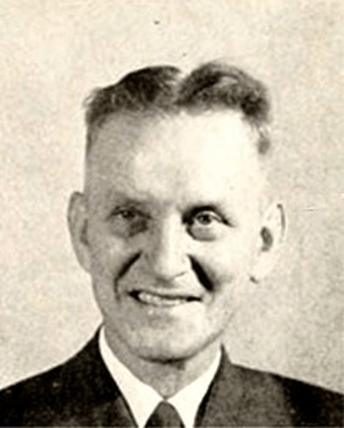
Captain Wilfred J. “Jasper” Holmes
April 4, 1900 – January 7, 1986
“Let Us Never Forget” Submariner, Intelligence Officer, (USNA 1922), Captain Wilfred Jay (Jasper) Holmes, USN
Captain Holmes was a United States Naval intelligence officer in Hawaii during World War II. He was assigned to the Estimates Section of the Fleet Radio Unit Pacific (FRUPAC) at Pearl Harbor, where he was deeply involved in the interpretation and analysis of Japanese wireless intercepts. In fact, he was one of a handful of officers in Hawaii who was privy to material classified above “top secret.” Captain Holmes was part of the team that interpreted and analyzed intelligence derived from the breaking of the Japanese naval encryption code JN-25 – classified as “Ultra.” This resulted in major victories in the Pacific like the Battle of Midway, the shoot-down of Admiral Isoroku Yamamoto, the destruction of the Kido Butai or Japanese flotilla that participated in the attack on Pearl Harbor and success of America submarines against the Japanese Maru fleet.
Wilfred Jay Holmes was born on April 4, 1900 in Stockport, New York to Johan Erik Jonasson Holmes and Ester Felina Moett. He grew up in Stottville New York and attended Hudson High School. Nominated to the United States Naval Academy from New York, Midshipman Holmes entered the Academy on June 19, 1918. He was a member of the Navy Track Team. First class year, he was first set Second Battalion Commander. Midshipman Holmes graduated 159 of 539 Midshipman on June 2, 1922.
In the 1922 Lucky Bag, Midshipman Holmes’ roommate wrote:
No, Ladies and gentlemen, this is not a waling advertisement for the world renowned Rubberset Shaving Brushes but a dashing young Swede from Hudson, New York. One would never guess that beneath this placid countenance lies the aesthetic soul of an ardent devotee of Terpsichore. Yet each time he emerged from the shower Plebe Year he would gracefully flit to and fro in an impressionistic dance of the muses. Curses, have we failed to mention the bath towel? That towel was just as necessary to Jasper as tulle is to Eva Tanguay. The combination of Navy life and love, however, has changed him to a sadder but wiser man, and his only past time is writing the nightly wail of his everlasting love in a billet-doux to Hudson, New York. “Jasper” is a true salt from the heels up with a little practice he’ll be able to hold his liquor with the best of ‘em. “Any mail for me, Assistant?”
On July 10, 1922, Ensign Holmes was assigned to battleship USS Nevada (BB-36).
By January 1, 1924 to May 1924, Ensign Holmes was assigned to submarine USS O-11.
On October 4, 1924, Ensign Holmes was assigned to submarine USS S-32.
LTJG Holmes married Miss Isabelle West. Together they had on son John Eric Holmes.
On June 29, 1927, LTJG Holmes was assigned under instruction at the United States Naval Academy Post Graduate School, Annapolis Maryland.
By January 1, 1929, Lieutenant Holmes was assigned under instruction at Columbia University, New York. Subsequently he completed is Master’s Degree in Electrical Engineering.
On August 13, 1929, Lieutenant Holmes was assigned to Submarine Squadron 20. Subsequently, he was assigned to submarine V-12.
By January 1, 1932, Lieutenant Holmes was assigned to submarine USS Barracuda (SS-163).
On July 18, 1932, Lieutenant Holmes was Navy Research Laboratory Bellevue, District of Columbia.
In 1934, Lieutenant Holmes a gifted writer won a Naval Institute essay prize.
In 1934, Lieutenant Holmes was Commanding Officer of submarine USS S-30 (SS-135).
On July 1, 1935, Lieutenant Holmes was receiving treatment Naval Hospital Pearl Harbor.
On March 1, 1936, Lieutenant Holmes medically retired from the Navy due to arthritis of the spine.
Lieutenant Holmes with a Master’s Degree in electrical engineering, and quickly found a position as an instructor at the University of Hawaii. He had considerable skill as a writer, too. He began publishing essays and short stories under the pen name Alec Hudson, several of which were published in the Saturday Evening Post. These often had a naval theme, and Lieutenant Holmes’ descriptions of naval equipment and procedure were detailed enough that another aspiring writer, Naval Academy Midshipman Edward L. Beach (USNA 1939), recognized that “Alec Hudson” must have been a naval officer.
In mid-1941, Lieutenant Holmes was called back to active service assigned to Communications Intelligence Unit. Tensions between Japan and the United States were rapidly increasing, and most naval officers were convinced that at some time soon, those tensions would flare into a shooting war. At the time, Fleet Radio Unit Pacific (FRUPAC), or Station HYPO, as the unit was known seemed to be making good progress on the JN-25 naval code, and another section of the unit was able to read much of the diplomatic code, Purple. Because Lieutenant Holmes had no cryptographic experience, he was assigned to the Estimates Section, where his experience as a serving submarine line officer would be best employed, compiling intelligence drawn from various sources to determine the strength, composition and movements of various Japanese military units – naval groups, air wings and island garrisons.
On December 1, 1941, the Imperial Japanese Navy changed the JN-25 code requiring codebreakers to start over.
By December 20, 1941, using all the techniques of communications intelligence – interception, RDF, call sign analysis, traffic analysis, and cryptanalysis – together, the HYPO group regained their contact with portions of the Japanese fleet blacked out since before Pearl Harbor.
Commander Rochefort and his team gave high priority to tracking the movement of Japanese submarines. This proved to be easier than it seemed at first glance. Japanese submariners were irresponsibly chatty, communicating almost daily to their commanders or home base, in a code that was not difficult to break. They were ordered about by the Japanese submarine commanders, with specific departure and arrival dates, speed of advance, tracks and “noon positions” to be adhered to. Departing from assigned area, the submarines often and stupidly lobbed a few shells from their deck guns into islands, positively revealing their positions.
A case in point was the three Japanese submarines patrolling off the west coast of the United States. On departure, they fired a few shells into a refinery near Los Angeles. Thus alerted, Commander Rochefort and Lieutenant Holmes, together with radio intelligence experts Lieutenant Thomas A. Huckins (USNA 1924) and Jack Williams, got on the scent.
Alerted by this bon voyage gesture, Commander Rochefort and Lieutenant Holmes plotted their great circle course from Midway to Kwajalein and determined their speed of advance, based on previous observation. It became clear that LCDR Elton W. “Joe” Grenfell in Gudgeon, returning from Japan, was almost in their path. Lieutenant Holmes contacted Captain Thomas Withers (USNA 1906) in guarded language, and soon a coded dispatch was on its way to LCDR Grenfell, ordering him to lie in wait for the Japanese submarines.
On January 27, 1942, LCDR Grenfell remained submerged exactly on the projected point of interception. At 9 A.M. Grenfell’s exec, Hap Lyon was manning the periscope. Sure enough, right on schedule, he spotted a Japanese submarine. “It was not even zigzagging. The men were lounging on the upper deck, sunbathing and smoking.”
LCDR Grenfell went to battle stations and fired three torpedoes from the bow tubes. His diving officer loss depth control dunking his periscope, but at 81 seconds they heard a dull explosion. When depth control was regained the submarine was gone. LCDR Grenfell reported the submarine as damaged. It appears that either the Japanese saw the torpedo wakes or the torpedoes duded against the side, In any event they panicked and dove with the hatches open and flooding their boat. Eliminating the breaking up sounds as she passed crush depth.
Commander Rochefort and Lieutenant Holmes knew it had sunk because after that morning one of the three Japanese submarines, in this case I-173, no longer came on the air to chat. It disappeared from radio traffic forever, proof to Commander Rochefort and Lieutenant Holmes, at least, that it was sunk.
I-173 was the first major Japanese man of war sunk in World War II and the first vessel to go down as a direct result of radio intelligence.
With the JN-25 naval and diplomatic codes broken, they resulted in major victories in the Pacific like the Battle of Midway, the shoot-down of Admiral Isoroku Yamamoto and the destruction of the Kido Butai or Japanese fleet that participated in the Pearl Harbor attack. To each submarine skipper who sunk a ship of the Kido Butai, LCDR Holmes awarded a bottle of Scotch.
In the middle of May 1942, Commander Joseph John Rochefort’s HYPO had determined that the Japanese were planning a major offensive in the Pacific and that the target was AF or Midway. Convincing Washington’s NEGAT intelligence efforts was a major problem. There were even those in Washington who suggested that their HYPO rivals had been taken in by an elaborate Japanese deception. They believed that the real Japanese objective was an attack on the west coast. It was to silence the skeptics in Washington that Commander Rochefort embarked on a brilliant piece of deception that has been celebrated and misinterpreted by every historian who has ever written about Midway. When Commander Rochefort cooked up the stratagem for sending a fake message about a water shortage on Midway, Commander Rochefort’s intention was not to persuade Admiral Chester W. Nimitz (USNA 1905) HYPO right, but to prove Washington wrong. The idea came from LCDR Holmes. LCDR Holmes studied the Midway Pan Am facility before the war when he was a professor at the engineering school of the University of Hawaii, and he had been impressed that the island’s entire freshwater supply was obtained from an evaporator plant.
LCDR Holmes had the idea of faking a water supply failure on Midway Island. He suggested using an unencrypted emergency warning, in the hope of provoking a Japanese response, thus testing whether Midway was or not a target. Commander Rochefort took the idea to Lieutenant Commander Edwin Thomas Layton (USNA 1924) on Admiral Nimitz’s staff. Admiral Nimitz approved it.
The Japanese took the bait. They broadcast instructions for the code group for the major attack point to load additional water desalination equipment, thus confirming LCDR Rochefort’s analysis. Commander Layton notes that the instructions also “produced an unexpected bonus”. They revealed that the assault was to come the first week of June, 1942.
The Battle of Midway was a ringing triumph and the turning point for the United States Navy in the Pacific. The Japanese casualties: four carriers (INJ Soryo, Kaga, Akagi and Hiryo), one cruiser, 2,500 men and 322 aircraft, while the American casualties: one carrier (USS Yorktown), a destroyer, 347 men and 147 aircraft.
In early 1943, the Japanese Maru code was broken. It allowed HYPO and Admiral Nimitz to begin the undersea war in earnest. Up until that time submarines were been direct to INJ capital ships usually well-guarded traveling at high speeds. But with the Maru code known, it enabled to redirect submarines economically and effectively against the slow-moving, poorly escorted enemy convoys. Commander Holmes was chosen by Admiral Nimitz to mastermind this offensive.
Commander Holmes’ work brought him into contact with units from all over the Pacific Fleet, but he remained a submarine officer in spirit, if not in assignment. Commander Holmes developed a close working relationship with Captain Richard D. Voge (USNA 1925), the operations officer of the Pacific submarine fleet. Captain Voge would come by HYPO every morning around nine o’clock, where he and Commander Holmes would compare the current positions of U.S. submarines with decrypted messages concerning Japanese fleet movements. Most days this information was somewhat general in nature, but from time to time intercepted and decoded messages provided enough detail to put an American submarine in exactly the right spot to intercept a major target.
Commander Holmes had taken on himself the particular and personal dedication to see the destruction of every ship that had participated in the attack on Pearl Harbor. During the war, from time to time, commanders of submarines would receive by messenger, without explanation, a bottle of fine whiskey. Little by little the word got around that one of the ships sunk on a recent patrol had carried special significance to someone in the know. In this way Commander Holmes never left out submarines. It was through him that submarine captains would receive orders to be somewhere at a certain time – and on occasion there was a bottle of booze at the end of the trail.
In June 1944, during the buildup to what would later be known as the Battle of Philippine Sea, HYPO collected and decoded Japanese operational plans detailed enough to enable two submarines, Cavalla and Albacore, to position themselves directly astride the Japanese Navy’s lanes of approach. Albacore got the big new carrier IJN Taiho, but Cavalla, on her first patrol, got the grand prize – the Japanese carrier IJN Shokaku, a veteran of the attack on Pearl Harbor.
Of the six Japanese aircraft carriers that had taken part in the attack on Pearl Harbor, four were sunk in the Battle of Midway and the Shokaku was the fifth to be sunk. HYPO had long since identified all the ships of the Kido Butai that had attacked Pearl Harbor, and their silhouettes were posted on the wall in the Estimates Section. It gave Commander Holmes an unprofessional vindictive satisfaction to check off each of those ships as it was sunk. Commander Holmes told Captain Voge, he would give a bottle of Scotch to any submarine skipper who sank one of them. Captain Voge was careful to present every qualifying skipper for his bottle, but Captain Holmes never saw Commander Herman J. Kossler (USNA 1934), the captain of the Cavalla, after he sank the Shokaku. Commander Kossler was the only submarine captain to sink a capital ship of the Kido Butai, and Commander Holmes still owes him a bottle of scotch. Commander Holmes missed Commander Kossler because Cavalla did not return to Pearl Harbor after that first, eventful patrol, instead putting in at the new forward submarine base at Majuro. In fact, Cavalla wouldn’t return to Pearl Harbor until September 1945, after the war had ended. Instead, Cavalla’s five subsequent patrols were all run out of forward operating bases in Australia, the Philippines and the western Pacific.
In April 1943, HYPO and Commander Holmes knew from the call sign intercepts that Admiral Yamamoto had arrived in Rabaul at the beginning of April 1943 to direct an all-out naval air offensive, code-named I-Go, against our bases in the lower Solomons and New Guinea. On April 11, 1943 Admiral Yamamoto decided to make a personal tour of the Japanese air bases in the northern Solomons. The first part of his trip would bring his plane within range of American fighters from Guadalcanal. Commander Holmes took the information personally to Captain Lawton who took it to Admiral Nimitz. Army P-38 fighters were dispatched and Admiral Yamamoto’s plane and its escorts arrived over Kahili at 0930 just as predicted. Major John W. Mitchell USA and his P-38s shot down two bombers escorted and four Zeros with the loss of one P-38.
Navy Distinguished Service Medal
Awarded For Actions during World War II
The President of the United States of America takes pleasure in presenting the Navy Distinguished Service Medal to Captain Wilfred Jay Holmes, United States Navy, for exceptionally meritorious and distinguished service in a position of great responsibility to the Government of the United States while attached to the Division of Naval Communications from 7 December 1941 to 16 April 1945. Captain Holmes rendered invaluable assistance in directing and carrying out the vital work of key activities of the Communications intelligence organization. By his judgment, planning and devotion to his exacting assignment, he contributed to the effectiveness of important operations.
Legion of Merit
Awarded For Actions during World War II
SYNOPSIS: Captain Wilfred J. Holmes, United States Navy, was awarded the Legion of Merit for exceptionally meritorious conduct in the performance of outstanding services to the Government of the United States as Officer-in-Charge of combat intelligence at Joint Intelligence Center, Poa, from 7 September 1943 to 1 September 1945.
Source: NCVA


Leave a Reply