
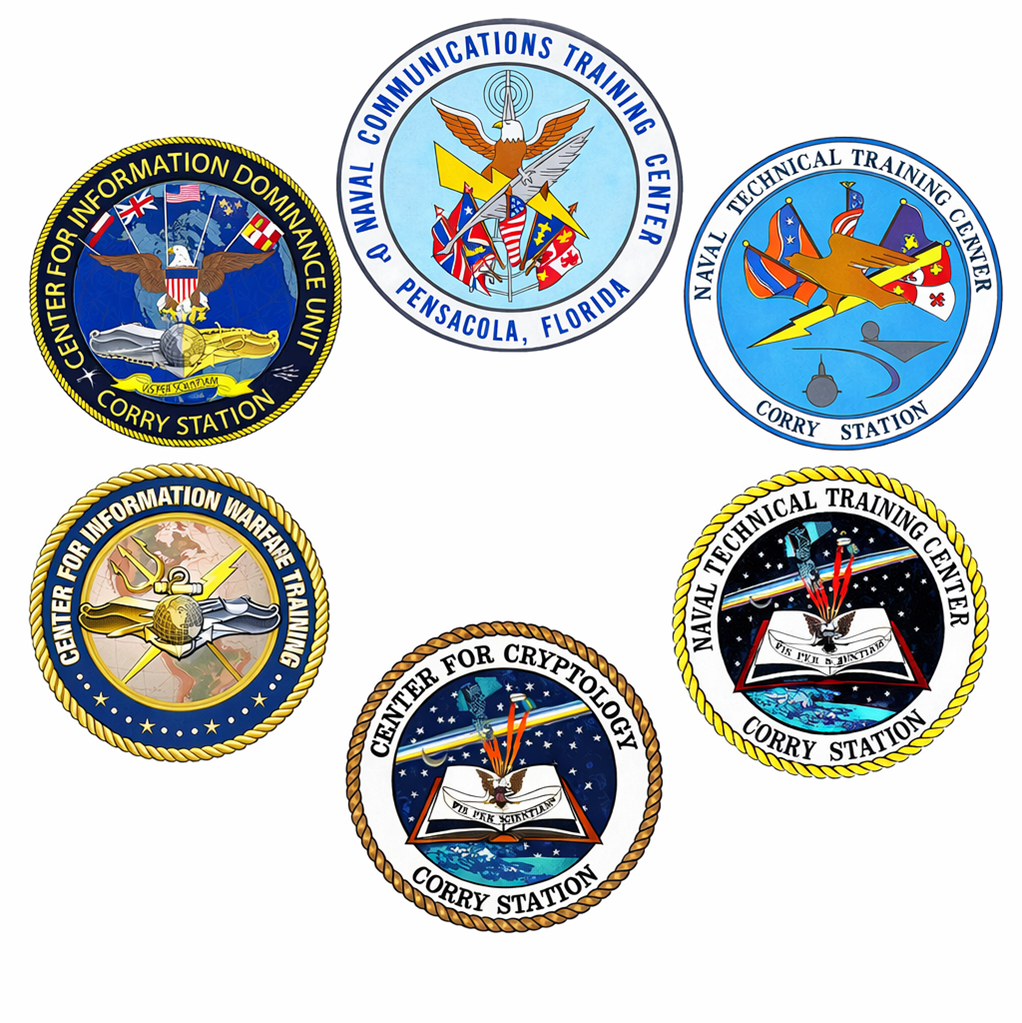
The following are major events that occurred at Corry Field/Station. This timeline does not include aviation training that started in 1934.
1961
In 1961, the Naval Communications Technician School transferred from Imperial Beach, California, to Pensacola, Florida. That same year, the first class of communications technicians—later redesignated as cryptologic technicians—began training at the Naval Communications Training Center located at Corry Field.
1973
In 1973, the Chief of Naval Operations (CNO) directed a name change for the command, redesignating the Naval Communications Training Center at Corry Field as the Naval Technical Training Center (NTTC), Corry Station.
1975
In 1975, the Consolidated Navy Electronic Warfare School was established at Corry Station, expanding the installation’s role in technical and operational warfare training.
1986
In 1986, the Navy and Marine Corps Intelligence Training Center (NMITC) was established in Virginia Beach, Virginia, to provide formalized training for members of the naval intelligence community.
2002
In 2002, the Chief of Naval Education and Training presented the Training Excellence Award to Naval Technical Training Center (NTTC) Corry Station, recognizing superior performance in education and training. During the same period, base support functions at Corry Station were realigned under Naval Air Station Pensacola as part of the Navy’s regionalization initiative.
2003
In 2003, the Center for Naval Cryptology—also known as the Center for Cryptology (CC) Corry Station—was established as part of the Navy’s “Revolution in Training.” Focused on cryptologic and electronic warfare technician ratings and related officer communities, the command became one of the Navy’s fifteen designated learning centers.
2005
In 2005, the Center for Information Dominance (CID) Corry Station was created through the merger of the Center for Information Technology (CIT) and the Center for Cryptology Corry Station. This initiative integrated training responsibilities for the four key disciplines of information dominance at the time—exploit, attack, defend, and operate—under a single learning center. Prior to the merger, CIT had been responsible for network operations training, while CC Corry Station oversaw signals intelligence training.
2006
In 2006, the Center for Information Dominance was recognized with the Naval Education and Training Command (NETC) Training Excellence Award, highlighting the command’s continued excellence in delivering technical and operational training to the fleet.
2009
In 2009, the Navy formally established the Information Dominance Corps, consolidating information-related warfare disciplines—including intelligence, information professional, cryptologic warfare, oceanography, and meteorology—into a unified community.
2011
In 2011, the Navy undertook a major organizational realignment, disestablishing the Center for Naval Intelligence and transferring oversight of both the Navy and Marine Corps Intelligence Training Center (NMITC) and the Fleet Intelligence Training Center (FITC) to the Center for Information Dominance. With the exception of oceanography and meteorology training, responsibility for educating personnel across the Information Dominance Corps was consolidated under a single command. During this period, two new CID schoolhouses were formally established at Corry Station, Florida, and Monterey, California.
2015
In 2015, the Council on Occupational Education recognized the Center for Information Dominance for achieving forty consecutive years of accredited institutional status, underscoring the command’s longstanding commitment to high-quality professional education and training.
7 July 2016
On 7 July 2016, the training organization officially changed its name from the Center for Information Dominance to the Center for Information Warfare Training (CIWT), reflecting the Navy’s shift in focus from “information dominance” to “information warfare.” As part of this transition, major subordinate schoolhouses—including the Corry Station command—were redesignated as Information Warfare Training Commands.
2016
Later in 2016, following guidance from the Chief of Naval Operations emphasizing the importance of information both “in warfare” and “as warfare,” the transition to CIWT was fully implemented. This change represented the convergence of multiple complementary training disciplines under a unified mission to develop information warfare professionals, and all major learning sites were formally renamed Information Warfare Training Commands.
2017
In 2017, IWTC Corry Station completed its first full year operating under the new Information Warfare Training Command construct. The command continued to deliver legacy accession pipelines for Cryptologic Technician ratings—Interpretive, Networks, Technical, and Collection—as well as Information Systems Technician training and Information Warfare Officer basic courses. During this year, early groundwork began for the Navy’s Ready Relevant Learning (RRL) initiative, including course analysis, engagement with fleet stakeholders, and restructuring of learning objectives to modernize training delivery.
2017 (Organizational Realignment)
Also in 2017, the Center for Information Warfare Training realigned its global learning sites under four major schoolhouses, effective January 1. This restructuring was intended to streamline command relationships and improve training efficiency across the Information Warfare enterprise.
2021
In 2021, IWTC Corry Station expanded its Culture of Excellence training initiatives, incorporating case-study-based instruction focused on ethics, resilience, and leadership development for both students and staff. The command increased emphasis on professionalism, behavioral readiness, and integration of Sailor 360 principles into the schoolhouse training environment, supporting improved command climate and human performance.
10 July 2023
On 10 July 2023, IWTC Corry Station convened its first Computer Network Operator Qualification Course (CNOQC), marking a historic milestone in the command’s evolution into a cyber warfighting training center. The course trained Cyber Warfare Technicians and the Navy’s first Maritime Cyber Warfare Officers, contributing directly to the development of Cyber Mission Force operators.
2023 (Cyber Training Infrastructure Expansion)
During 2023, the command also integrated the Persistent Cyber Training Environment (PCTE) through the installation of a regional node known as “Phoenix” at Corry Station. This capability provided a significant leap in cyber training realism by enabling mission-rehearsal environments and joint cyber exercise support.
2026 (Current Trajectory)
By 2026, IWTC Corry Station is operating as a major accession and intermediate cyber training hub and serves as a key Navy contributor to Cyber Mission Force readiness. Ongoing initiatives include the integration of artificial intelligence and data warfare familiarization into training pipelines, expansion of cyber mission rehearsal environments, and the adoption of learning analytics and adaptive training technologies. The command continues to balance its historic role in signals intelligence training with growing demands for cyber warfare expertise, reflecting an overall training focus on integrating cyber, data, and information warfare skillsets.
 Station HYPO
18 March 2026 at 09:47
From where I started in 1970 as an “R brancher”, to where Corry Field is now…I feel as “primitive” as when I first learned that one of my fellow students had already “learned ditties” in High School while using a pencil. My transition into a “T brancher” was more dependent on my poor typing skills at the time, but opened up a more expansive Navy program for which I’m grateful as well.
Now, as a source of “Warfare” training, inclusive of AI along with all the innovations up ’til now, I can imagine a far more expansive career field for those who qualify into this ever changing rating.
(written with but a bit of “pride” as well as “envy”…I look back fondly of time spent at Corry Field)
LikeLike