
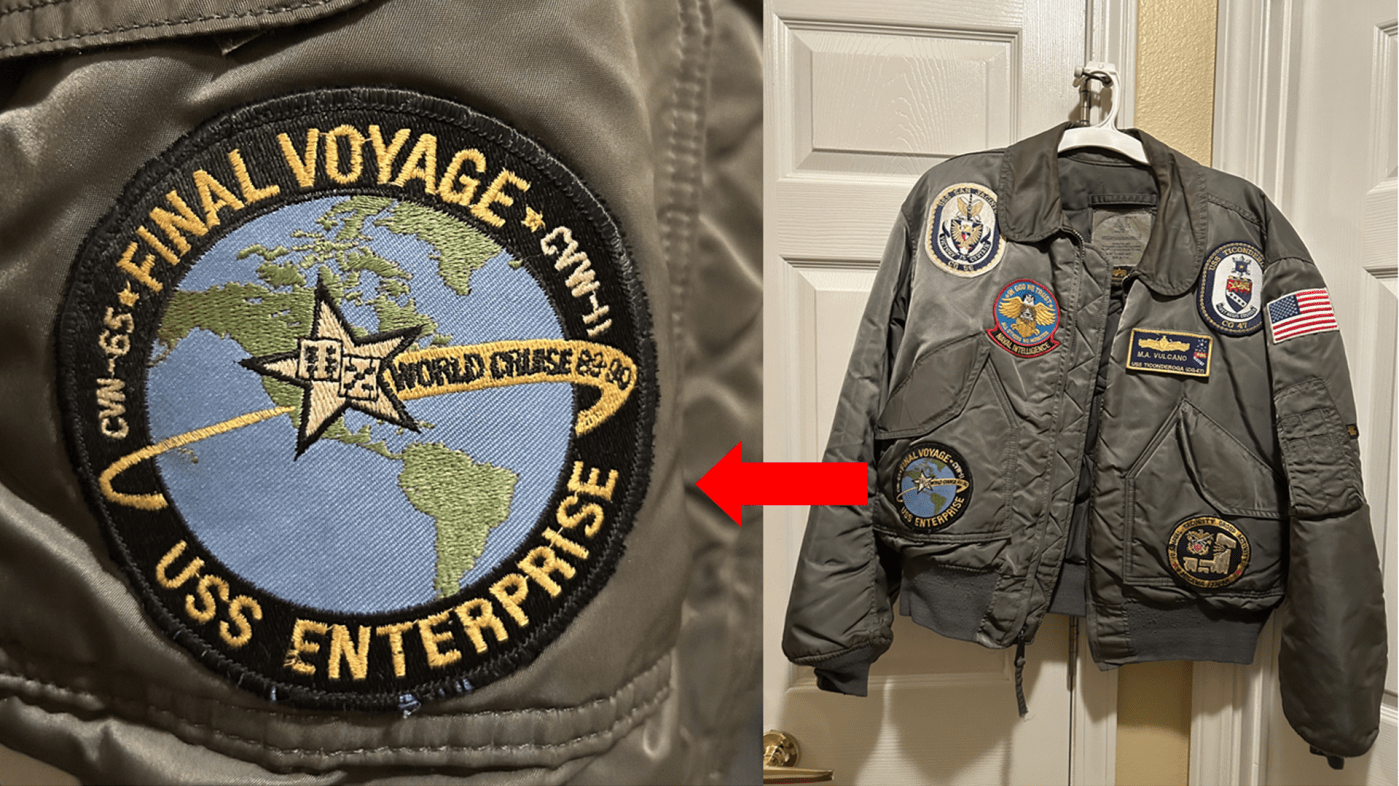
It was 1989. I was a CTR2 on my first Western Pacific deployment, stationed at NSGA Pearl Harbor, Hawaii, serving as a direct support operator. I received TAD orders to report to USS ENTERPRISE (CVN-65), homeported in Alameda, California. The Enterprise was 26 years old, and this would be the “Big E’s” final deployment — a round-the-world cruise before heading to the Philadelphia Naval Shipyard for decommissioning. Hence the patch: “Final Voyage.”
As we got underway and passed beneath the Golden Gate Bridge, it looked like hundreds of people lined the span, tossing flowers down as a sign of appreciation. Unfortunately, mixed in with the flowers were bricks and rocks, and everyone on the flight deck suddenly found cover in a hurry.
Once clear of the channel, we headed south to Southern California to embark the air wing, then turned north up the West Coast of the United States and Canada, around the Aleutian Islands, and across the Pacific — skirting the eastern side of Japan before entering the Sea of Japan.
While operating in the Sea of Japan, I was tracking a potential threat aircraft to the Big E and reported it to the Commodore in CVIC. As a CTR2, I figured my responsibility ended there.
Thirty seconds later, the Commodore came back on the circuit and asked, “What’s the aircraft doing?”
I responded that it was likely conducting mirror-image strike tactics against the Big E.
Again, I thought the exchange was over. Thirty seconds later, he came back: “What do you recommend?”
That question stopped me for a split second. I was a CTR2. He was a Captain. But I answered: I recommended launching aircraft to establish a combat air patrol (CAP) between the possible hostile aircraft and the Enterprise.
Within seconds, the 1MC announced the launch of ready aircraft. Minutes later, two F-14 Tomcats were airborne. SSES was located directly beneath the flight deck, so we heard launches every day — but this time felt different. I couldn’t believe that my recommendation had just launched two $70-million fighters into the sky.
That was the hook for me.
Forty-five days after departing Alameda, we dropped anchor in Hong Kong harbor for a liberty call. We rode an hour to shore in Chinese junk boats. Naturally, the first thing a group of Sailors did was find a British pub. It seemed odd that everyone inside was wearing costumes — until we realized it was October 31. We had just walked into a Halloween party. When you’re at sea that long, you lose track of time.
About a month or so after getting underway from Hong Kong, my detachment ended. I was catapulted off the Big E, landed in the Philippines, and then made my way back to Pearl Harbor.
That first deployment — and the moment a Captain asked a CTR2 for a recommendation — sealed it for me. I was a lifer.
As a side note, instead of decommissioning after that deployment, Enterprise entered the Philadelphia Naval Shipyard for an extensive refueling and complex overhaul, including re-coring her nuclear reactors. After completing the overhaul, she was homeported in Norfolk, Virginia, and continued serving the fleet until her final decommissioning in 2017 — concluding an extraordinary 55 years of service.
 Station HYPO
27 February 2026 at 11:15
Interesting that as a CTR2 you even had the knowledge as to what to even “suggest” to the Captain at the time. Things must’ve taken a more positive spin in the case of your training since I’d been trained as a CTR…then being transitioned into a CTT when my tech abilities exceeded my typing skills in 1970.
Also, for what it’s worth, by the mid-80’s I’d thought that the need to watch what was “tossed” at the ships going under the Golden Gate Bridge, wouldn’t have included what you’d mentioned…but then, appears there are always going to be a full spectrum of ‘village idiots’ anywhere in CA.
LikeLike
27 February 2026 at 11:24
As I may have suggested in the past – – – – A CT will always be the spearhead of the U S Navy world wide
LikeLike
27 February 2026 at 12:18
Recalls a similar incident when I was a CTI1(SS) and LPO of our DIRSUP det aboard USS EISENHOWER during Ocean Venture 81. We were very busy, thanks to the many birds flying down from North Cape wearing big, bright red stars on their tail when a call came to the SSES Admin area. CDR Creighton, OS Division Officer and the CARGRU Force Cryptologic Coordinator, answered and called me to the phone. The C.O., who was following our reporting, asked me my recommendation. I was almost speechless but had to answer him – he was the C.O. He thanked me and hung up.
Flight deck activity rapidly increased after that. Interception and escorting began, we were told, at 110 NM NW of USS EISENHOWER.
Within a minute, we watched as the flight deck was hurriedly cleared and not two, but four F-14s were launched from the bow and port catapults. That evening, the CARGRU Intel Officer gave each of us in OS Division copies of a photo, signed by the C.O., of F-14 numbers 101, 102. and 103 (#104 took the picture) escorting a Red Star-tailed bird.
Don White, CTIC(SS)
LikeLike
27 February 2026 at 13:20
love this story and the ones in the comments. So true and I remember decisions being make that affected the entire CSG based on recs from our team of CTs. Awesome stuff
LikeLike
27 February 2026 at 13:25
I recall as a CTI1(NAC) on the Caribbean swing doing the same sort of advising and doing the daily briefings for both COMSECONDFLT and CINCLANTFLT.
LikeLike
28 February 2026 at 05:41
Berthed pier side twice in Hong Kong. They had decent liberty boats in the early 2000’s. Sad that Hong Kong is no longer a place that 7th Fleet sailors get to experience. I’ve been five times and have a great story from each…..last one was Cobra soup in the same place Anthony Bourdain shot a segment from his episode in HK. Best place for knock off anything…..
LikeLike