
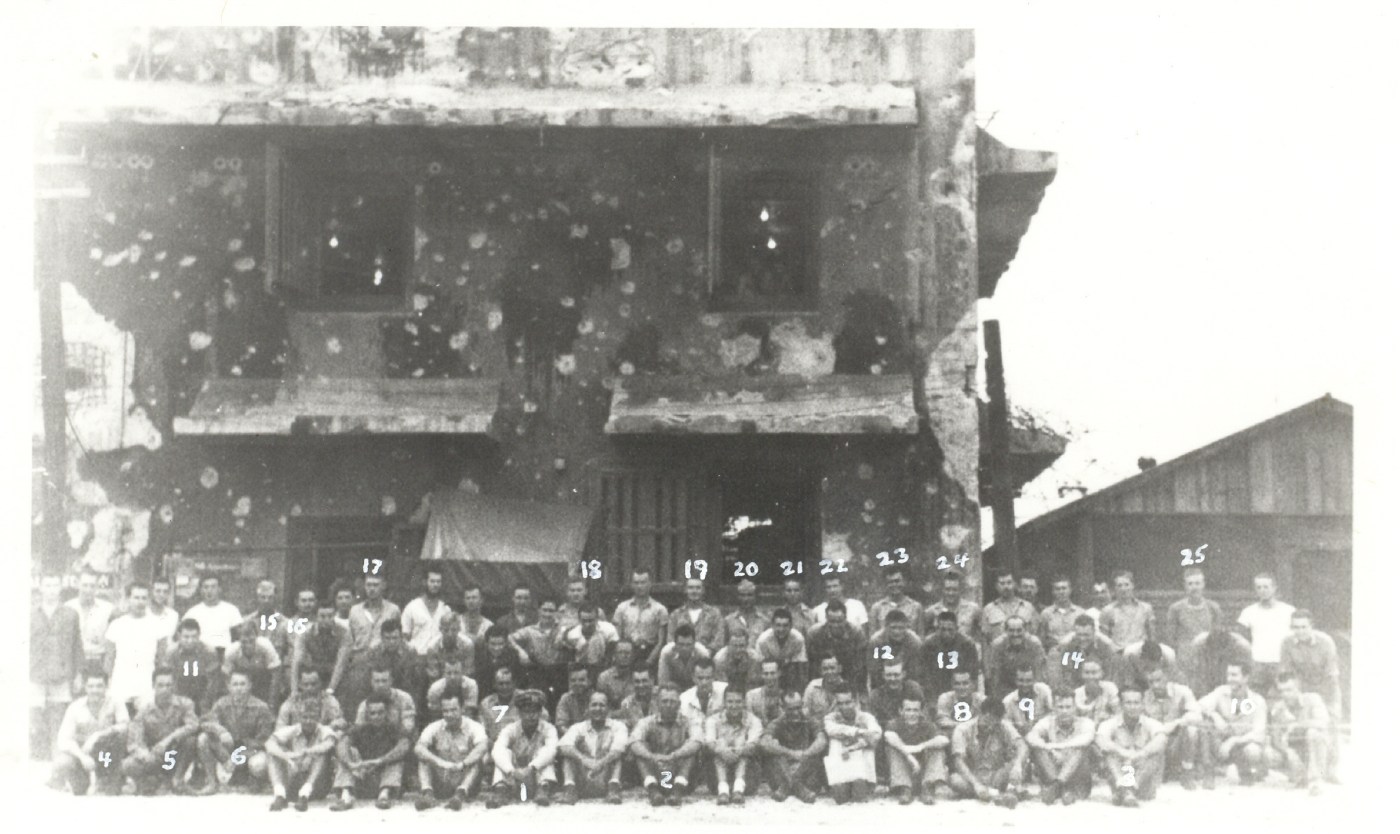
This photograph was taken in front of a captured Japanese Navy Communications facility. The U.S. Marines, 3rd Radio Intelligence Platoon took over the station and used as communications interception facility. Pictured are Marines and Navy Radio Intelligence personnel.
Front row: (1) LT Jay David, USNR (NAVSUPPRADSTA OIC); SGT Donald W. Enochson; and (3), at far right, 1st LT Joseph A. Petrosky, Jr, USMC (Platoon Commander) (OTRG class #12).
Second row: (kneeling): (4) PFC Wilbur G. Gilland; (5) PFC John Cavrich; (6) PFC Kenneth R. Perkins; (7) CPL Charles A. Jamerson; (8) CPL Richard F. Hudson; (9) PFC Floyd W. Dial; and (10) SGT John R. Menser.
Third row: (bending over): (11) PFC William R. Van Sickle; (12) PFC James M. Reifert; (13) PFC Robert M. Condon; and (14) CPL Hubert J. Merrigan.
Back row: (standing): (15) SGT John M. Crook; (16) PFC William Phillips, (17) CPL Norman E. Martinson; (18) CPL Paul E. Bailey; (19) CPL Kenneth W. Bean; (20), with cover, MTSGT Clarence F. Gentilecore (Platoon Sergeant) (OTRG class #11) ; (21) SGT Ernest W. Brown; (22) SGT Benjamin F. Wright: (23) PFC Robert J. Kopczynski; (24) PFC Ralph C. Bradshaw; and (25) PFC Keith K Bean. On watch personnel were not included in the photograph.
The Battle of Kwajalein (January 31 – February 3, 1944) was a pivotal WWII Allied victory in the Marshall Islands, where U.S. forces successfully invaded the world’s largest coral atoll to break Japan’s outer defensive perimeter. Using lessons from Tarawa, the 7th Infantry and 4th Marine Divisions quickly secured Roi-Namur and Kwajalein Island, facilitating the island-hopping campaign.
Key Aspects of the Battle of Kwajalein
- Significance: This battle was a crucial step in the U.S. “island-hopping” campaign, allowing the Allies to pierce the Japanese “outer defensive perimeter” and move closer to the Japanese home islands.
- Combatants: U.S. Army (7th Infantry Division) and Marines (4th Marine Division) vs. Japanese defenders.
- Outcome: A decisive U.S. victory. The Japanese defense was overwhelmed, with only 51 survivors out of 3,500 defenders on Roi-Namur.
- Casualties: The U.S. suffered 372 killed and 1,592 wounded, while Japanese forces lost approximately 7,870 men.
- Strategy: Following the high casualties at Tarawa, U.S. forces utilized heavy, concentrated naval and air bombardment before landing, leading to a much faster victory.
- Aftermath: The U.S. immediately converted the captured atoll into a major naval and air base to support further operations in the Pacific.
The battle was part of a larger operation known as Operation Flintlock, which aimed to seize control of the Marshall Islands from the Japanese.


17 February 2026 at 10:51
Even though this article was previously posted back in March 2025, I don’t really care since I’ve reached that time in my life that repetition is not only a good thing but a functional requirement.
These historical sketches Mario posts on Hypo is just one of the reasons I faithfully visit the blog every day.
LikeLike