
President Donald Trump has ordered a “total and complete blockade” of all U.S. sanctioned oil tankers entering or leaving Venezuela, sharply intensifying pressure on President Nicolás Maduro’s government amid soaring tensions.
The directive follows weeks of escalating U.S. military activity in the Caribbean, and recent tracking data shows a substantial concentration of U.S. naval forces off Venezuela’s northern coast—suggesting what a blockade could look like in practice.
Newsweek has contacted the State Department and Venezuela’s Foreign Ministry for comment.
Why It Matters
Venezuela depends overwhelmingly on oil exports for revenue, and the blockade targets that economic lifeline at a critical moment. By encircling Venezuela with warships and aircraft, the U.S. aims to throttle sanctioned oil shipments to international markets, potentially crippling the country’s economy and squeezing Maduro’s hold on power.
The move also raises legal and geopolitical concerns, with critics labeling the blockade a de facto act of war and a violation of international law.
What to Know
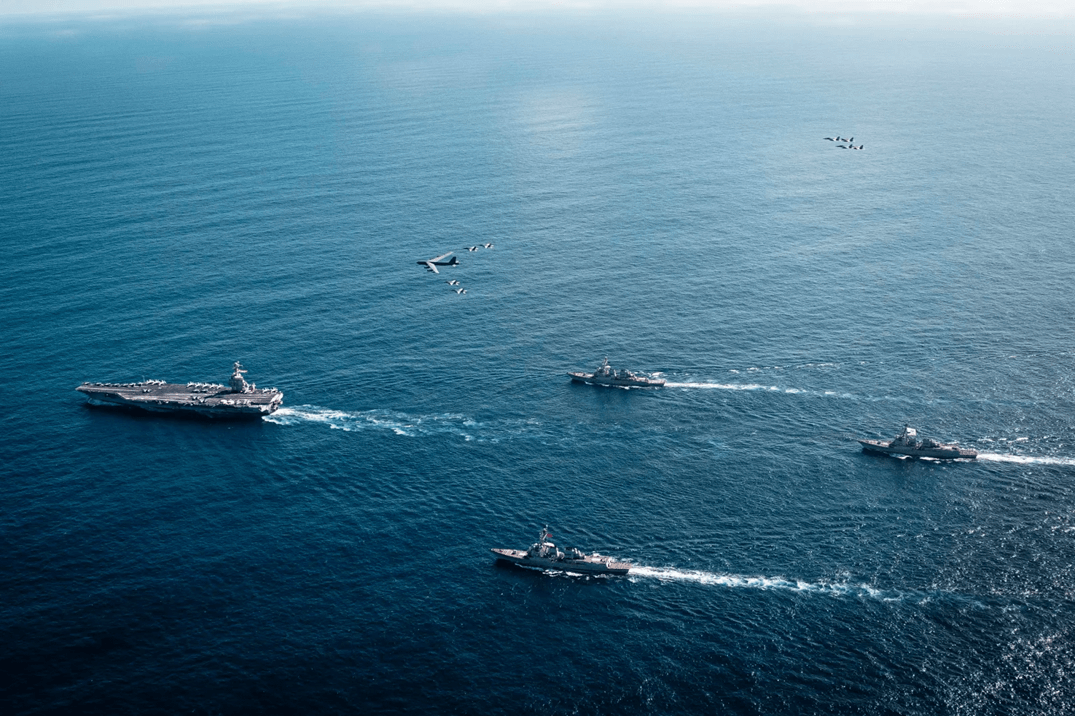
Positioned in a broad arc 50-100 miles offshore are roughly 12 U.S. warships capable of enforcing a maritime interdiction. At the core is the USS Gerald R. Ford carrier strike group, operating in the central Caribbean after a recent port call in the U.S. Virgin Islands.
Supporting vessels include the guided missile destroyers USS Winston S. Churchill, USS Bainbridge, USS Mahan, cruisers USS Lake Erie and USS Gettysburg, and amphibious ships USS Iwo Jima, USS San Antonio and USS Fort Lauderdale. The MV Ocean Trader adds surveillance and expeditionary capacity.
Complementing the sea presence, an estimated 30 to 50 U.S. aircraft are operating in the region. These include F 35A fighters and EA 18G Growlers providing strike and electronic warfare capability, P 8A Poseidons and MQ 4C Triton drones conducting maritime surveillance, C 17 Globemaster III transports, six KC 135 and KC 46A Pegasus tankers sustaining operations, and HH 60W and HC 130J aircraft for combat search-and-rescue. AC 130J Ghostrider gunships offer precision strike support, while an AN/TPS 80 radar in Trinidad and Tobago expands regional detection coverage.
The U.S. seizure of the oil tanker Skipper off the Venezuelan coast earlier this month highlights how the blockade could be enforced: the vessel was taken under authority of a federal warrant and detained pending legal proceedings, halting the movement of its cargo of crude.
What People Are Saying
President Donald Trump: “Venezuela is completely surrounded by the largest Armada ever assembled in the History of South America. It will only get bigger, and the shock to them will be like nothing they have ever seen before — Until such time as they return to the United States of America all of the Oil, Land, and other Assets that they previously stole from us.”
Venezuelan Vice President Delcy Rodríguez: “The blockade is a violation of international law and an attempt to seize Venezuela’s natural resources.”
What Happens Next
U.S. forces are likely to maintain high readiness, rotating ships and aircraft as needed while the diplomatic fallout mounts. Venezuela has condemned the blockade and vowed a legal challenge, even as oil prices tick upward on forecasts of disrupted supply. Regional governments and international organizations are watching closely as the situation evolves.
Featured image: The U.S. Navy’s “Gerald R. Ford” Carrier Strike Group operates as a joint, multi-domain force with a U.S. Air Force B-52 Stratofortress and other aircraft, November 13, 2025
Source: Newsweek, 17 December 2025… by Amir Daftari
 Station HYPO
Leave a comment