
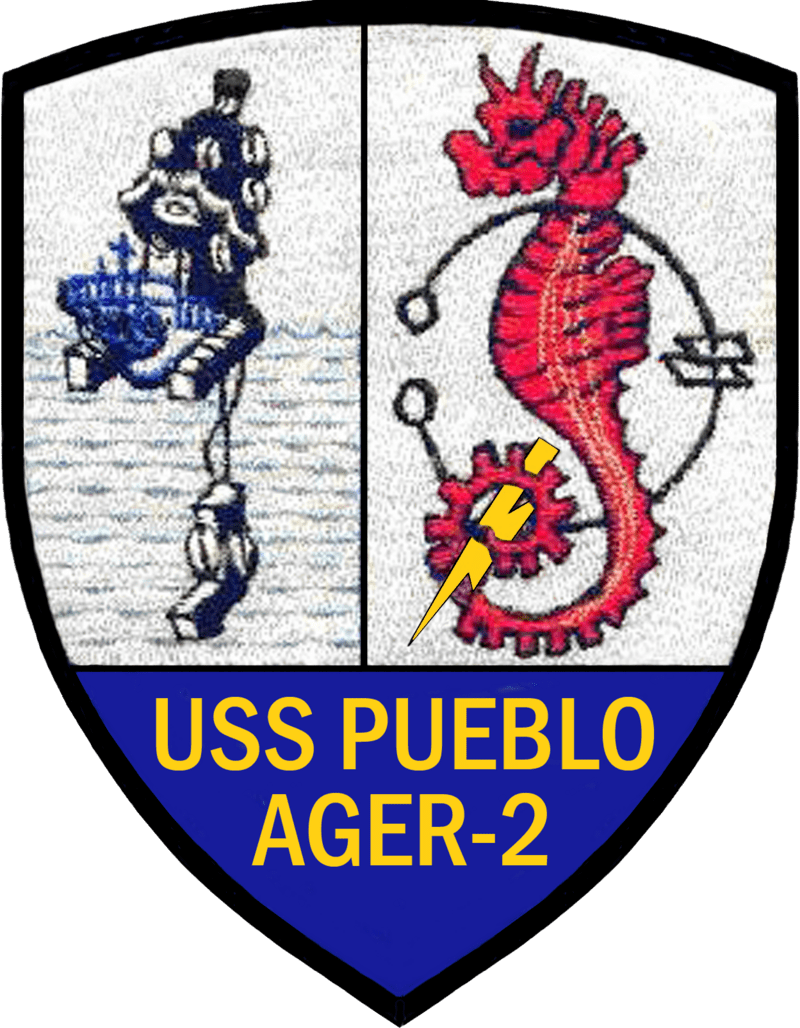
Tomorrow begins an 19-part series examining that human dimension: the courage, endurance, and suffering of the Pueblo’s crew, who endured the consequences of one of America’s most devastating intelligence failures. Their story is not only about loss, but also about survival, loyalty, and the enduring strength of the human spirit under extreme brutality.
On January 23, 1968, the U.S. Navy intelligence ship USS Pueblo (AGER-2) was seized by North Korean naval forces in international waters off Wonsan. The incident triggered one of the most severe intelligence breaches in American history and pushed the Korean Peninsula—and the world—dangerously close to a second Korean War and possibly World War III. While much has been written about the geopolitical fallout, the human story is often overlooked—the suffering, endurance, and resilience of Pueblo’s crew, who spent 11 brutal months as prisoners of war.
Commanded by Commander Lloyd M. “Pete” Bucher, the Pueblo was outwardly a lightly armed environmental research vessel but was in fact conducting signals intelligence (SIGINT) for the U.S. Navy and the National Security Agency. When North Korean patrol boats closed in, Bucher attempted to evade them, but the ship—outgunned and unable to fight back—was forced to surrender after one sailor was killed and several were wounded.
The intelligence compromise was immense. The Pueblo carried highly classified cryptographic materials, communication codes, and SIGINT equipment crucial to U.S. operations during the Cold War. North Korea quickly handed much of this material to the Soviet Union, severely undermining U.S. code security for years. The United States was forced to overhaul cryptographic systems worldwide at enormous cost, leaving intelligence networks vulnerable during a critical phase of the Cold War.
Behind this strategic disaster was a harrowing human ordeal. The 82 surviving crew members were taken to Pyongyang, where they endured nearly a year of physical abuse, psychological torture, and starvation. They faced relentless interrogations, beatings, and propaganda sessions designed to force false confessions. Many suffered broken bones, internal injuries, and lasting trauma. Yet the crew found ways to resist—most famously by giving the “Hawaiian good-luck sign” (an obscene gesture) in propaganda photos and claiming it was a Hawaiian peace symbol. When their captors discovered the ruse, the punishment was brutal.
The crisis escalated global tensions. With the Vietnam War already straining U.S. resources, President Lyndon B. Johnson faced intense pressure to respond militarily. Strike options against North Korea were actively considered, and U.S. forces in the Pacific were placed on high alert. The risk of a wider conflict—potentially involving China and the Soviet Union—was real. Ultimately, diplomacy through the Neutral Nations Supervisory Commission and Swedish intermediaries secured the crew’s release on December 23, 1968, exactly 11 months after their capture.
Crossing the Bridge of No Return at Panmunjom, the crew returned to a divided and war-weary nation. Their homecoming was bittersweet—marked by relief, but also by the trauma of captivity and a deep sense that their government had failed to protect them.


4 December 2025 at 11:03
I attended CTR “A” school at NSGA Skaggs Island, CA in 1966. One of my roommates was Ralph McClintock. He was a ham radio licensee so he was well-experienced in Morse Code. His training was accelerated and he graduated way ahead of the rest of our class. He received orders to the USS Pueblo. The following year while I was a COMSEC section supervisor on Guam, I read a message about the capture of the Pueblo and her crew. I was thankful that I was a dummy and learned code the hard way.
LikeLike
4 December 2025 at 12:55
I was on duty at Misawa AFB Japan with the Navsecgru detachment when that occurred. Worked 48 hours straight afterwards, I was a CTR3 back then
LikeLike
4 December 2025 at 22:36
I was sitting the WESTPAC side of the DF shack on Midway Island when Kami interupted the GU flash circuit directing all stations to a steady carrier on a specific freq. This action was highly unusual. Kami told everyone to give their best bearing possible. I stayed on that posit until the carrier ceased. We found out much later it was the USS PUEBLO.
LikeLike
9 December 2025 at 06:01
I was about half-way through my CTT (A school) in Pensacola, FL when the Pueblo was pirated seized. It was a shock to all of us with the hopes that LBJ would actually do something about it. Much to our disappointment, that never happened. After A school graduation, I was stationed in Adak for a year – and loved it.
LikeLike
11 December 2025 at 15:11
I was a Canadian Sailor at the Naval communications centre (NSS) in Maryland on that January morning at time of the incident.
LikeLike