
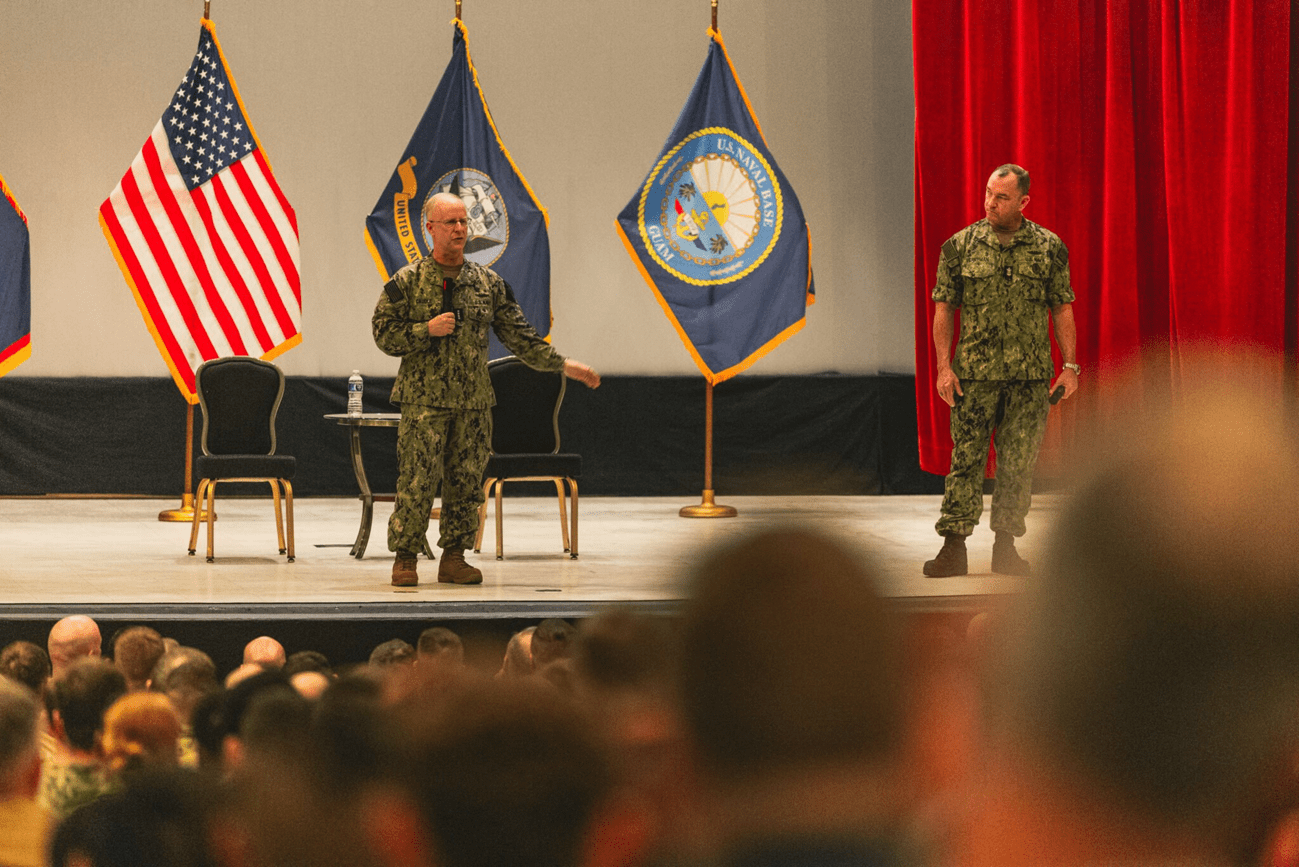
Chief of Naval Operations Adm. Daryl Caudle called on the U.S. Navy to heighten its readiness capabilities and be able to fully surge and respond at any moment during an all hands call to Guam-based personnel last week.
“You have to be ready, day one. Now you hear a lot about 2027 – I want you ready like in 27 minutes from now,” Caudle said while speaking to sailors Wednesday in Guam.
Caudle’s speech referred to a notional 2027 targeted timeline for the Navy to be ready for a potential protracted Pacific conflict. The fleet-wide guidance was debuted in 2024 by then-CNO Adm. Lisa Franchetti, USNI News previously reported.
“There is no time to wait on this. So, as you’re onboard your ships, your installations, your air squadrons – whatever it might be – every single day, every ounce of energy needs to be in making sure that you’re ready to go into conflict,” Caudle said to the sailors.
Caudle’s Guam visit was part of a 10-day tour of the Indo-Pacific, which wrapped on Saturday. Caudle visited South Korea, Japan, Guam and Hawaii for his first overseas tour as the Navy’s top officer, using the trip to focus on sailor welfare and Navy readiness and to engage with military and civilian leaders.
During his tour, Caudle emphasized a need to adjust warfighting efforts to respond to peer competitors like Russia and China. While in Korea, the CNO noted that China now has more ships than the U.S. Navy and the disparity was increasing.
Caudle reflected on how the sea service would previously operate.
“I [would] park a bunch of ships off somebody’s coast, I [would] run and deliver an [air tasking operation] I [would] fly with impunity over the skies of somebody’s country and drop a bunch of precision-guided bombs. Finally, Marines or somebody comes marching in and kind of cleans up all night. That’s not how you fight big peer competitors like China or Russia. It doesn’t work that way,” Caudle said.
Being ready now, Caudle said, will require money, training, leadership, oversight, teamwork and taking care of navy personnel families – all of which are outlined in his vision for the U.S Navy he published in his first C-Note to the fleet.
The lines of effort include the battle ready sailor and a battle ready force, which includes sufficient repair parts, planned maintenance systems and ensuring navy ships leave the maintenance facility on schedule.
The third line is the future naval force, which focuses on how to integrate current, emerging and future technologies into the force.
“Our capital ships are not going anywhere, but how I enable those and synergize those and put those things on steroids will be amplified through the use of these other types of technologies. Put your thinking caps on – I need that to be an all-hands effort too as I think on what the future force looks like and how we invest to make that come into reality,” Caudle said to the sailors.
The last line is integration, not only as a Navy and with other navies globally, but with the joint U.S. forces. Bringing together all elements of the armed forces across the U.S. services and partner nations is the advantage against pacing threats like China.
“They’re bigger than us – but not with our joint force, not with our partners, not with how we synchronize our ability to bring our lethality to bear when we want to,” Caudle said.
Featured image: Chief of Naval Operations Adm. Daryl Caudle, left, and Master Chief Petty Officer of the Navy John Perryman, host an all-hands call with sailors at Naval Base Guam theater, Nov. 19, 2025. US Navy photo
Source: USNINews Dzirhan Mahadzir | November 24, 2025 2:00 PM
 Station HYPO
Leave a comment