
Every year on November 11, Americans pause to honor the men and women who have served in the United States Armed Forces. Known today as Veterans Day, this federal holiday carries a history rooted in both war and peace, born from the hope that the sacrifices of millions would one day secure a lasting global harmony.
The Origins: Armistice Day and the End of World War I
The story begins on November 11, 1918, when the guns of World War I finally fell silent. After four years of devastating conflict, the Allied Powers and Germany signed an armistice agreement—effectively ending the “war to end all wars.” The cease-fire went into effect at the 11th hour of the 11th day of the 11th month, a moment that quickly became a symbol of peace and remembrance.
In 1919, President Woodrow Wilson proclaimed November 11 as Armistice Day, a time to honor the heroism of those who served and to commemorate the hope for enduring peace. The day was first marked by parades, public gatherings, and a brief pause in business and school activities at 11 a.m.—the precise moment the armistice had taken effect.
Expanding the Meaning: From Armistice to Veterans Day
For nearly two decades, Armistice Day remained focused on World War I veterans. However, by the mid-20th century, America had endured two more major conflicts—World War II and the Korean War—and millions of new veterans had returned home.
In 1945, World War II veteran Raymond Weeks of Birmingham, Alabama, proposed expanding Armistice Day to celebrate all U.S. veterans, not just those who fought in World War I. His idea gained national support, and in 1954, President Dwight D. Eisenhower signed legislation officially changing the name from Armistice Day to Veterans Day. The change reflected the country’s desire to honor all who served, in wartime or peace, living or deceased.
A Brief Calendar Confusion
In 1968, Congress passed the Uniform Monday Holiday Act, which aimed to provide more three-day weekends for federal employees. The law moved the observance of Veterans Day to the fourth Monday in October. However, this change proved unpopular. Many Americans felt that November 11—so significant to history—should remain the date of observance.
Responding to public sentiment, President Gerald Ford signed a bill in 1975 restoring Veterans Day to November 11, effective in 1978. Since then, the nation has continued to observe it on that date, regardless of which day of the week it falls.
A Living Legacy
Veterans Day is more than a historical marker; it’s a reflection of America’s ongoing commitment to those who have worn the uniform. It serves as a reminder that freedom comes at a cost and that the nation owes a profound debt to those who serve to protect it.
From the trenches of World War I to the modern-day conflicts and peacekeeping missions around the globe, Veterans Day stands as a timeless tribute to courage, duty, and sacrifice—a day not just of remembrance, but of gratitude.


11 November 2025 at 08:44
“Thank you for your service” to all the readers of the HYPO Blog for their service to our incredible nation. And a very special thank you to Mario for his dedication in bringing to us, the readers, meaningful, endearing and historical articles.
LikeLike
11 November 2025 at 16:47
Always my pleasure! Cheers, Mario
LikeLike
11 November 2025 at 12:25
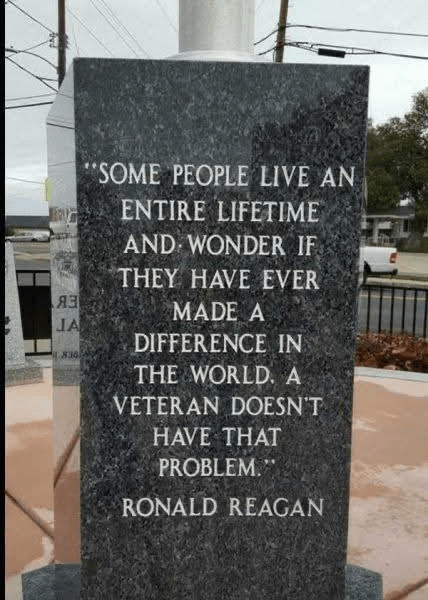
That Reagan quote doesn’t resonate with me. I did 20 and don’t feel that way at all.
LikeLike
11 November 2025 at 16:47
Dear Anonymous,
You might not feel like you made an impact, but I promise you did.
You gave twenty years of your life—twenty of your strongest, most valuable years—to serve this country and protect its people from threats both foreign and domestic. That’s not something ordinary people do. That’s something only a rare kind of person is willing to do.
To give you a sense of how uncommon your path is: as of early 2025, only about 1.32 million Americans serve on active duty. That’s less than one-half of one percent of the entire U.S. population. Out of hundreds of millions of people, you were part of that small, dedicated group who raised their right hand and said, “I’ll go.”
Maybe you don’t see the impact day to day—but it’s there. It’s in the freedom others get to enjoy because you stood watch. It’s in the people who never had to know danger because you and others like you faced it first. It’s in the quiet sense of safety that most Americans take for granted, not realizing the sacrifice behind it.
You gave your time, your energy, and your heart to something far greater than yourself. And even if the world doesn’t always show it, that matters. You matter. Your service left a mark—on your shipmates, your unit, your community, and this country.
Never doubt that.
Sincerely,
Mario Vulcano
LikeLike