
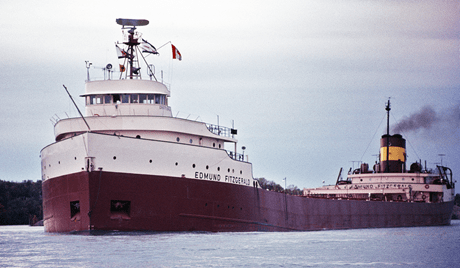
On November 9, 1975, the SS Edmund Fitzgerald departed Superior, Wisconsin, at 2:15 p.m. carrying 26,116 tons of taconite pellets bound for Detroit, Michigan. Commanded by Captain Ernest M. McSorley, the 729-foot freighter soon met the Arthur M. Anderson, captained by Jesse B. Cooper, as it left Two Harbors, Minnesota. With a fierce storm forecast to sweep across Lake Superior, both captains chose to travel north of the usual shipping lanes—a common precaution in rough weather.
By the morning of November 10, gale warnings had escalated to full storm warnings. As the two ships passed near Caribou Island, Captain Cooper observed that the Fitzgerald was sailing dangerously close to a shoal around 3:15 p.m. Over the next few hours, Captain McSorley reported significant damage—a down fence rail, lost vent covers, a list, and inoperative radar.
At 7:10 p.m., First Mate Morgan Clark of the Anderson radioed the Fitzgerald for a status update. McSorley’s final words were brief but steady: “We are holding our own.” Just minutes later, at 7:15 p.m., the ship vanished from radar amid a blinding snow squall. When repeated attempts to reach the vessel failed, the Coast Guard declared the Edmund Fitzgerald and its 29-man crew missing. Only scattered debris was later recovered.
Four days later, on November 14, 1975, a U.S. Navy aircraft detected a large object 530 feet below the lake’s surface, 17 miles from Whitefish Point. The wreck was confirmed, marking one of the most haunting maritime disasters in Great Lakes history.
Today, the 50th anniversary, an estimated 2,000 people are expected to gather at Split Rock Lighthouse on Minnesota’s North Shore to honor the 50th anniversary of the tragedy. Hosted by the Minnesota Historical Society, the ceremony will commemorate the 29 men who lost their lives that stormy night on Lake Superior.
For the past 40 years, Split Rock has marked each anniversary with a solemn reading of the crew’s names, accompanied by the tolling of a ship’s bell, followed by the lighting of the lighthouse beacon in their memory. This year’s event will uphold that tradition, with former site manager Lee Radzak—who started the memorial decades ago—sharing reflections on its origins and significance.

Current site manager Hayes Scriven says the event remains profoundly moving. “Listening to the names and the bell being rung, and then seeing the light come on—it’s very emotional,” he said. Scriven noted that ticket sales have already surpassed previous years, advising attendees to arrive early for the 4 p.m. ceremony. Free shuttles will operate from Silver Bay to accommodate the crowd.
Scriven believes the enduring fascination with the Fitzgerald stems from both Gordon Lightfoot’s haunting ballad, “The Wreck of the Edmund Fitzgerald,” and the lingering mystery surrounding the ship’s final moments. “We’re just trying to provide a place for memory and remembrance—and to really put into perspective the power of the lake,” he said.
As the lighthouse beacon once again pierces the November darkness, it will serve as a powerful reminder of the lives lost, the lake’s unyielding strength, and the legacy of the ship that “went down with all hands” fifty years ago.


 Station HYPO
Leave a comment