
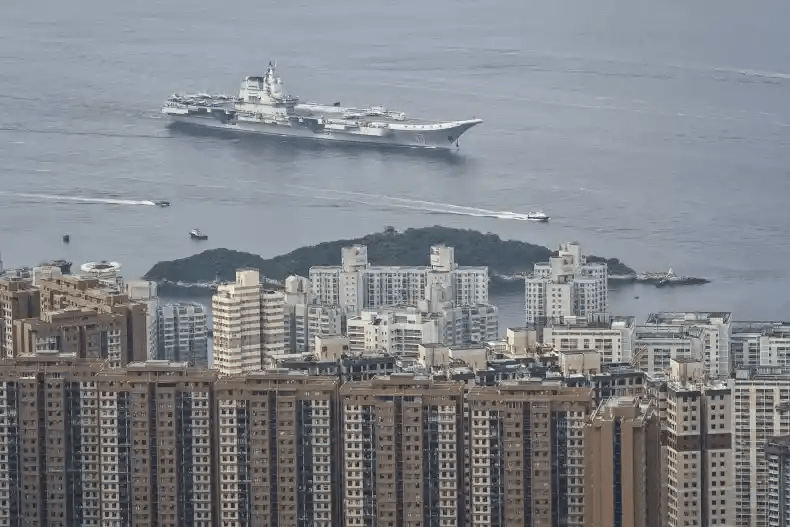
Chinese media reported that the number of fighter pilots recruited for the country’s aircraft-carrier fleet hit a record high this year, as part of the East Asian power’s rapid naval buildup.
Newsweek has reached out to the Chinese Defense Ministry for further comment via email.
Why It Matters
China operates the world’s largest navy by hull count, with over 370 ships and submarines in service, including two aircraft carriers. In June, both aircraft carriers were simultaneously deployed to the broader Western Pacific, demonstrating the country’s growing naval power.
While the United States continues to possess the world’s largest aircraft carrier fleet—with 11 operational vessels—the Chinese navy is set to commission its third and most-advanced aircraft carrier, with reported plans to build the nation’s first nuclear-powered aircraft carrier.
What To Know
China Central Television reported on Friday that the People’s Liberation Army Navy—the official name of the Chinese navy—has recently concluded its pilot recruitment for the year.
The intake includes high school graduates, students from naval aviation schools, and recent bachelor’s and master’s degree graduates from both military and civilian universities, the report said. It described the recruitment sources as “increasingly diverse and optimized.”
The report said that both the number of candidates meeting the standards for carrier-based fighter pilots and the proportion of qualified applicants have reached record levels.
While the report did not provide exact figures, it added that “tens of thousands of young students” across China had “enthusiastically” signed up for naval pilot recruitment, significantly expanding the recruitment and selection base compared to previous years.
Citing a military expert, Chinese state media Global Times said that the recruitment performance aligned with the development of the country’s carrier-based aircraft, referring to the increasing variety and number of planes designed to operate from aircraft carriers.
Last November, the Chinese military officially unveiled two carrier-based fighter jets—the J-15T and the J-15D. Unlike the original J-15 variant, the T model is capable of taking off from all three Chinese aircraft carriers, which use two different aircraft launching systems.
Meanwhile, the D variant of the J-15 family is designed to conduct electronic warfare missions, matching its U.S. counterpart—the EA-18G Growler electronic warfare aircraft.
The Chinese military is also developing a stealth carrier-based fighter aircraft as one of the variants of the J-35 family, alongside the J-35A, which is designed for the nation’s air force.

What People Are Saying
Chinese military affairs expert Fu Qianshao told the Global Times on Friday: “The fact that pilot recruitments have reached a new high shows that the intake is steadily increasing, which aligns with the development trend of China’s carrier-based aircraft.”
The Pentagon commented in its report on Chinese military power: “In 2023, the [People’s Liberation Army] transferred the majority of [People’s Liberation Army Navy] land-based fighter and bomber aircraft, air defense, and airfield units to the [People’s Liberation Army Air Force] to refocus [People’s Liberation Army Navy] efforts on developing a carrier-based aviation force.”
What Happens Next
Chinese pilots assigned to carrier-based aviation units will need to be capable of both flying aircraft and operating electronic warfare systems in the future, the Global Times reported—raising the bar for professional skills and expanding the demand for talent across disciplines.
Featured image: File photo: The Chinese aircraft carrier CNS “Shandong” sails into Hong Kong on July 3, 2025. Chan Long Hei/AP Photo
Source: Newsweek, 29 July 2025… by Ryan Chan
 Station HYPO
Leave a comment