
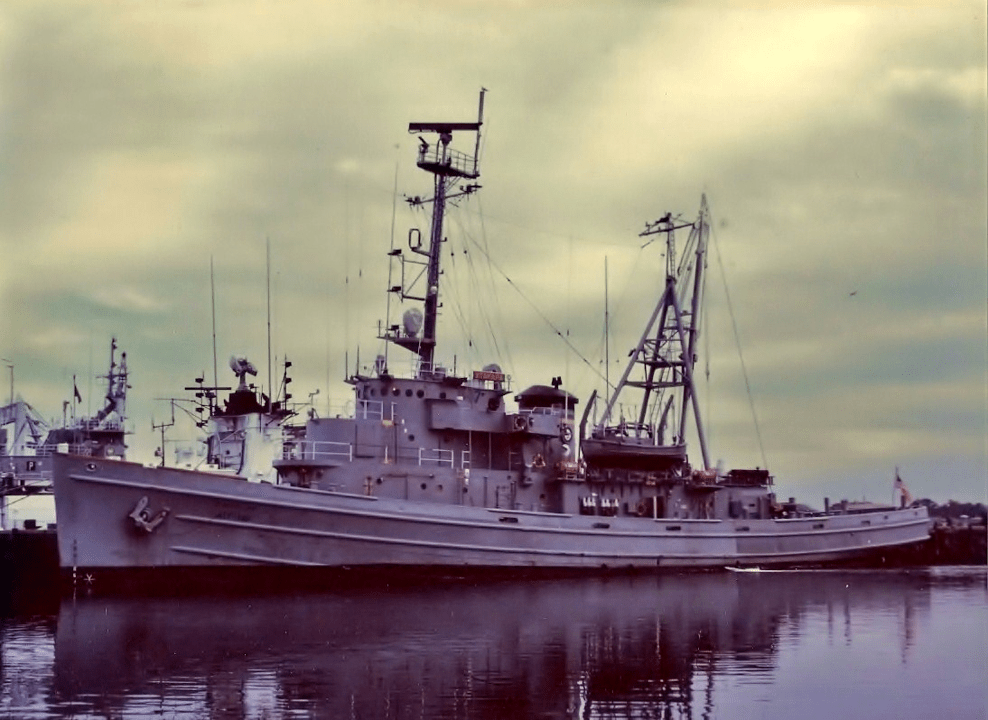
The Cold War was a contest not only of military might but of intelligence. While spy planes and satellites often steal the spotlight in histories of espionage, some of the most effective intelligence-gathering platforms were far less conspicuous. Among these unsung platforms was the USS Atakapa (ATF-149) — a fleet ocean tug that, for a brief but critical period, played a key role in Signals Intelligence (SIGINT) collection for the U.S. Navy. Though designed for towing and salvage, Atakapa’s quiet deployment into the world of covert surveillance reveals a hidden dimension of naval operations during the height of U.S.-Soviet tensions.
Commissioned in 1944 during World War II, the USS Atakapa was a member of the Abnaki-class of fleet ocean tugs. Built for durability and heavy towing tasks, these ships were equipped to recover vessels and aircraft and support amphibious operations. For the first two decades of her career, Atakapa served in this conventional role, operating in the Atlantic, Caribbean, and Gulf of Mexico in towing, salvage, and fleet support capacities.
But by the mid-1960s, the U.S. Navy began to repurpose even support vessels for intelligence missions, driven by the growing demand for real-time collection of Soviet naval activity. As part of this shift, the Atakapa received a temporary but significant reassignment.
The Covert Transformation: A Tug Turned Spy Ship
In June 1966, the Atakapa underwent a quiet but important retrofit. She was outfitted with signals intelligence (SIGINT) equipment—specialized gear used to intercept, record, and analyze enemy electronic emissions, including radar signals, communications, and telemetry. This marked the beginning of her short-lived but consequential role as a covert surveillance asset.
Unlike large, conspicuous AGTR “technical research” ships, the Atakapa’s outward appearance as a humble fleet tug allowed her to operate with minimal suspicion. Her small size and utilitarian profile made her ideal for close-in surveillance in constrained or politically sensitive areas.
Surveillance off the Norwegian Coast (1966)
The Atakapa’s most significant SIGINT mission took place between June 21 and September 14, 1966, when she was deployed off the coast of Norway to monitor a major Soviet naval exercise in the Norwegian and Barents Seas. During this Cold War flashpoint, Soviet submarine and surface activity had sharply increased, particularly as the USSR expanded its presence in the Arctic and Mediterranean.
Operating under radio silence and maintaining a discreet profile, Atakapa tracked two Soviet Zulu-class submarines, recording their movements and direction of travel. Her crew documented the subs’ course into the North Atlantic and toward the Mediterranean — a critical piece of intelligence that confirmed the Soviet Navy’s extended range and operational ambitions.
Most remarkably, Atakapa’s surveillance efforts provided intelligence that no other U.S. platform collected at the time. This validated the Navy’s experiment with using small ships like the Atakapa as nimble, low-profile SIGINT collectors.
Following the success of the Norwegian mission, she transited to the Baltic Sea, gathering additional SIGINT data. However, intelligence collected in that phase was largely redundant, as it overlapped with collection already being done by other U.S. and allied assets in the region. Nevertheless, her presence served an important diplomatic purpose, signaling U.S. interest in monitoring Soviet activities even in tightly controlled waters.
Mediterranean Operations and Post-Liberty Adjustments (1967–1968)
In 1967, following the infamous USS Liberty incident—when an American SIGINT ship was attacked during the Six-Day War—Navy policy regarding unarmed intelligence platforms shifted dramatically. Recognizing the vulnerabilities of these “white-hull” ships, the Navy began to arm select collection platforms for self-defense.
Between June and October 1967, and again in 1968, the Atakapa was deployed in the Mediterranean Sea under the direction of the U.S. Sixth Fleet. While details of these missions remain sparse, it is confirmed that she conducted electronic surveillance operations during this time, now equipped with .50 caliber machine guns for force protection — a direct response to the Liberty tragedy.
These missions extended Atakapa’s intelligence role, giving the Navy flexible surveillance options in volatile geopolitical theaters where larger spy ships would draw too much attention or provoke diplomatic backlash.
End of an Intelligence Career
By 1969 or 1970, Atakapa’s role as an intelligence platform came to an end. As Cold War intelligence collection evolved with the development of specialized AGI (Auxiliary General Intelligence) ships and satellite systems, the need for small, converted support vessels diminished. According to former crew accounts, the Atakapa’s SIGINT gear was removed, and she returned to her traditional duties of towing and salvage. Some equipment from her spy missions reportedly remained onboard into the early 1970s but was no longer in use.
Legacy and Final Years
Atakapa continued her conventional Navy service until 1992, when she was decommissioned after nearly five decades of duty. Though her Cold War intelligence missions spanned just a few years, they contributed to the broader American effort to understand and contain Soviet naval power. Her successful 1966 operation off Norway stands out as a moment when an unassuming tugboat outperformed expectations — gathering signals intelligence that would shape U.S. Navy awareness of Soviet submarine movements for years to come.
The USS Atakapa (ATF-149) is a reminder that not all Cold War heroes carried missiles or sonar arrays. Some were quiet observers, listening in the shadows and silently reshaping the strategic picture. For a brief time, Atakapa joined the silent service not beneath the waves, but on the surface — doing the work of intelligence under the cover of towing cables and salvage hooks. Her story is an essential, if often overlooked, chapter in the history of naval espionage.
 Station HYPO
26 July 2025 at 09:58
I was stationed at CinCLantFlt as a CTO. I irritated my Chief so bad he threatened to get me sent to the Atakapa. I got my act together real fast.
LikeLike