
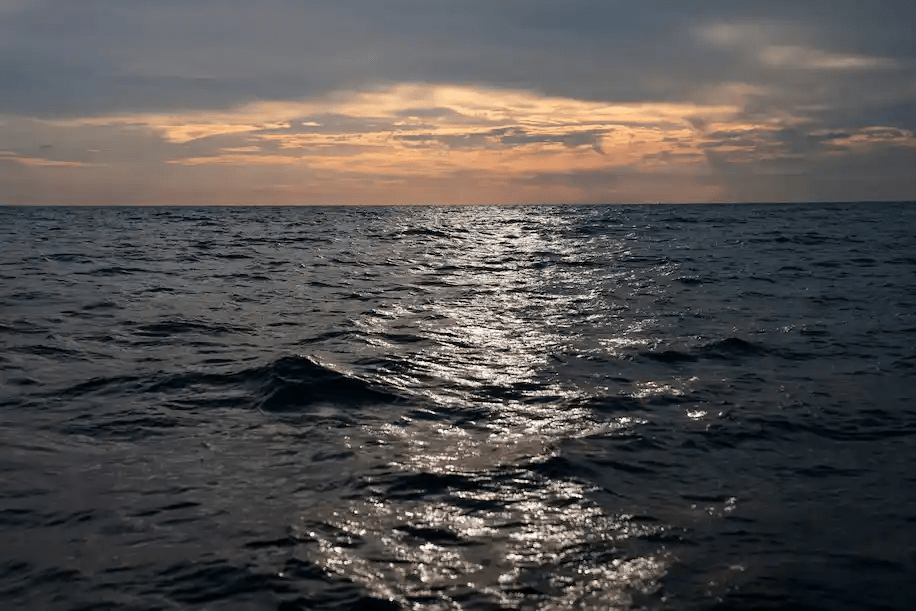
The U.S. still has an advantage on the waves, but ocean science needs more — not less — investment.
There is a wall display in the Port Office overlooking the Woods Hole Oceanographic Institution’s dock on the southern tip of Cape Cod. Old and yellowing, it quietly speaks volumes after more than 90 years.
The display shows wavy lines traced on mimeograph paper above handwritten notes from a crewman aboard the USS Guitarro. It was sent to the institution after one of the submarine’s World War II deployments. “The ENG. officer is happy to be able to forward this card because it means we were able to ‘walk away’ from this one,” the note reads.
Those fading lines map changes in temperature with depth — data recorded by a bathythermograph, or BT, an instrument built at Woods Hole by Allyn Vine. Developed in the 1930s to study how sound travels through seawater, the BT found new and urgent purpose during wartime. It became a hidden advantage for U.S. naval forces, one of many provided by ocean science, that enabled surface ships to detect submarines more precisely and helped submariners such as those aboard the Guitarro escape by diving beneath sharp thermoclines —sudden changes in temperature at depth — that could bend or block sonar.
Another defining moment for ocean science came in June 1944. In the final hours before the D-Day invasion, a small team of oceanographers and meteorologists that included Walter Munk, a legendary scientist at Scripps Institution of Oceanography, advised Allied commanders to postpone the landing for 24 hours. Their analysis of wave behavior, wind patterns and tides in the English Channel predicted a brief window of favorable conditions that allowed thousands of troops to land on the beaches of Normandy in one of the most consequential operations in modern history. Had the invasion occurred just one day earlier, conditions probably would have doomed it to failure.
Neither the BT nor marine forecasting began as military technologies. They were products of ocean science — which is aimed at understanding, not fighting. But in both cases, that understanding helped win a war and usher in an era of unprecedented prosperity.
Today, we face a new era of strategic uncertainty and increasingly complex operational challenges, both above and below the waves. But the lesson remains: National security depends on our ability to observe, understand and anticipate the ocean environment — an ability that will be severely hampered if the Trump administration succeeds in reducing or eliminating key programs and offices spread across the federal government in next year’s budget.
Modern naval operations also rely on real-time, high-resolution environmental data. Knowing how sound propagates, where currents flow, or how ice forms and moves can determine success or failure, especially in environments such as the Arctic, where rapid warming is transforming the strategic landscape.
For now, the United States enjoys a distinct advantage in undersea technologies and maritime operations. No other nation operates on, above or beneath the ocean with greater reach, capability or experience. Our integrated fleet of submarines, research vessels, sensors and unmanned systems is unmatched. But that advantage is shrinking.
Other nations are investing aggressively in marine research, infrastructure and technology. China in particular is deploying autonomous platforms and fielding new research vessels and icebreakers at a pace the United States has not matched. These investments are not just scientific — they are strategic and will shape the balance of power on the world’s oceans for decades to come.
Despite this, federal investment in ocean science remains disproportionately small. In recent years, it has accounted for less than 0.2 percent of federal discretionary spending, and current proposed cuts would reduce that even further. Those cuts include a 42 percent reduction in Office of Naval Research support for basic academic-sponsored research, a 64 percent cut to the National Science Foundation’s ocean sciences division, and elimination of the National Oceanic and Atmospheric Administration’s Office of Oceanic and Atmospheric Research. If they are implemented, we risk falling behind in a race we cannot afford to lose.
The United States is, and has always been, a maritime nation. From the earliest days of commerce and exploration, our security, economy and identity have been tied to the sea. Today, more than 90 percent of global trade travels by ship, and more than 95 percent of international data flows through seafloor fiber-optic cables. Our way of life depends on secure, reliable access to the maritime domain — above and below the surface.
But to lead at sea, we must understand the sea.
Our leadership depends on a renewed national commitment to ocean science, which means treating ocean observation systems as critical infrastructure. It means fully funding agencies such as the Office of Naval Research, the NSF and NOAA. It means expanding observing networks, investing in autonomous systems, modernizing the academic research fleet, and ensuring that both scientific and military operators have access to the most advanced tools to explore and understand the ocean.
Institutions such as Woods Hole, Scripps and many others have long provided the backbone of U.S. ocean leadership.
When Woods Hole researchers developed the BT, they sought knowledge, not weapons. When Walter Munk and Allied scientists forecast maritime conditions for D-Day, they sought precision, not battle. But in both cases, their work changed the course of history.
Today, we must carry that mindset forward. Investing in ocean science is not just about curiosity — it is about ensuring our future readiness, resilience and national security.
Source: Washington Post, 21 July 2025… by Peter de Menocal, Margaret Leinen, and John Richardson
 Station HYPO
22 July 2025 at 14:20
Whereas the intention to increase our Ice-breaker fleet shows signs of interest in those areas of the ocean most prone to ice…and the vast ignorance of what lies beneath…it’ll be decades before they’re all built and relevant. Using ’em as test beds for what’s presently being needed, most likely, will be too late so we’re reduced to the three agencies listed. I see NO future in the Office of Naval Research, the NSF and NOAA. Like blood vessels of an elderly man, they’re sclerotic and blocked by yrs. of bureaucracy…no longer elastic and able to “do the research” needed for our Navy’s mission, but bogged down in political dogma.
The “next war” on and under the seas will be AI driven and controlled. None of the above agencies are flexible enough to be relevant…so “research” is stymied by clinging to “the science” of what’s been “deemed appropriate” by “consensus.” Look…that’s not how true “science” is done, but, I’m sure…anyone offering any non-traditional ideas, have long since found other fields of interest and job opportunities. You don’t “get the grants” bucking the system. In effect, all of the above, have been “given an agenda” and told to “prove it” or forget about it.
Frankly speaking…if the word came to take the “best of what you’ve got” and scuttle the rest…it’d be a sad, short list. Most irrelevant and moreso when the next war (there ALWAYS will be a “next” one) breaks out and we find out, just like the Russians in the Black Sea, that “bringin’ what you’ve got” is the “last war’s” solutions. We seem either unable or incapable of learning from the “Art of War” written on bamboo sticks centuries ago…
LikeLike