

Morris “Moe” Berg was an American professional baseball player, scholar, and spy. Although he played 15 seasons in Major League Baseball (MLB) as a catcher for teams including the Chicago White Sox, Cleveland Indians, and Boston Red Sox, Berg was better known for his intellect and later, his work with the Office of Strategic Services (OSS) during World War II. Fluent in multiple languages and educated at Princeton and Columbia, Berg became a unique figure in American history: a man who excelled in sports, academics, and espionage.
Early Life and Education
Morris Berg was born on March 2, 1902, in New York City to Jewish immigrant parents from Ukraine. His family later moved to Newark, New Jersey, where Berg was raised. His father, Bernard Berg, was a pharmacist who ran his own drugstore and encouraged educational advancement, although he reportedly disapproved of Morris’s passion for baseball.
Berg graduated from Newark’s Barringer High School in 1918 and was accepted into Princeton University, where he majored in modern languages. He excelled academically and graduated magna cum laude in 1923. He was known for his intellect and reportedly could speak a dozen languages with varying degrees of fluency, including Latin, Greek, French, Spanish, Italian, German, Sanskrit, and Japanese.
After Princeton, he attended Columbia Law School, earning his law degree in 1930 while continuing to play professional baseball. He also studied at the Sorbonne in Paris and in Heidelberg, Germany.
Baseball Career
Moe Berg’s baseball career began in 1923 when he signed with the Brooklyn Robins (later the Dodgers). Over the next 15 years, he played as a backup catcher for several teams, including the Chicago White Sox, Cleveland Indians, Washington Senators, and Boston Red Sox.
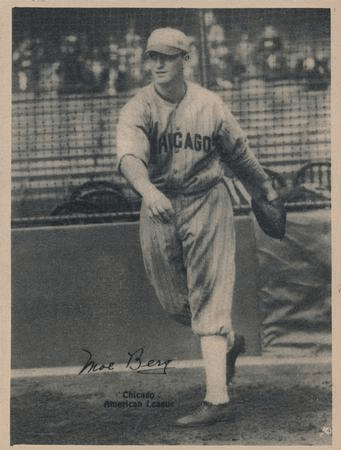
Though his batting average was unremarkable (.243 lifetime), Berg was considered a skilled defensive catcher and a master of the intellectual side of the game. Teammates and sportswriters often referred to him as “the brainiest man in baseball.” His knowledge of the game and multiple languages made him a favorite in the clubhouse and among journalists.
Notably, Berg was selected to participate in a 1934 American All-Star baseball tour of Japan, which featured players like Babe Ruth and Lou Gehrig. While there, Berg conducted clandestine filming of Tokyo and its harbor from the roof of a hospital under the pretense of visiting a sick Japanese diplomat. The footage he captured would later prove useful to U.S. military planners during World War II.
Espionage Career
Office of Strategic Services (OSS)
During World War II, Berg was recruited into the Office of Strategic Services (OSS)—the precursor to the CIA—because of his language skills, international travel experience, and intellect. His work primarily involved intelligence gathering in Europe.

Among his most notable wartime assignments was a mission to assess the progress of the German atomic bomb project. In December 1944, Berg traveled to Switzerland to attend a lecture by Werner Heisenberg, the German physicist and Nobel laureate. Berg’s task was to determine whether the Nazis were close to developing a nuclear weapon. He carried a pistol and was instructed to assassinate Heisenberg if the scientist revealed they were making significant progress. After attending the lecture and analyzing Heisenberg’s comments, Berg concluded that Germany was not close to building the bomb and chose not to carry out the assassination.
He also helped debrief European physicists who had fled Nazi-occupied territories and assisted with Operation Alsos, a mission aimed at capturing German scientific personnel and preventing them from falling into Soviet hands.
Later Life
After the war, Berg declined several job offers, including one from the CIA. He reportedly lived off a series of friends and admirers, never settling into a permanent career. Despite his fame, Berg lived a reclusive and somewhat nomadic life in his later years, moving between relatives’ homes and living in modest conditions.
He died on May 29, 1972, in Belleville, New Jersey. His final words were reportedly, “How did the Mets do today?”
Legacy
Moe Berg remains one of the most unusual and intriguing figures in American sports and intelligence history. His life has been the subject of numerous books, documentaries, and a 2018 biographical film titled The Catcher Was a Spy, starring Paul Rudd.
Honors
- Inducted into the National Jewish Sports Hall of Fame
- Commemorated by the U.S. intelligence community and baseball historians alike
In Popular Culture
Moe Berg is often cited as an example of the Renaissance man—an individual who crossed cultural boundaries and defied stereotypes. His life has inspired a niche but passionate interest among fans of baseball, intelligence history, and Jewish-American heritage.
 Station HYPO
20 June 2025 at 06:52
First I heard of all these aspects. A couple of them, yes, but not all. Magnificent! Dennis Green
LikeLike
20 June 2025 at 07:24
Facinating! I wonder how many stories about the Greatest Generation are yet to be told?
LikeLike
20 June 2025 at 09:15
One of the books about Moe Berg is “The Catcher Was A Spy” by Nicholas Dawidoff which has a copyright in1994. A truly fascinating story. A most interesting photograph has Casey Stengel, Moe Berg and General Groves sitting together around a table in the Yankee Stadium press room chatting. What are the odds? A very interesting book.
Kerry Sandstrom
LikeLike
2 July 2025 at 09:05
Hmmm. Baseball Hall of Fame weekend coming up! Might have to post this out in front of the Cooperstown Vets’ Club!
LikeLike
8 August 2025 at 16:06
i wrote a story on Moe Berg in my book Baseball From Providence To Prominence. Amazon.com.
LikeLike