
Proceedings, June 2025… by Rear Admiral Sean Bailey, Captain Brian Evans, and Commander Matthew Timmerman, U.S. Navy
After more than 24 hours of careful movement to evade detection, the strike group remains more than 18 hours from its designated position to launch strikes. The screen is distributed to the maximum extent feasible, optimizing sensor employment while attempting to complicate adversary targeting. The tactical situation (TACSIT) assessment from the information warfare commander (IWC) holds all units within ordered mission go/no-go criteria. Determining that adversary positioning and sensor capabilities provide a period of simplified maneuver and decreased detection risk, the strike group commander and information warfare commander retire for a couple hours of sleep before the operation’s next phase.
As the strike group continues its clandestine transit, conditions appear to confirm the decreased risk of detection. But then a chat report comes in: The protected satellite communication (SATCOM) voice circuits for the air and missile defense commander and the sea combat commander are down. Immediately, one of the forward screening destroyers reports SLQ-32 detection of an adversary airborne surface search radar. Seconds later, supplementary plot (SUPPLOT) reports indications and warnings of a missile launch. Based on adversary capabilities, the force may have only minutes to respond.
In the Tactical Flag Command Center, the battle watch captain and force tactical action officer assess the situation: Was the screening destroyer the only unit located, or is the entire force now at risk of being targeted? What are the detection ranges of adversary airborne radar versus the destroyer’s SLQ-32? Is the SATCOM disruption a casualty, interference, or jamming? Should we break emission control to defend the force? If so, what sensors should we energize? What’s the updated TACSIT assessment? Has anyone called the IWC?
An Imperative to Innovate
As the above scenario illustrates, to meet the complex threats posed by peer adversaries, strike group operations must ensure:
1) synchronization of information warfare missions,
2) continual integration of information warfare across warfare areas, and
3) development of tactically astute future information warfare commanders.
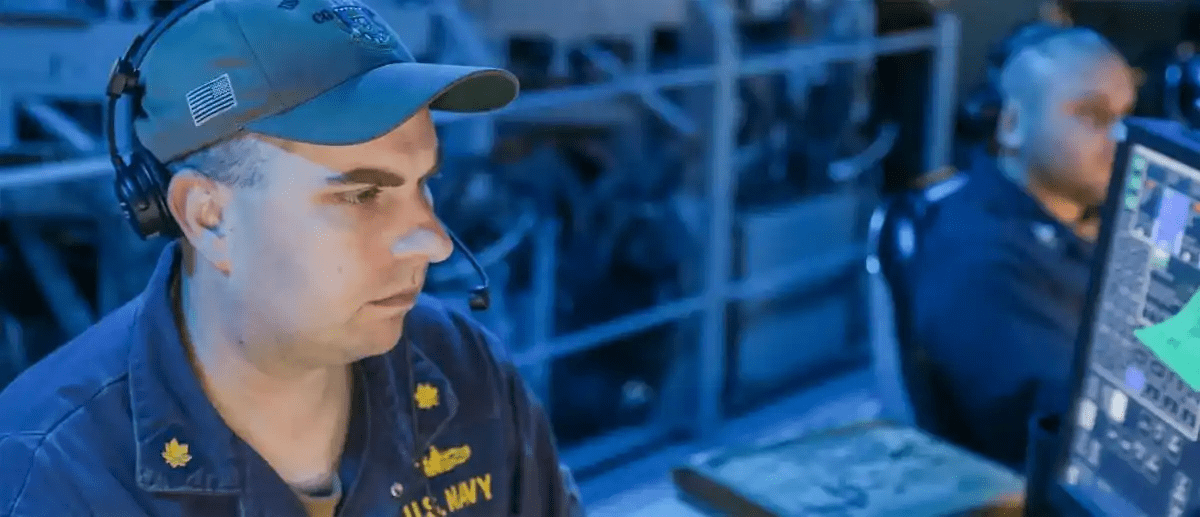
To address these requirements and preserve the independence of the information warfare commander SUPPLOT battlespace awareness watch (callsign INDIA) that supports all warfare commanders, Carrier Strike Group Eight (CSG-8) built out an information warfare command center (IWCC). The IWCC solidifies the traditional information warfare watch construct (call sign QUEBEC) by co-locating and organizationally aligning all the watches and functions subordinate to the information warfare commander. The concept of co-locating strike-group-level assured command and control (AC2) and integrated fires functions is not new. Naval Information Warfare Systems Command and Naval Air Forces seek to outfit carriers across the fleet with IWCCs. But this is not sufficient to fully synchronize the information warfare mission. CSG-8 assessed an IWCC would not achieve the necessary cross-warfare integration or officer tactical development without corresponding changes in information-warfare command and control.
CSG-8’s solution for enhancing information-warfare synchronization and establishing a conduit for cross-warfare integration was to introduce a trained, qualified, and empowered information warfare tactical action officer (IWTAO). Officers who qualify and serve in this role operate across the spectrum of information warfare missions. The knowledge, exposure, and experience they gain will aid them as future information warfare commanders. By implementing this tactical action officer, CSG-8 energized the upgraded QUEBEC module within the IWCC to enhance information warfare effectiveness, improve cross-warfare integration, and increase lethality.
IWTAO – Trained and Tested
Standing orders establish this tactical action officer as the information warfare commander’s direct representative to the strike group commander and other warfare commanders. Answering to the callsign QUEBEC, the IWTAO is the senior watchstander for execution of force-wide information warfare operations, actions, and activities. In this capacity, the officer oversees and directs tactical execution by the subordinate information warfare watch officer, force communications watch officer, and defensive cyberspace operations (DCO) watch officer, as well as various assistants to those positions.
To prepare information warfare tactical action officers to fulfill their tactical responsibilities, CSG-8 established a comprehensive and challenging qualification process. The IWTAO job qualification requirement captures critical competencies regarding electronic warfare (EW), AC2, space operations, DCO, TACSIT management, and counterintelligence, surveillance, reconnaissance and targeting (C-ISRT). Knowledge sections on broader strike group operations, such as air plans or surface screens, also were included to equip information warfare tactical action officers for cross-warfare commander communication and coordination.
In addition to knowledge requirements, candidates stand two under-instruction watches at each subordinate watchstation. They also stand five IWTAO under-instruction watches during which they must demonstrate proficiency with IWCC systems, information warfare directives and procedures, and information warfare tactics. Finally, following separate recommendations from CSG-8’s AC2 officer and integrated fires officer, an oral qualification board is conducted with the information warfare commander as the final qualifying authority.
Critically, CSG-8 established its training process for these tactical action officers before completing the advanced and integrated phases of the fleet readiness training plan. This enabled core IWTAO watchstanders—as well as milestone-screened information warfare lieutenant commanders on the CSG-8 staff and information operations direct support officers, to fully qualify prior to CSG-8’s composite unit training exercise (COMPTUEX) and deployment certification event. Following COMPTUEX, several information warfare officers from other warfare commander staffs and the flagship also qualified, supporting the IWTAO watch on a not-to-interfere basis with their primary duties.
IWTAO – Empowered to Execute
To achieve operational outcomes, the information warfare tactical action officer was empowered to act and vested with appropriate authorities as the direct representative of a warfare commander. Key to this empowerment are formal directives to ensure the officer possesses and understands the information warfare commander’s guidance, direction and delegated authorities:
- IWC standing orders enumerate the information warfare tactical action officer’s explicit duties and responsibilities; reporting requirements; and authorities, including for deviation from standing guidance.
- CSG-8 operational task messages establish the relationships and authorities among warfare commander watches and establish the information warfare tactical action officer within the QUEBEC module as the node for information warfare integration and synchronization.
- Daily intentions messages and night orders articulate tactical considerations and execution guidance for the information warfare tactical action officer in the conduct of information warfare missions, including integration with broader strike group operations.
- Pre-planned responses authorize in advance sets of actions conducted on behalf of the information warfare commander during tactical or casualty situations where timely response is critical to sustaining warfighting advantage.
CSG-8 iterated through multiple revisions of the directives listed above. Directives were thoroughly coordinated across warfare commanders to ensure shared understanding and alignment of the tactics, techniques, and procedures employed by the information warfare tactical action officer.
The ability to act decisively also requires an ability to seek clarification and confirm direction when needed, meaning the information warfare commander must be available and possess sufficient tactical awareness to provide direction. Availability is not generally a challenge, but building awareness required development of multiple status displays to form a common picture and a means to distribute it within the ship. Furthermore, it required novel technical solutions to enable the information warfare commander to monitor radio circuits in spaces not previously equipped to do so. These efforts ensure the commander can sustain, or quickly ascertain, the necessary tactical awareness to guide and direct the tactical action officer when decisive action is needed.
IWTAO: Cornerstone in Combat
Integrating the tactical action officer into the IWCC yielded immediate improvements in information warfare synchronization and readiness. With subordinate watchstanders focused on their functional areas, the information warfare tactical action officer can manage impacts, dependencies, and timing across functions, such as the synchronization of C-ISRT maneuver or DCO measures with actions to sustain AC2. In addition, the officer’s broader view improves tactical decision-making by more tightly integrating the outputs of other information warfare disciplines, such as intelligence on potential adversary courses of action or meteorological assessments of electromagnetic spectrum propagation.
An unanticipated advantage was improved management of information warfare system readiness. The tactical action officer provides a means for effectively managing maintenance activities and is also well-positioned to reach across the strike group and coordinate additional support for emergent casualties, including personnel transfers between units. In combat environments, the information warfare tactical action officer was essential to deconflicting maintenance activities between units or during casualties, ensuring that critical AC2 and electronic warfare systems remained postured to defend the force.
The information warfare tactical action officer serves as the linchpin of IW integration across warfare areas. The officer also is positioned to coordinate and synchronize actions with the tactical action officers of other warfare commanders. This enables more advanced IW tactics such as optimal sensor employment based on meteorology, dynamic signature control, C-ISRT maneuver and routing, and non-kinetic effects employment. Furthermore, the tactical action officers from various warfare commanders may work together to resolve AC2 concerns, manage signature control measures and TACSIT, and execute C-ISRT maneuvers.
The investment has also significantly matured the tactical expertise of the officers standing the watch. Through the qualification process and watch experience, information warfare tactical action officers gain significant knowledge and exposure to the breadth of information warfare missions, systems, and tactics. Officers now better understand the relationship between their specialty and others, enabling development of plans that better synchronize information warfare functions. Over the long term, IWTAO integration will not only enhance strike group operations but will help develop tactically astute officers to serve as future information warfare commanders.
Tactical gains resulting from IWTAO integration were documented by Commander, Carrier Strike Group Four during CSG-8’s COMPTUEX and validated in real-world operations in the Sixth Fleet and then Fifth Fleet areas of operation. Both while close to Russian Navy vessels, and under combat conditions in the Red Sea defending the force against Houthi threats, information warfare tactical action officers provided the commander with additional options, added decision time, and tactically sound recommendations for counter-targeting, EW employment, and force maneuver. These contributions demonstrate the value of IWTAOs across diverse mission sets, multiple geographic theaters, and under combat conditions.
An Imperative to Iterate
It is now up to the fleet to embrace the imperative to iterate. CSG-8 has offered an innovative solution that advances information warfare mission synchronization, enhances cross-warfare integration, and helps develop future information warfare commanders. It is not a fully mature concept, but CSG-8’s integration of an information warfare tactical action officer is an evolutionary leap in IW tactical execution. Fleet and type commanders should not let this progress slow.
Other strike groups must adopt and evolve the IWTAO concept. Type commanders also should pursue an IWTAO personal qualification standard, additional qualification designator, and appropriate promotion/selection board convening order language to support and encourage the evolution of the IWTAO construct. Continuing innovation enabled through strike group adoption, and refinement supported by type commander policy, will ensure the consistent presence of highly lethal information warfare tactical action officers across the fleet.
Sean Bailey: Rear Admiral Bailey is currently assigned as Commander, Carrier Strike Group Eight.
Brian Evans: Captain Evans is currently assigned as Information Warfare Commander, Carrier Strike Group Eight.
Matthew Timmerman: Commander Timmerman is currently assigned as the Carrier Strike Group Eight integrated fires officer.
Source U.S. Naval Institute
 Station HYPO
9 June 2025 at 13:01
Things have certainly come a long way since my SUPPLOT watch standing days in SUPPLOT and coordinating with the TFCC Watch Officers.
LikeLike
9 June 2025 at 17:04
YES!!!! Excellent article. My next question is: how do IWC Reservists fit in? Loads of talent and willing/able Sailors. I’ve got a handful who might be interested.
LikeLike
9 June 2025 at 21:32
I’d assume a move like this would come down to manning. These same personnel have traditionally been expected to fulfill other watch standing duties. The skillsets you mention here seem to lean strongly towards specific rates and designators that are not always readily available.
It’s great to see recent lessons learned from multiple CSGs being iterated on. Having more seniority representing the Quebec watch will lead to positive outcomes. Given the expectations coming down the pipeline for IW, maturation is required.
LikeLike
10 June 2025 at 20:12
Love this. When I was BWC in a CSG there was always a little bit of hesitation when taking reports from the Quebec watch (and honestly some of the CVN TAOs too). This is a great step in the right direction.
LikeLike