
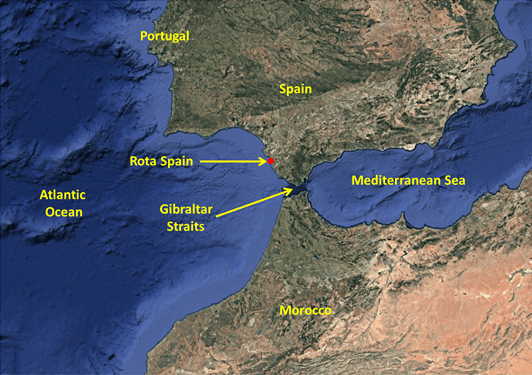
The Rota facility became fully operational on May 31, 1963 and was disestablished on June 6, 2005.
Most of Commanding Officers:
CDR J. L. Mayer Apr 62 – Jan 65
CAPT J. D. Oliver, Jr. Jan 65 – Jul 66
CAPT W. H. Kreamer Jul 66 – Sep 67
CAPT W. T. Hunt Sep 67 – Oct 69
CAPT R. W. Zimdars Oct 69 – Sep 71
CAPT A. W. Slifer Sep 71 – Jun 74
CAPT R. J. Forsyth Jun 74 – Jun 76
CAPT W. B. Peirce Jun 76 – Jul 78
CAPT T. F. Arnold Jul 78 – Aug 79
CAPT C. F. Noll Aug 79 – Aug 81
CAPT R. C. Wilgenbusch Aug 81 – Jul 84
CAPT W. F. H. Berthiaume Nov 92 – 94
CAPT J. D Price Sep 89 – Aug 93
CAPT K. E. Verbruggee 1994
Rota was a tenant command located within the boundaries of the 6,100-acre Spanish Base Naval de Rota, Spain’s largest naval installation. NAVSTA Rota was strategically positioned near the Straits of Gibraltar and at the halfway point between the U.S. and Southwest Asia. Due to this ideal location, the base provided invaluable support to both U.S. Sixth Fleet units in the Mediterranean and USAF Air Mobility Command units transiting to Germany and Southwest Asia. Under the guidance of the Agreement for Defense Cooperation, the U.S. and Spanish navies worked together and shared many facilities. The U.S. Navy had the responsibility for maintaining the station’s infrastructure, including a 670-acre airfield, three active piers, 426 facilities, and 806 family housing units. Rota remained under the Spanish flag and was commanded by a Spanish Vice Admiral. While the Spanish Navy was responsible for the external security of the base, both navies were charged with internal security. The U.S. Navy maintained approximately 5,200 acres of the 6,000-acre complex.
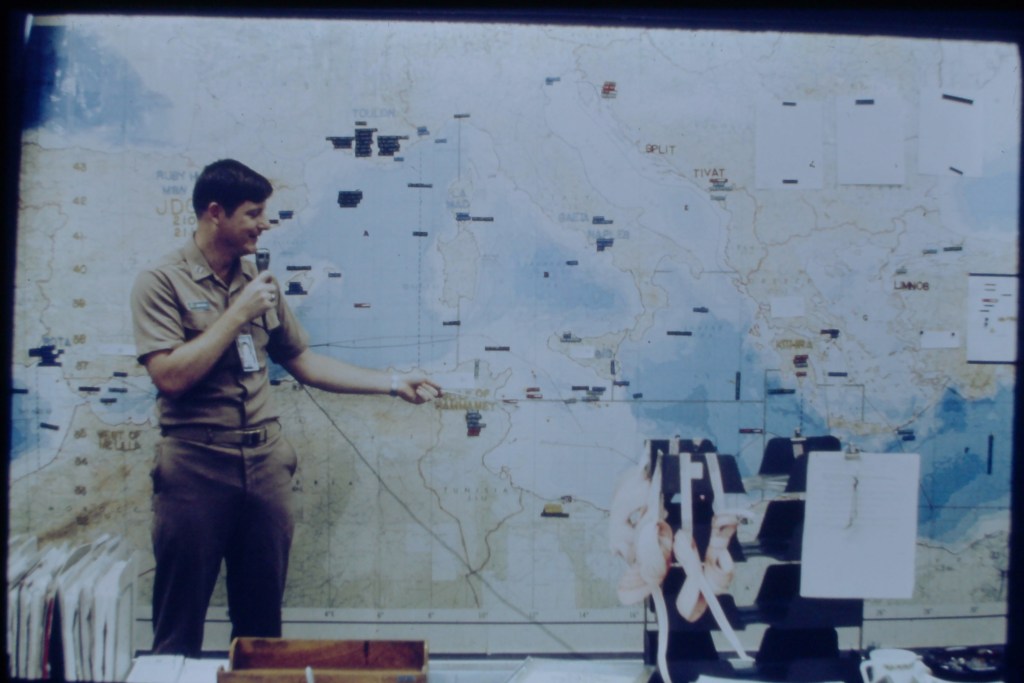
Naval Station Rota provided support for U.S. and NATO ships, facilitated the safe and efficient movement of U.S. Navy and U.S. Air Force flights and passengers, and supplied cargo, fuel, and ammunition to units in the region. The Naval Station was the only base in the Mediterranean capable of supporting Amphibious Readiness Group post-deployment wash-downs. The base port also offered secure, pier-side maintenance and backload facilities. Rota supported Amphibious Readiness Group turnovers and hosted sailors and marines from visiting afloat units. The base also provided quality-of-life support to Morón Air Base, ARG support sites at Palma de Majorca, NATO headquarters in Madrid, and the Military Sealift Command’s Maritime Prepositioning Squadron. Additionally, Rota supported NASA Space Shuttle missions and ongoing operations in the European theater of operations.
The mission of U.S. forces at Sigonella, Rota, and Souda Bay was to provide command control and logistics support to U.S. and NATO operating forces. These three facilities underwent a transformation from maritime patrol airfields to multi-role hubs, providing crucial air-links for USAF strategic airlift in support of CENTCOM and Africa area contingency operations.
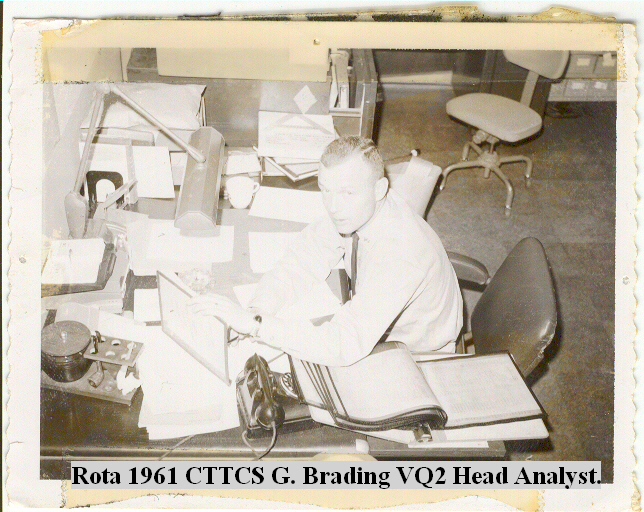
American facilities at Naval Station Rota, Spain, were wide-ranging and diversified in their primary role of supporting the U.S. Sixth Fleet operating in the Mediterranean. From its inception in the early 1950s, Rota Naval Base developed into one of the most modern, advanced naval installations in the world, a precept that guided its design. There were approximately 3,000 U.S. military members, 3,000 command-sponsored family members, 250 U.S. civilian workers, and 1,250 Spanish employees stationed there.
In September 1953, after almost two years of surveys, negotiations, and planning, the governments of the U.S. and Spain signed economic aid and defense agreements. Construction of the Naval Base at Rota had already begun under the technical supervision of the Navy’s Bureau of Yards and Docks.
Major Rota commands included the Naval Station; the Naval Computer and Telecommunication Area Master Station, Mediterranean Detachment (NCTAMS Med Det); the Naval Hospital; the 725th Air Mobility Squadron (725 AMS); the Naval European Meteorology and Oceanography Center (NEMOC); the Marine Corps Security Force Company Europe; the Naval Mobile Construction Battalion; and the Military Sealift Command, Europe Representative (MSCREP).
Rota was established in 1953, following the signing of an agreement for facilities use between the United States and the Kingdom of Spain. The agreement required two years of surveys, negotiations, and planning, which led to groundbreaking on the base in 1955. Rota Naval Base was constructed under the technical supervision of the Navy’s Bureau of Yards and Docks. Approximately 10,000 concrete tetrapods, resembling large jacks, were carefully placed to create a seawall that protected a large artificial harbor.
Construction of the Naval Communication Station, Spain, began in December 1961, and the facility became fully operational on May 31, 1963.
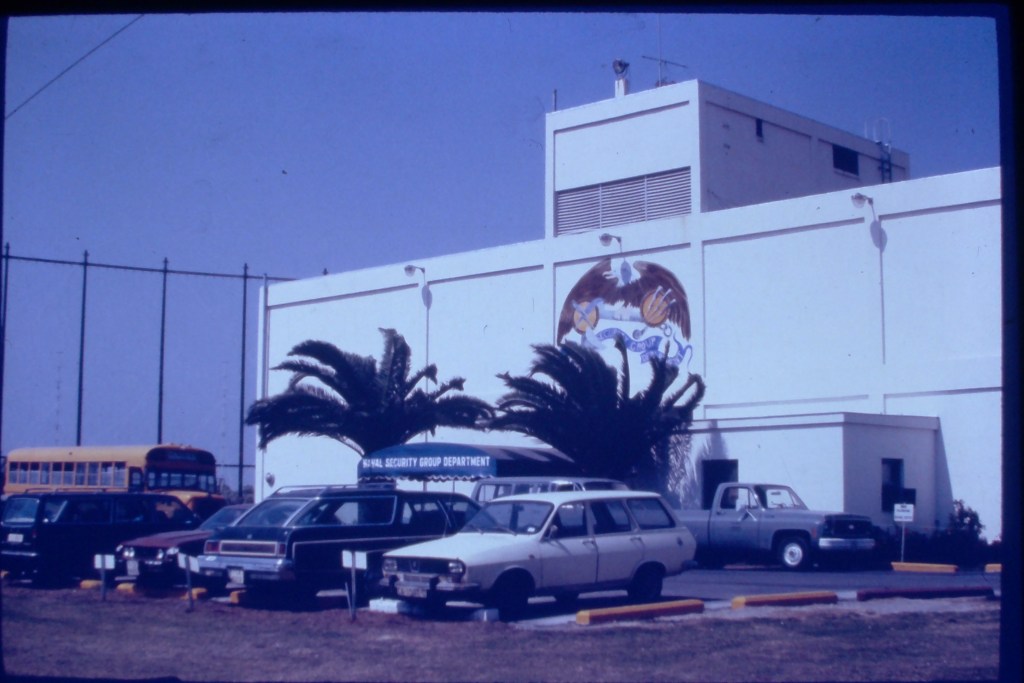
The establishment of the Naval Radio Station, Guadamar, Spain, in 1963 marked the growth of NAVCOMMSTA. The next expansion occurred in 1964 with the addition of the Naval Security Group Department. The Naval Radio Station (Transmitter Site) at Morón was added in December 1965.
The completion of the satellite communication installation in May 1983 significantly increased mission reliability.
The teamwork of 944 military and 78 civilian personnel achieved the daily command mission of providing reliable communication support to the Sixth Fleet’s area of operation.
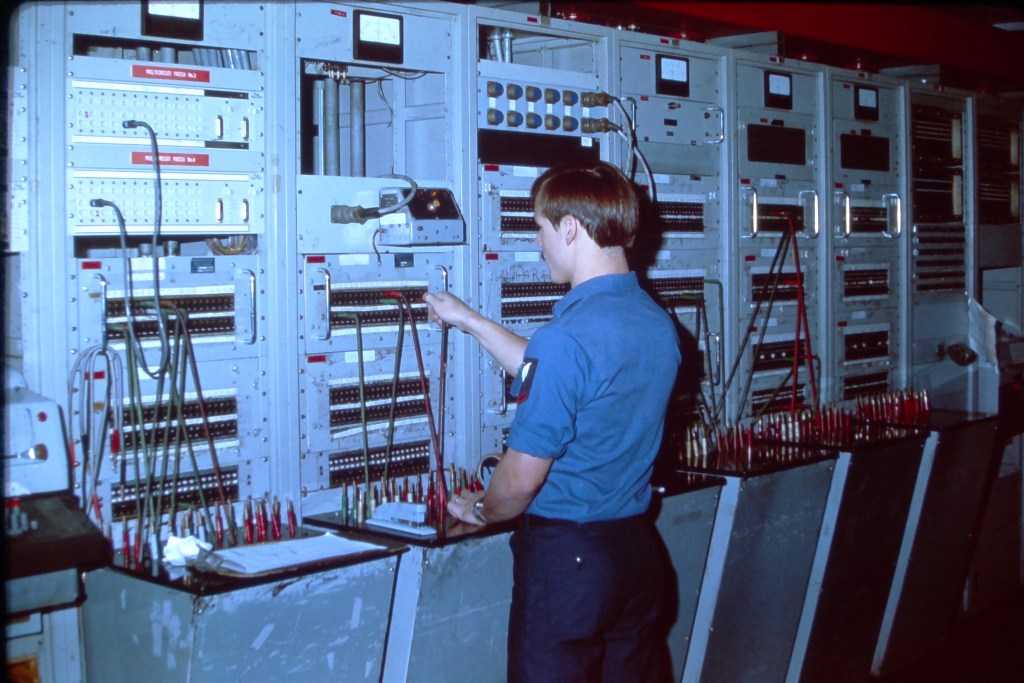
The U.S. Naval Security Group Activity Rota maintained and operated a high-frequency direction-finding (HFDF) facility and provided communication support to Navy and other Department of Defense elements. The communications facility located at Rota included an operations building situated in the center of an AN/FRD-10A Circularly Disposed Antenna Array.
Disestablishment of Rota Memo:


6 June 2025 at 11:21
Requested this duty staion 2Xs… got GTMO then Okinawa … both close, no?
LikeLike
6 June 2025 at 13:39
This article didn’t mention the squadron of US submarines that operated out of Rota. I was stationed in Rota aboard the USS Simon Lake AS33, we arrived in Dec 72 and relieved the USS Holland. I transferred in Jun 74. My daughter was born in the Naval Hospital. We lived in Chiponia. My next-door neighbor was a CT. As I remember there were quite a few retired USN folks that lived in the area. With the base gone did they leave too?
LikeLike
6 June 2025 at 15:14
Did you know that a sailor aboard the USS Holland wrote the song “Brandy” (you’re a fine girl) and used to sing it while playing his guitar in some of the bars in Rota. The song/melody were very different than what was later produced by “The Golden Earing”.. Supposedly the sailor sold his song plus others he had written for peanuts after he got discharged and went back to the states. This is hearsay as I have no direct first-hand knowledge of this. (CTR2 Rota HFDF and also lived in Chipiona, and went regularly to the beaches (of course), tapa hopping and the local Mohamed Discotecha located at the lighthouse).
LikeLike