
On May 18, 1992, NSGA Subic Bay, Zambales, Luzon, Republic of the Philippines closed. The details leading up to the closing follows.
Mount Pinatubo
On June 15, 1991, Mount Pinatubo, just 20 miles from Subic Bay, exploded with a force eight times greater than the Mount St. Helens eruption. It was the largest eruption in the past five decades and led to the largest recorded evacuation of people due to a volcanic threat. Day turned to night as volcanic ash blotted out the sun. Volcanic earthquakes and heavy rain, lightning and thunder from a typhoon passing over northern Luzon made Black Saturday a 36-hour nightmare. By Sunday morning, when the volcano’s fury subsided, Subic Bay, once one of the most beautiful and well-maintained Navy bases in the Pacific, lay buried under a foot of the rain-soaked, sandy ash. Buildings everywhere collapsed under the weight of the coarse gray ash. Two girls, one a nine-year-old American and the other a Filipino citizen, died when trapped under a falling roof at George Dewey High School. In the city of Olongapo, more than 60 volcano-related deaths were reported, including eight who were crushed when part of Olongapo General Hospital collapsed.
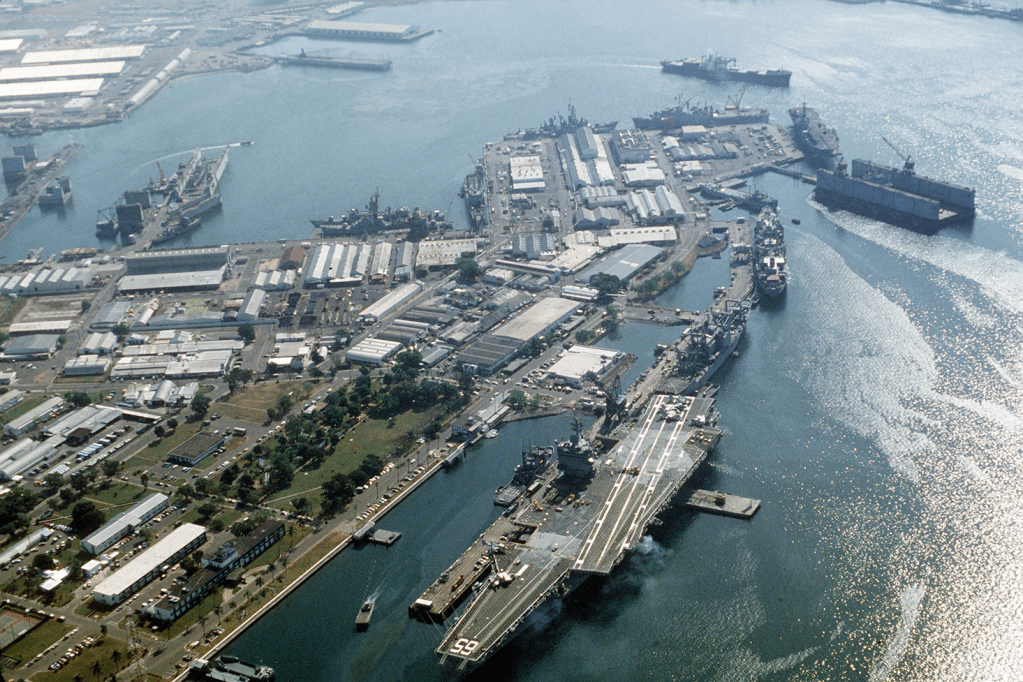
By Sunday night, the threat of continued eruptions combined with the lack of water and electricity, led to the decision to evacuate all dependents. U.S. warships and cargo planes began the emergency evacuation of thousands of Navy and Air Force dependents. Seven Navy ships sailed Monday, June 17, with 6,200 dependents. A total of 17 ships, including the aircraft carriers, USS Abraham Lincoln (CVN 72) and USS Midway (CV 41) evacuated all 20,000 dependents over the next few days. The evacuees were taken by ship to Mactan Air Base and then were airlifted by U.S. Air Force C-141 Starlifters to Andersen Air Force Base at Guam.
After the dependents were evacuated, an intense clean-up was initiated. All hands,
American service members and Filipino base employees, worked around the clock to restore essential services. Clark Air Base, much closer to Mount Pinatubo, was declared a total loss and plans for a complete closure were started. Within two weeks NAS Cubi Point was back in limited operation. Soon, most buildings had electricity and water restored. By mid-July service had been restored to most family housing units. The dependents began returning September 8, 1991 and by the end of the month almost all were back at Subic Bay from the United States.
On October 28, 1991, NSGA Clark AB was evacuated, relocated and merged with NSGD Subic Bay to form NSGA Subic Bay. Six months later on May 18, 1992, NSGA Subic Bay closed.
Negotiations
Many months before the expiration of the Military Bases Agreement of 1947 on September 16, 1991, intense negotiations between the governments of the U.S. and the Philippines began. These negotiations resulted in the Treaty of Friendship,
Peace and Cooperation between the U.S. and the Republic of the Philippines. This would have extended the lease of the American bases in the Philippines. However, on
September 13, 1991 the Philippine Senate rejected the ratification of this treaty, citing a number of reasons for the rejection. This was a devastating blow to President Corazon Aquino’s administration, who were strongly pro-treaty and even called for a referendum by the Filipino people. In December of 1991, the two governments were again in talks to extend the withdrawal of American forces for three years, but this broke down as the United States refused to spell out in detail their withdrawal plans or say if nuclear weapons were kept on base because nuclear weapons were forbidden on Philippine soil. Finally, on December 27, President Corazon Aquino, who fought to delay the pullout to cushion the country’s battered economy, issued a formal notice that, in accordance with the treaty, United States forces must be withdrawn from Naval Base Subic Bay and Naval Air Station Cubi Point, by the end of 1992.
During 1992, tons of material including dry docks and equipment were shipped to various Naval Stations. Ship-repair and maintenance yards as well as supply depots were relocated to other Asian countries including Japan and Singapore. On October 1, 1992, the U.S. Navy withdrew from Subic Bay Naval Base. Subic Bay was the last of the U.S. military bases in the Philippines, which were handed over to the Philippine government. On November 24, 1992, the American Flag was lowered in Subic for the last time and the last 1,416 Sailors and Marines at Subic Bay Naval Base left by plane from NAS Cubi Point and onboard the USS Belleau Wood (LHA 3). This withdrawal marked the first time since the 16th Century that no foreign military forces were present in the Philippines. The U.S. presence in the Philippines ended.
The former U.S. Naval Base Subic was converted into a free-trade zone and a free port by the Philippine government.
History
After the Battle of Manila Bay, during the Spanish-American War of 1898, U.S. troops focused on using the Spanish Naval Station at Sangley Point and largely ignored Subic Bay and the arsenal, which was occupied by Filipino forces. The Filipinos constructed a gun battery on top of a ridge using one of the six-inch guns on Grande Island. In December 1898, the American Army launched an operation to clear the countryside of insurgents; 90 soldiers from the 32d U.S. Volunteers set out to capture Olongapo. The soldiers entered Santa Rita, just outside of Olongapo, then proceeded to capture the Navy Yard (Subic Bay) on December 10, 1898. The Marines then took responsibility for the Navy Yard while the Army took over administrative and operational control of Olongapo.
The Navy began extensive plans for fortifications, dockyards, drydocks, workshops, a hospital, a railroad linking Olongapo with Manila and storage facilities for 20,000 tons of coal, which were drawn up and submitted to the Congress. In November of 1901, President Theodore Roosevelt issued an Executive Order establishing the Subic Bay Naval Reservation. More troops were assigned to Subic. In March 1902, U.S. personnel were divided between Olongapo and Cavite. Cavite continued to be the headquarters of the U.S. Navy, because of its proximity to Manila. In June 1907, as tensions with Japan mounted, orders were secretly issued for U.S. Army and U.S. Navy forces in the Philippines to concentrate at Subic Bay. In 1917, the U.S. was drawn into World War I. All the Navy’s shipyards including Subic Bay began working at a feverish pace to prepare ships for sea. The Washington Naval Treaty of 1922 called for the limitation of Naval armaments and included provisions that facilities for the repair and maintenance of American Naval forces in the Philippines would be reduced. Shops were dismantled at the Navy Yard at Subic Bay.
By mid-1940, the Nazis had overrun Europe and Japan was beginning to flex its military muscle. The U.S. prepared to update the coastal defenses of Manila and Subic Bays. The 4th Marine Regiment, which had been guarding legations in China, was ordered to withdraw to the Philippines. The first members of the regiment disembarked at Subic Bay early on the morning of November 1, 1941. The remainder arrived on December 1. The marines were housed in temporary wooden barracks and in tents at the Naval Station and the rifle range. On December 11, 1941, Japanese zeroes first appeared and the Japanese Navy invaded the Philippines. By December 24, the situation at Subic had become hopeless, and an order to destroy the station and withdraw was given. All buildings on the station were torched, while Filipinos burned the entire town of Olongapo. All Marines withdrew to Bataan and eventually to Corregidor where they made their last stand. The U.S. Army base at Fort Wint was evacuated on December 25. On January 10, 1942, soldiers of the Japanese Imperial Army’s 14th Infantry Division marched into Olongapo and on the 12th, the Japanese commandeered native fishing boats to seize Grande Island. The Japanese Subic Bay Naval Station was established with 4 companies of soldiers and a company of Kempeitai (direct translation: Law Soldier Regiment). Kempeitai is the Japanese word for military police.
The Japanese then started ship-building at Subic Bay and began constructing wooden auxiliary vessels. Several hundred workers from occupied China and Formosa were brought in as laborers, in addition to 1,000 Filipinos. Nine ships were built and shipped to Cavite for engine installation; however, none of the ships would see active service, as they were all destroyed by U.S. Navy aircraft. On October 20, 1944, four U.S. Army divisions aboard 650 U.S. Navy vessels landed at Palo, Leyte, fulfilling MacArthur’s promise to return to the Philippines. On December 13, the Japanese began evacuating civilians and non-essentials from Manila aboard the Oryoku Maru and four other merchant ships. As the ship was heading for Japan, fighter aircraft from the USS Hornet attacked the ships and left hundreds of Japanese dead or wounded. The Oryoku Maru, heavily damaged, pulled into Subic Bay. Early the succeeding morning, three fighters scored two direct hits on the Oryoku Maru and she burst into flames. After burning for two hours, she settled into the water about 100 yards off Alava Pier.
By January 1945, the Japanese had all but abandoned Subic Bay. The U.S. Fifth Air
Force had dropped 175 tons of bombs on Grande Island. The commander of Japanese forces in the Philippines, General Tomoyuki Yamashita, had withdrawn his forces into defensive mountain positions. On January 29, 40,000 American troops of the 38th Division and 34th Regimental Combat Team came ashore without resistance at
San Antonio, Zambales, near the site of what later became the San Miguel Naval Communications Station. The column advanced toward Subic Bay. The Japanese skeleton force, left at Olongapo, had no hope of holding back 40,000 U.S. troops, and evacuated. Once again, Olongapo was torched, (by the Japanese) and was completely destroyed. The 34th Regiment took over.
The following day, Grande Island was taken and Navy minesweepers began clearing the bay. Engineers of the 38th Division remained in Olongapo to begin reactivation of Subic Bay Naval Station. Bridges, buildings and the water distilling plant were repaired and the beaches and streets were cleared. Soon enough, LSTs were making dry-ramp landings near the town of Subic. Immediately after the liberation of the Philippines, Subic Bay was designated Naval Advance Unit No. 6, housing a submarine and a motor torpedo boat base unit. Grande Island was reoccupied and garrisoned with 155 mm. guns and anti-aircraft guns, but was never developed again as a permanent coastal defense fort. In 1963, most of the remaining guns were moved back to the U.S., and were displayed in coastal defense parks. A few years after the war, Grande Island was first used as a fleet recreation area.
The town of Olongapo was re-established across the drainage canal on its present site, about 1,000 yards inland from where it stood before the War. Even though
Philippine Independence was granted on July 4, 1946, Olongapo remained under the administration of the U.S. Naval Reservation. The Commanding Officer of the Naval
Station was also chairman of the town council, the school board, the hospital board and other governing bodies.
The need for a Naval Air Station was realized during the Korean War. Admiral
Arthur W. Radford, Chief of Naval Operations conceived of the construction of a Naval Air Station at Cubi Point, which was then a rugged and jungle covered strip of land 3 miles from Subic Naval Base. In spite of the magnitude of the job and the tremendous difficulties the construction involved, the project was approved by the Pentagon. Civilian contractors were initially tapped to fulfill the project, but after seeing the forbidding Zambales Mountains and the maze of jungle at Cubi Point, they claimed it could not be done. The Navy’s Seabees were then given the project and in 1951, the Seabees began the first phase. The first Seabees to arrive were MCB-3 on October 2, 1951; the second, MCB-5, arrived on November 5, 1951. In all, it took five years and an estimated 20-million man-hours to build the Navy base at Cubi Point. Seabees cut a mountain in half to make way for a nearly two-mile long runway. They blasted coral to fill a section of Subic Bay, filled swampland, moved trees as much as 150 feet tall and six to eight feet in diameter, and relocated an entire native fishing village to the city of Olongapo. The $100 million facility was commissioned on July 25, 1956 and comprised the Air Station and an adjacent pier that was capable of docking the Navy’s largest carriers.
On December 7, 1959, under provisions of the RP-US Military Bases Agreement, the
U.S. relinquished Olongapo to the Philippine government. Included in the turnover were water, electrical and telephone systems valued at $6 million. The Vietnam War placed tremendous workload on Subic Bay. The base became the service station and supermarket for the U.S. Seventh Fleet after the Gulf of Tonkin incident in 1964. From an average of 98 ship visits a month in 1964, the average shot up to 215 by 1967, with about 30 ships in port on any given day. A new record was set in October 1968, with 47 ships in port. The fire-ravaged USS Forrestal was repaired in August of 1967, before her return to the U.S for a complete overhaul. Destroyers O’Brien, Ozbourn, Turner Joy and Edson, damaged by North Vietnamese shore batteries, were repaired at Subic Bay.
NAS Cubi Point served as the primary maintenance, repair and supply center for the 400 carrier based aircraft of the Seventh Fleet’s carrier force. On June 3, 1968 the Royal Australian Navy carrier Melbourne collided with the USS Frank E. Evans about 240 miles southwest of Manila. The USS Kearsarge brought 196 of the 199 survivors to Subic Bay. A Joint Australian/U.S. Board of Inquiry convened on June 9, in the library of George Dewey High School, the same day the stern section of the Evans arrived under tow by a tug. It was stripped and towed to sea as a gunnery target. Following the fall of Saigon in the summer of 1975, hundreds of thousands of refugees fled Vietnam. Thousands of these refugees were rescued at sea by U.S. Navy ships and taken to Subic Bay. A temporary processing center that handled thousands of refugees was set up on Grande Island in 1975.
The Military Bases Agreement of 1947 was amended in 1979, changing the role of the Americans at Subic Bay from landlord to guest. The amendment confirmed Philippine sovereignty over the base and reduced the area set aside for U.S. use from 244 to 63 square kilometers. Philippine troops assumed responsibility for the perimeter security of the base to reduce incidents between U.S. military and Philippine civilians. The unhampered operation of U.S. forces was assured. The U.S. granted the Philippines $500 million in military sales credits and supporting assistance.
 Station HYPO
18 May 2025 at 13:32
I’ve always known the Seabees were capable of doing anything but my goodness, “cut a mountain in half!” Made many port calls Subic Bay and always enjoyed them.
LikeLike
18 May 2025 at 16:03
It was kinda’ sad to watch the Navy’s withdrawal from Subic, Cubi, Olongapo and the Air Force withdrawal from Clark.
I recall Olongapo as often referred to as “Disneyland West”!
LikeLike
19 May 2025 at 08:44
was proud to serve at San Miguel, 1971. will always remember the crossroads Rich Steiger, CTR
LikeLike
20 May 2025 at 12:14
I was at San Miguel from 1967 – 1969 and enjoyed the PI but not the surrounding country and towns, lots of bars in the Cross Roads, same on Main Street Olongapo. The base at Subic was cool and I played some golf there plus enjoyed the EM club and Base Exchange. Had my first Mai Tai at their EM club, yummy! Many good memories of the people I served with in the PI. My first section supervisor was CTT Chief Bill Bottiford, whom I am sure has passed by now! If anyone knows of his whereabouts or address, I would like to drop him a line! Also, my best buddy John Bertolini has passed since then and we went on to serve in Germany together. Shout out to a good friend, Jim Overton who went back home to Oklahoma and at last email, is doing ok for an old man. Oh, yes, I am 77 so can not boast about it but am still kicking in NC.
LikeLike