
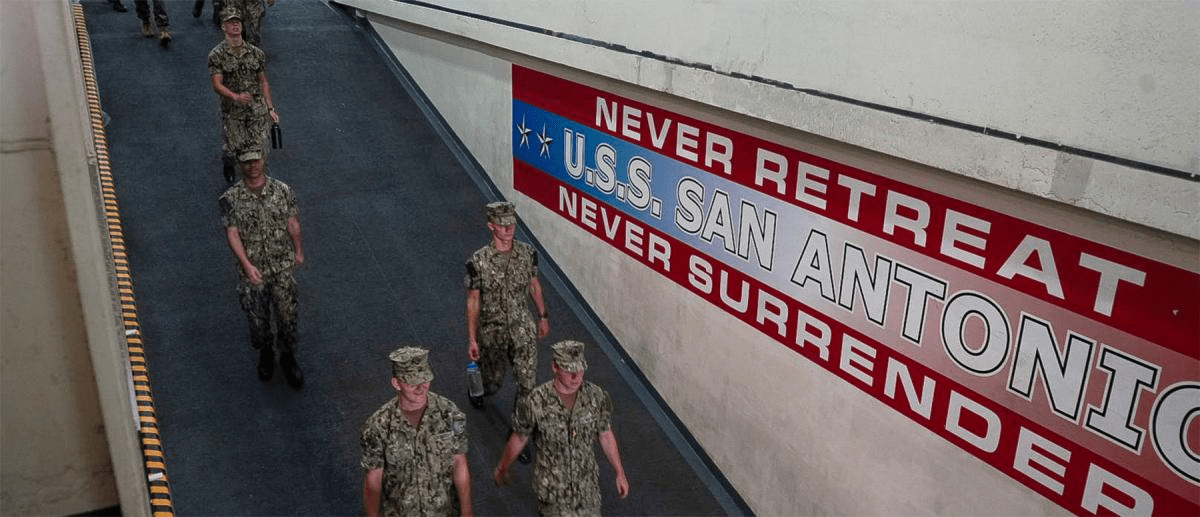
By Ensign Jordan K. Bowman-Davis (U.S. Navy), a maritime cyber warfare officer.
In the summer of 1967, Midshipman First Class Joseph Glutting was put in charge of a 3-inch gun crew onboard the USS Worden (CG-18) during a search-and-rescue operation south of Hanoi. North Vietnamese shore batteries spotted their helicopter and fired off a volley so close that the explosions drenched Glutting and his men with seawater. As a destroyer came to their rescue, Glutting remarked, “That’s the kind of ship I want to be on—going forward and attacking, not heading out of harm’s way.” Fellow midshipmen that same year flew S-2 Trackers on antisubmarine warfare missions and were even sent ashore with Marine Corps Combined Action Platoons. A year later, Midshipman Richard Gano made course adjustments during an underway replenishment onboard the ammunition ship Mauna Kea. “I returned to the Academy with a letter designating me as an OOD, a Vietnam Service Ribbon and later a Meritorious Unit Commendation ribbon,” Gano said. “I was proud of my contributions to the war effort. The cruise ended up being a dream come true.”
To present-day midshipmen, such stories seem fanciful. Summer cruises, while novel, often conjure memories of standing and listening; hurrying up and waiting; feeling pampered yet standing in the way of the mission. Responsibilities are few and ownership is low. This is a far cry from private-sector recruitment pipelines characterized by summer-long internships, direct feedback on projects, and striving for a full-time offer. NROTC summer training falls short of both its own historical precedent and its current civilian equivalent, potentially decreasing retention and lethality. To reverse this trend, the Navy should reimplement frequent, extensive, and engaging merit-based training for its midshipmen.
From the Classroom to the Sea
Ample time at sea was the basis of a naval officer’s education for much of history. In the 1842 Report of the Secretary of the Navy, Abel Upshur commented that even prior to an initial appointment, a midshipman shall have seen at least a year’s service at sea, and not less than five years afloat, before being considered “passed.”
By 1845, the curriculum of the Naval Academy consisted of five years of training: one year of classroom education followed by three years at sea before a final academic year. In the early 20th century, training time at sea decreased in favor of a growing academic focus, but it remained substantial. In June of 1911, Midshipman Edward Ellsberg boarded the USS Indiana (BB-1), setting off for a two-and-a-half-month cruise that would take him across the Atlantic twice. A modern midshipman by contrast might see two months in the fleet across his or her entire four years of training, if lucky, with no guarantees of commissioning into the designators experienced. The Regulations for Officer Development states that only one training cruise is required for those who do not enter college with a scholarship. Despite four years of preparation, the Navy sends new officers to perform duties of which they possess little hands-on knowledge.
Longer Cruises, Clear Goals
To make practical training more meaningful, the Navy should increase the frequency and duration of cruises. When midshipmen only have two weeks onboard a platform or a shore-based installation to train, instructing them in roles that would benefit the mission is impractical. Mitigating the risk their presence creates is the greater focus, because while a midshipman learning and leading brings little immediate benefit to the unit, one injuring himself or damaging a piece of equipment may jeopardize a commanding officer’s (CO’s) career.

Longer stays could allow commands to employ midshipmen meaningfully. Perhaps my most impactful cruise experience was providing the ship’s navigator with homeport information on a Russian spy vessel suspected of trailing us. Making this one small report left me ecstatic, for I had contributed to the mission. Watching fighter jets swoop low, I stood amid the action as the CO took command. I consider myself lucky to have witnessed this moment of tension. Providing midshipmen the option to use the full duration of their summers and academic breaks, should they choose it, would increase their confidence and job satisfaction, offering future officers the chance to see the Navy in its full breadth.
With duration established, clear goals for each cruise should be set. Tying a midshipman’s training directly to his or her career progression raises the stakes of the experience. The Naval Academy gets this right in the Powered Flight Program, which enables graduates to jump ahead in the aviation training pipeline by a month, after a three-week intensive cruise that culminates in a solo flight. Not only does this give the Navy a way to fast-track able pilots and reduce a flight-school backlog in Pensacola, but it also offers students an early chance to evaluate the career and its rigors—eliminating a time-consuming redesignation and transfer process should the designator not work out in their favor.
Better Incentives for Better Retention
Contrast this with cruises in other warfare areas. Midshipmen onboard surface or subsurface platforms are given a mock personnel qualification standard (PQS) with the equivalent of videogame side quests. “Talk to person X. Don a SCBA in a mock fire drill. Visit the bridge.” The onus is on the midshipman to engage, and results vary. Perhaps there are better uses for summer cruise PQS assignments. For instance, they could be oriented toward the acquisition of one’s warfare device. As another performance incentive, perhaps a midshipman’s demonstrated knowledge and willpower onboard a warfighting vessel could contribute as much to their service assignment as performance in ROTC or Academy billets. The Navy tries to reward quality prospects: High-performing midshipmen can get a guaranteed slot on a vessel at the behest of its CO. This sort of positive incentive structure should be expanded, offering midshipmen with exceptional motivation and aptitude a goal to strive for.
Extended cruises and training objectives might add cost and paperwork. But the potential benefits of greater retention and lethality are worth the burden. Midshipmen should commission possessing a better sense of what their job entails, and a confidence to contribute immediately. What Commander Robert Mumford wrote in 1977 still rings true: “We have created a gap between the image with which we recruit officers and the reality of their existence. The romantic image is of a man who goes to sea, leads other men, exercises discretion and power-an independent thinker and doer, an individual in an era of massive organizations. In reality, he is closer to a colorless cipher, conforming to countless paper requirements in order to survive.”
The Navy’s training methods need to become more practical. The service must offer a pipeline on par with civilian internships. The Navy’s readiness depends on a cadre of officers willing and able to contribute to the mission from the very start of their careers.
Jordan Bowman-Davis
Ensign Bowman-Davis is a maritime cyber warfare officer and a graduate of Rutgers / Princeton NROTC.
Source: usni
 Station HYPO
28 March 2025 at 17:22
Makes perfect sense to me. I can still hear the phrase, “Well, that may be what they taught you in school, but here’s how it’s done in the real word.” I can see where an extended glimpse into the real world, while in the academic enviornment, would be most beneficial.
CTRC-CDR 65-95
LikeLike
28 March 2025 at 21:00
Mike Det TAD off Vietnam ..71-72 best experience of being a CT….
LikeLike