
During the height of the Cold War, the United States Navy quietly operated a small fleet of intelligence collection ships that sailed close to the territorial waters of potential adversaries, gathering valuable electronic and communications intelligence. Among the first of these vessels was USS Banner (AKL-25/AGER-1)—a modest cargo ship transformed into one of the Navy’s earliest dedicated signals intelligence (SIGINT) platforms.
Although officially designated an “Auxiliary General Environmental Research” (AGER) ship, Banner’s true mission had little to do with oceanographic science. Instead, she became one of the National Security Agency’s most valuable afloat intelligence collection assets during the 1960s.
From Coastal Freighter to Intelligence Ship
USS Banner began life in 1944 as U.S. Army FS-345, a Design 381 coastal freighter built by the Kewaunee Shipbuilding and Engineering Company in Wisconsin. During World War II she transported cargo throughout the Southwest Pacific, supporting Allied operations from Guam to the Philippines.
The U.S. Navy acquired the ship in 1950, redesignating her T-AKL-25, before commissioning her as USS Banner (AKL-25) in November 1952. Throughout the 1950s she served as a light auxiliary cargo ship, supplying isolated Pacific outposts from Guam, including bases throughout the Mariana Islands, Chichijima, and Hahajima.
By the early 1960s, however, advances in Soviet, Chinese, and North Korean military capabilities created a growing need for mobile intelligence collection platforms capable of operating much closer to hostile coastlines than the Navy’s larger intelligence ships.
Birth of the AGER Program
In 1964 the Department of Defense and the National Security Agency began developing a new class of inexpensive, highly mobile intelligence collection vessels. Rather than constructing new ships, the Navy selected several small surplus cargo vessels that could be converted into sophisticated electronic surveillance platforms.
Banner entered the Puget Sound Naval Shipyard in 1965 for an extensive conversion. Although publicly described as an “environmental research ship,” the designation AGER served primarily as cover for her true mission. She officially became AGER-1 on 1 June 1967—the first ship of what would become the Navy’s AGER program.
Intelligence Collection Missions
Operating from Yokosuka, Japan, USS Banner spent much of the late 1960s conducting peripheral reconnaissance missions throughout the Western Pacific.
Her missions focused on collecting several forms of intelligence:
Signals Intelligence (SIGINT)
The ship intercepted military radio communications transmitted by Soviet, Chinese, and North Korean military units. Linguists and communications specialists monitored voice traffic while cryptologic technicians recorded encrypted transmissions for later analysis by the National Security Agency.
Communications Intelligence (COMINT)
Banner collected communications between naval headquarters, coastal defense forces, military aviation units, and strategic command centers. Even when messages were encrypted, analysts could determine valuable information by studying transmission patterns, frequencies, call signs, and operating procedures.
Electronic Intelligence (ELINT)
One of Banner’s most important responsibilities was recording radar emissions from:
- Coastal surveillance radars
- Surface-search radars
- Air-defense systems
- Fire-control radars
- Missile tracking radars
- Naval combatants operating at sea
Each radar possessed a unique electronic “fingerprint.” By cataloging these characteristics, U.S. forces developed libraries that later allowed aircraft, submarines, and warships to rapidly identify enemy radar systems during a conflict.
Electronic Order of Battle
By repeatedly operating near Soviet and Chinese coastlines, Banner helped intelligence analysts determine:
- Locations of radar installations
- Naval operating areas
- Air-defense networks
- Fleet readiness
- Communications procedures
- Deployment patterns
These observations became an important part of the Cold War electronic order of battle maintained by the National Security Agency and the Navy.
Operating Close to Potential Adversaries
Unlike larger intelligence ships that often operated farther offshore, Banner was specifically designed to work close enough to hostile coastlines to intercept line-of-sight electronic emissions. Her missions frequently took her near:
- The Soviet Far East
- Vladivostok
- Siberian naval facilities
- North Korean ports
- Chinese coastal military installations
These patrols were often tense. Soviet destroyers, patrol craft, and intelligence vessels routinely shadowed Banner. On several occasions Soviet ships signaled, “Heave to or I will fire,” but Banner maintained her course while remaining in international waters and complying with international navigation rules. Unlike North Korea, the Soviet Union generally avoided escalation, recognizing that attacks on American intelligence ships could invite similar actions against Soviet vessels operating near the United States.
The Clickbeetle Missions
Within the intelligence community, Banner’s Far East patrols were conducted under the code name CLICKBEETLE. These operations concentrated on monitoring Soviet Pacific Fleet activities while simultaneously collecting intelligence on Chinese and North Korean military communications.
The intelligence gathered proved valuable in expanding U.S. knowledge of emerging Soviet missile systems, naval deployments, and Far Eastern military exercises throughout the late 1960s.
USS Pueblo (AGER-2)
The second ship converted under the AGER program was USS Pueblo (AGER-2), another former Army freight vessel almost identical to Banner.
Like Banner, Pueblo carried communication technician (known today as cryptologic technicians), communications specialists, and sophisticated electronic collection equipment. Her mission was to collect electronic intelligence off the Korean Peninsula.
On 23 January 1968, during her very first operational deployment, Pueblo was attacked and seized by North Korean naval forces while operating in waters the United States maintained were international. One American sailor, Fireman Duane Hodges, was killed, and the remaining crew spent eleven months in captivity before their release in December 1968.
The incident became one of the Cold War’s most significant intelligence crises. Large quantities of classified equipment and documents fell into North Korean hands, prompting major changes in the Navy’s destruction procedures, shipboard security, and intelligence collection operations worldwide.
USS Palm Beach (AGER-3)
The third and final member of the class was USS Palm Beach (AGER-3).
Although nearly identical in appearance to Banner and Pueblo, Palm Beach operated primarily outside the Far East, conducting intelligence collection missions in other strategic regions. Together, the three ships represented the Navy’s complete AGER fleet.
Originally, the National Security Agency envisioned converting as many as 25 small cargo ships into intelligence collection vessels, later reducing the proposal to 15. Budget limitations and the risks highlighted by the capture of Pueblo ultimately ended the program after only three ships were completed.
End of Service
USS Banner continued intelligence patrols until mid-1969, when surveys determined the aging vessel was no longer economical to maintain. She was decommissioned at Yokosuka, Japan, on 14 November 1969, struck from the Naval Vessel Register the same day, and sold for scrap in 1970.
Legacy
Although overshadowed by the dramatic capture of USS Pueblo, USS Banner pioneered a new generation of small, highly capable intelligence collection ships. Her operations demonstrated that modest vessels could effectively gather critical electronic intelligence while operating close to potential adversaries.
The information collected by Banner helped map Soviet and Asian military communications networks, identify radar systems, and improve the electronic warfare capabilities of U.S. forces during one of the most dangerous periods of the Cold War.
Today, USS Banner remains an important chapter in the history of U.S. naval cryptology and the National Security Agency’s global signals intelligence mission. As the first AGER ship, she laid the foundation for a program that, although short-lived, significantly enhanced America’s understanding of its Cold War adversaries.
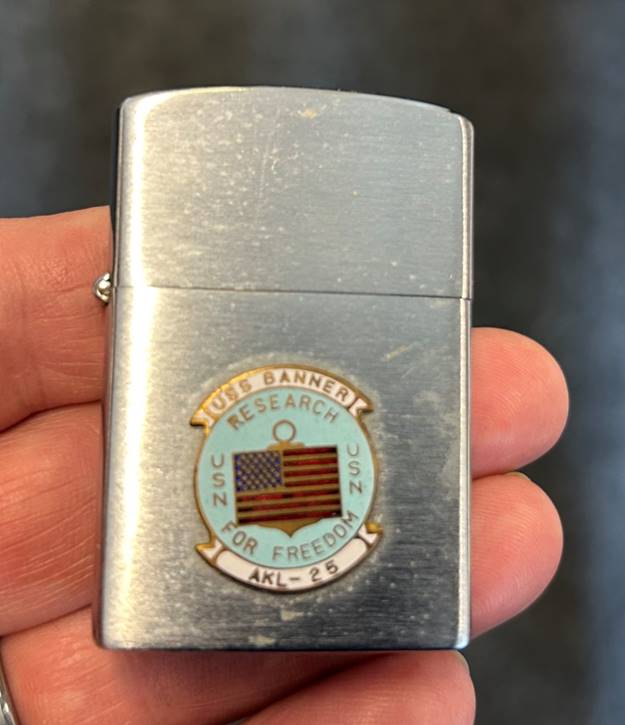
The featured image, a Zippo lighter from the USS Banner is displayed at the Command Display at Corry Station, Pensacola, Florida.
 Station HYPO
3 July 2026 at 12:27
Story of the USS Sphinx (ARL-24)???
LikeLike