
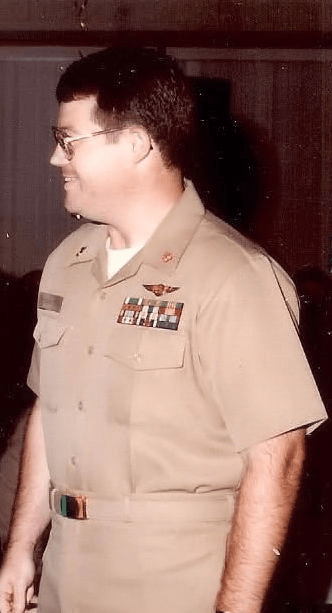
I joined the Navy via the CASH (delayed entry) program on December 12, 1974 at MEPS in Little Rock, Arkansas. I then headed to basic training at RTC San Diego on December 27, 1974. My recruiter was a CTRC. I was guaranteed CTR school but I was under the misconception that I was going to be a Radioman. This was based on the CTRC telling me that I was going to be working with radios. It wasn’t until I was going through classification in bootcamp that I realized I was going to Pensacola while another recruit in my company was staying in San Diego for RM A school.
I arrived in Pensacola in March 1975 and started my DIT DAH training as a CTR student. I spent a lot of mandatory (both self-imposed and assigned) on the morse code trainer “Ralph” system. However, the fastest I could copy was 14s. I went to ARB and got disenrolled from R branch A school and enrolled in O branch in July. I graduated in October 1975 as an honor student with orders in hand to a DIRSUP billet at NAVCOMSTA / NSG Dept Rota Spain, arriving in November 1975.
While in Rota (2 year tour) I worked at the BULL RING in the communications center when not deployed. Back in 1975 it was all torn-tape relay with about 30 O branchers on each of 4 watch sections.
Rode mainly gator-freighters (LPH/LPD) with a FF thrown in the bunch. Ships included:
- USS Guadalcanal (LPH 7) – Med. The team crossed deck to the USS Coronado.
- USS Coronado (LPD 11 – years later redesignated as AGF) – Med
- USS Pharris (FF 1094) – Med, IO (via Suez), Persian Gulf. On the Pharris there was no SSES, TAC Space or QUICVan. The O branchers worked out of the RM’s Offline Crypto Room and the R/I branchers work in a converted fan room one deck up and forward. Each of these spaces were very small.
- USS Guam (LPH 9) – Med
Departed Rota (October 1977) enroute Guam to an Airborne DIRSUP billet to fly with VQ-1. Before arriving in Guam stopped over in San Diego for DWEST and SERE schools.
Arrived Guam December 1977 and stationed at NAVCAMSWESTPAC (NCWP) / NSG Dept. When not deployed with VQ-1 I performed comm center duties at the elephant cage, with various assignments in Tech Control, Message Center & SEATICC. When deployed with VQ-1, flew missions out of Guam, Philippines, Okinawa, Wake Island, and Diego Garcia. I was with the initial VQ-1 Detachment (Echo) in Diego Garcia. There were three O branchers flying with the Q in DG. One would fly, one would support the EP-3 communications on the ground and the other would have their day off. This was the normal rotation while on DG. Our missions off of DG were usually around 13 hours in length. 5 hours to track, 3 hours on track, and 5 hours back. One of the missions I flew on was a 14.1 hour mission. Eventually the Q was authorized to land and RON (Remain Over Night) in Djibouti. This would allow the mission aircraft to remain on track longer.
PCS’d from Guam on November 4, 1979 (The day the American Embassy was overrun in Iran) with orders to NTTC Corry Station as a CTO A school instructor via instructor school at NATTC Millington, TN. Arrived at Corry in February 1980. The course was still teaching teletype writing and paper tape reading. Half way through my tour I was moved to become the curriculum maintainer for the A school, working for CTOCM Jerry Weatherholtz. It was during this time a new computer lab was being installed and used to teach new students with message preparation on MOD 40 equipment. I transferred down the runway on Corry in May-August 1983 to attend COMSYSOPSCOM C School in preparation for my next duty station, back on Guam at NCWP/NSG Dept.
Arrived Guam in September 1983 and assigned as the Technical Control LPO / CMS Custodian. My last few months I moved onto the watch section as the CWC (Communications Watch Chief) until my transfer to NAVCAMSEASTPAC (NCEP) / NSG Dept Wahiawa in a DIRSUP billet.
Arrived at NCEP in September 1985. The DIRSUP shop was a ‘new’ DIRSUP shop of O branchers, with about 10-12 personnel assigned. While stationed at NCEP I was deployed on the following ships:
- USS Arkansas (CGN-41) – WPac/IO
- USS Coronado (AGF-11 – COMTHIRDFLT Staff, which had moved from Ford Island Hawaii onto an afloat command ship. There were some female O branchers on the staff and was not allowed to ride, thus DIRSUPPERS augmented the staff.) – EPac
- USS Horne (CG-30) – WPac/IO
- USS Sterett (CG-31) – WPac/IO
- USS Horne (CG-30) – EPac/North Pac
- USS Missouri (BB-63) – Recommissioned in 1986. World cruise departing Long Beach in Sept 1986 and returning Dec 1986. Following itinerary:
- Long Beach / Hawaii / Australia / Tasmania / Indian Ocean (port stop in Diego Garcia) / Transit Suez Canal / Med (Istanbul Turkey, Naples Italy, Palma de Mallorca Spain, Lisbon Portugal) / Crossed the Atlantic and transited the Panama Canal / Returning to Long Beach.
October 1988 transferred from NCEP to Fleet Numerical Oceanography Center (FNOC) in Monterey, CA. I was part of the first group of 6 CTOs, and a CWO (CWO4 Jim Avery – RIP) as the DIVOFF to work in the 24/7 SPINTCOMM to support the Special Weather Intelligence (SWI) mission. Upon arrival I was assigned as the SSO/Clearance Point Of Contact to gather and submit the necessary paperwork for personnel clearances. Prior to the CTOs arrival, Aerographer’s Mates (AGs) worked in the SPINTCOMM as communicators. Circuits were connected to 2 Autodin Switching Centers (ASCs). Because the AGs did not understand message format their was a HIGH error / rejection rate in their message transmissions, due to formatting. After the CTOs arrived the error rate dropped to ZERO. There was a CTO and AG on each SPINTCOMM watch section.
In October 1991 transferred to COMUSNAVCENT Staff onboard the USS LaSalle (AGF3) in Bahrain arriving in November. The ship had just finished a refurbishment period in Bahrain, that included the N2 spaces. TACINTEL had not been brought back online. While the ship/spaces were being worked on, COMUSNAVCENT SI COMMS were established in container boxes onboard the Naval Support Activity in a temporary SCIF. The message traffic was received via STU III telecom.
After TACINTEL was re-energized on the LaSalle, of course there were problems encountered which plagued SI COMMS support to the shipboard staff. Over the next 2-3 months there were Tech Reps sent to the ship after several CASREPs were issued from the staff. Eventually TACINTEL got better, with the occasional hiccup. For my first 6-7 months onboard, CTOC Dan Hoffman (RIP) was the only CPO on the N2 staff of about 40-50 personnel. Thus, his attention was to take care of the personnel and SI Comms management became my focus in the theater with in-chopping and out-chopping Battle Groups.
Within the last few months of my tour, VQ-1 started staging missions out of Bahrain. The CTO Flyer with the crew got sick and was unable to fly. The crew COMEVAL found out I used to be a flyer and requested that I support a couple of their missions. I explained to the COMEVAL that the last time I had flown was in 1979. It is now 1992. When I boarded the EP-3 it was a new ball game. No more ‘mighty mite’ teletype, teletype tape or carbon canary paper to deal with. It was now computerized. Type the message in and hit SEND. WHOA!
I transferred from COMUSNAVCENT in December 1992 and reported for duty at NSGA Pensacola in January 1993, which was a Software Support Activity. I was assigned to the TACINTEL shop. I was part of the TACINTEL group to perform testing for the replacement of the UYK-20, which were TAC-3s. Travelling to Pt Loma in San Diego to become familiar with the TAC-3 and perform some system testing. I also travelled to Hawaii to be present when the portable/mobile TACINTEL was demonstrated by
CTOCS Doug Voliva onboard MCAS Kaneohe Bay. The system consisted of a portable antenna and a ‘suitcase’ TACINTEL. I am unaware if the system was ever stood up and deployed. I was also involved with supporting the RNINTEL system for the Royal Navy. Travelled to SCU Leydene to implement a new RNINTEL software release.
With about a year left on my tour at NSGA Pensacola, I was offered the job as the NSGA Pensacola Comm Center CPO. During this time the comm center implemented a HIGH SPEED 1.5 MB circuit to support SI comms for NSGA Pensacola and other local commands.
In December 1995 I transferred to the Fleet Reserve with 21 years and 4 days of service.
Upon my retirement I was hired by a DON contractor to support a possible TACINTEL contract. The company did not win the contract thus my focus turned to developing Computer Based Training (CBT). The company I worked for had developed a CBT that supported air warfare and it was purchased by the Royal Netherlands Air Force. Myself and a co-worker travelled to Amsterdam for delivery of the software and to train the Netherland AF how to modify it for their use.
I held a few government contract jobs over a period of 5-6 years. This included CBT development, system testing and deployment of Improvised Explosive Devices (IED) detection equipment to airports across the country and as far as Guam/Saipan. This was a time individual security companies managed the check points at each airport and before TSA came on the scene. This job required site surveys to be conducted prior to deployment of and training on the equipment. Training was provided to Check Point persons up through FAA Special Agents, airport police and EOD personnel.
In 2001 I was hired as GS Computer Specialist at Defense Finance and Accounting Service (DFAS) – Technology Services Organization (TSO) onboard Saufley Field in Pensacola. My duties included system testing and application management. While working at DFAS, I obtained my CompTia A+, Network+, and Security+ certifications. DFAS-TSO was tagged in the 2005 Base Realignment and Closure (BRAC). By the end of 2010 DFAS had consolidated a number of their sites and DFAS-TSO Pensacola was closed down. Before DFAS-TSO was closed down, in July 2010 I was picked up by the Center for Information Dominance (CID) Corry Station as their Information System Security Manager (ISSM). While working at CID, I obtained my Certified Information Systems Security Professional (CISSP). I performed as the ISSM until July 2018, at which time I retired from the government.
Immediately after retiring from the government, I took a job back on Saufley Field as a contractor to manage (in take/inventory), image, and ship computers/peripherals to NROTC colleges and NJROTC high schools worldwide for about 3 years. After 3 years working in/out of a non-climatically controlled warehouse I turned this over to someone younger and fully retired.


9 June 2026 at 08:29
1st time reading CASH acronym. What does it stand for?
LikeLike
9 June 2026 at 13:20
very cool career CTOC!!
LikeLike
9 June 2026 at 13:21
(sorry I should have signed my comment above
-CTO2
LikeLike
9 June 2026 at 16:57
Whew! I’m exhausted.
LikeLike