
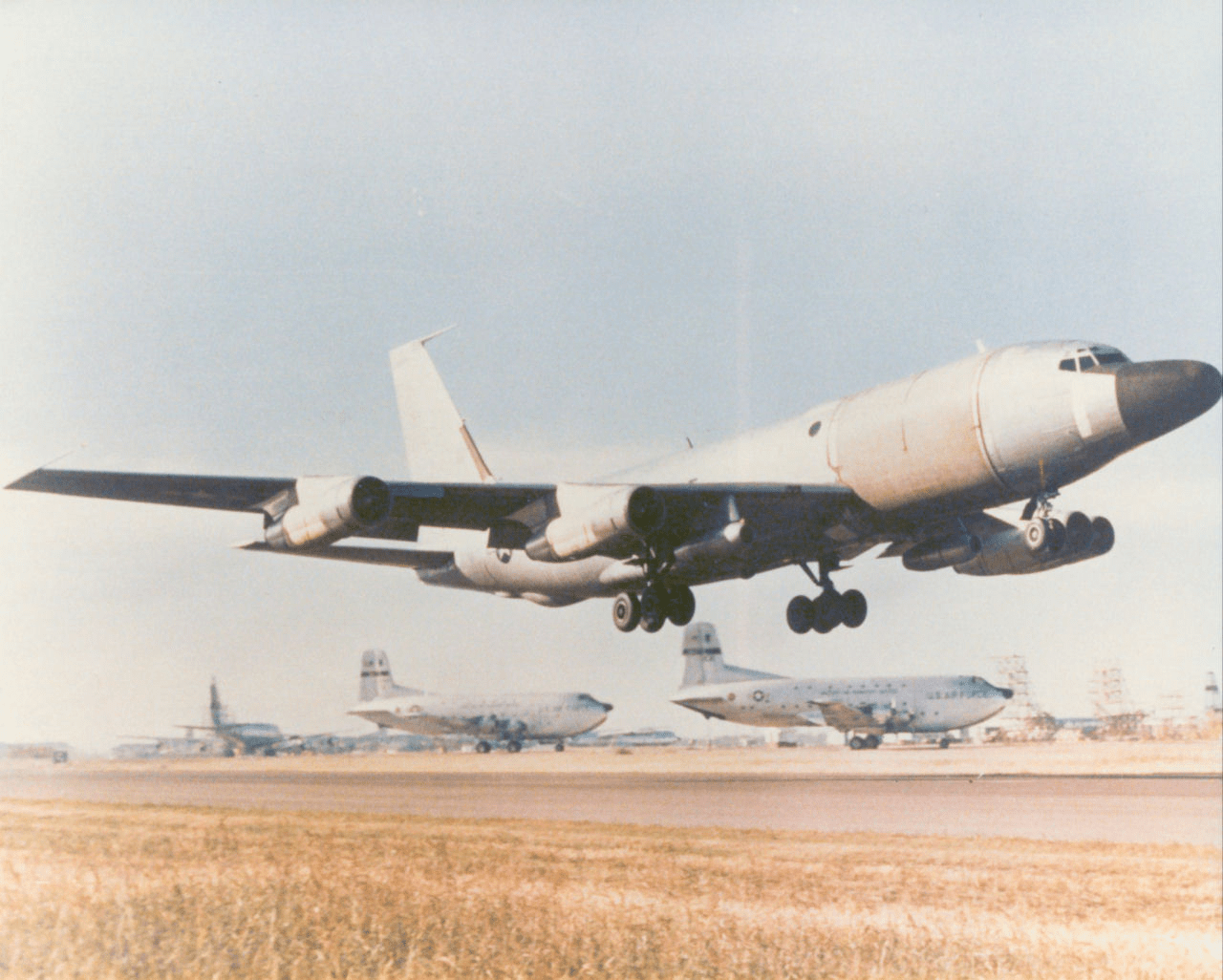
Rivet Amber was a one-of-a-kind RC-135 reconnaissance aircraft outfitted with highly specialized intelligence-collection equipment. On June 5, 1969, the aircraft disappeared over the Bering Sea with all 19 aircrew members aboard.
The distinctive green band encircling her fuselage was made of composite material and housed a massive seven-megawatt phased-array radar weighing more than 35,000 pounds. Beneath the wings, between the inboard engines and the fuselage, were what appeared to be a fifth and sixth engine. One was a Lycoming T55 jet engine dedicated solely to powering the radar; the other was a heat exchanger used to cool the system. During the Cold War, Rivet Amber was the largest and most expensive reconnaissance jet of its kind, equipped with the most powerful and sophisticated airborne radar ever flown.
Rivet Amber was not her only nickname; she was also known as “Lisa Ann.” She was an extraordinary aircraft and, at the time, the most expensive airplane in the U.S. Air Force inventory—until the introduction of the B-2 Spirit. Her radar system alone would be valued at approximately $350 million in today’s dollars.
Rivet Amber (aircraft 62-4137) operated alongside Cobra Ball (aircraft 59-139), her reconnaissance partner. Amber was an RC-135E, while Cobra Ball was an RC-135S. Both aircraft were assigned to the 6th Strategic Wing under Strategic Air Command and operated from Shemya Air Force Base, launching highly classified reconnaissance missions focused on the Soviet Union and North Korea. Rivet Amber was unique—the only RC-135E in existence at the time—and the extreme weight of her radar made her the heaviest and most expensive RC-135 to operate.
On the morning of June 5, 1969, Rivet Amber, piloted by Captain Duncan Wilmore, was assigned a ferry flight from Shemya Island to Eielson Air Force Base near Fairbanks, Alaska. Weather conditions en route were rough but considered manageable. With a crew of 19 aboard, the aircraft departed Shemya for the last time, flying under the call sign Irene 92.
For the first portion of the flight, everything appeared normal. Approximately 40 minutes after departure, Elmendorf Air Force Base attempted contact.
“Elmendorf Airways, Elmendorf Airways, Irene 92, Irene 92, over.”
“Irene 92, Elmendorf, go ahead.”
“Elmendorf Airways, Irene 92 experiencing vibration in flight. Not certain of the emergency. We have the aircraft under control, Irene 92.”
“This is Elmendorf. You say you’re not declaring an emergency. Is that Charlie?”
During the transmission, Elmendorf Tower reported hearing heavy breathing over the radio, followed by the words:
“Crew, go to oxygen.”
The final attempted radio contact occurred at 1822Z. Irene 92 never responded again.
With the aircraft overdue and unresponsive, the 6th Strategic Wing initiated an immediate search. The U.S. Coast Guard and Air Force units scoured the Bering Sea for any sign of wreckage or survivors. For two weeks, hundreds of Airmen searched relentlessly.
Nothing was ever found—not a single piece of debris, nor any trace of the crew.
In the decades since, numerous theories have emerged, ranging from catastrophic mechanical failure to an emergency landing or even hostile action. Despite extensive investigation, the fate of Rivet Amber and her crew remains unknown.
To this day, the loss remains the deadliest incident involving an RC-135. The aircraft family has served the U.S. Air Force since the mid-1960s, and the last fatal RC-135 crash occurred in 1985.
All 19 Airmen aboard Rivet Amber were presumed dead:
Lt Col. Charles B. Michaud
Maj. Peter S. Carpenter
Maj. Richard N. Martel
Capt. Michael E. Mills
Maj. Horace G. Beasley
Maj. Rudolph J. Meissner
Capt. James F. Ray
T/Sgt. Hervey Hebert
S/Sgt. Roy L. Lindsey
M/Sgt. Herbert C. Gregory
T/Sgt. Charles F. Dreher
S/Sgt. Richard J. Steen Jr.
T/Sgt. Lester J. Schatz
S/Sgt. Robert W. Fox
Sgt. Douglas Arcano
T/Sgt. Donald F. Wonders
T/Sgt. Eugene L. Benevides
Sgt. Sherman E. Consolver Jr.
Sgt. Lucian A. Rominiecki


5 June 2026 at 07:54
The captain’s name doesn’t appear in the list of missing airmen. Adding his name would make 20 in the crew. So one of the named airmen wasn’t on the plane or 20 were lost.
LikeLike