
By Thomas W. Butler
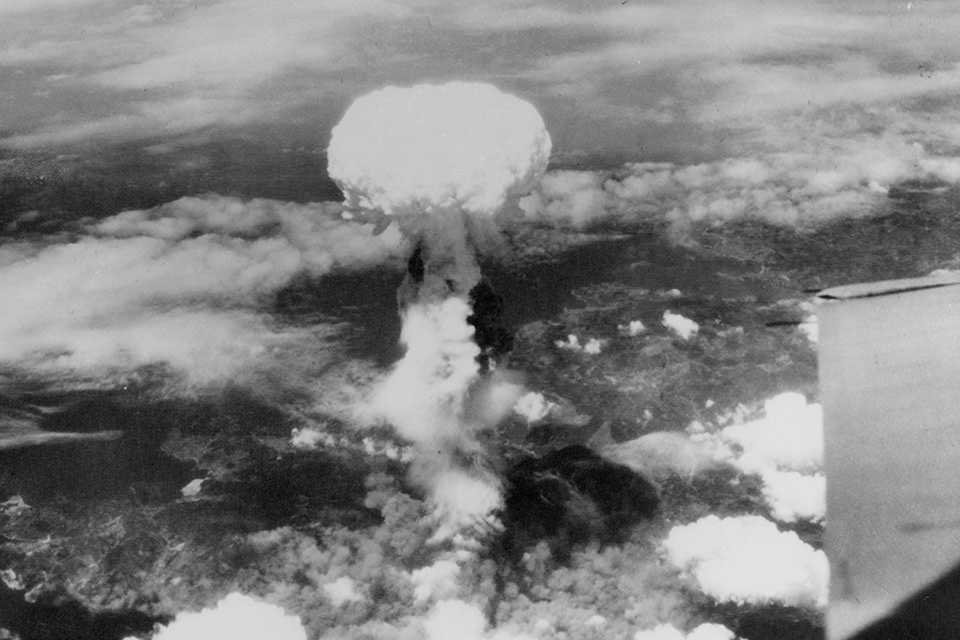
I have said elsewhere in these reminiscences that those of us at Fleet Radio Unit Pacific FRUPAC on Iwo Jima in August 1945, unreservedly endorsed the dropping of atomic bombs on Hiroshima and Nagasaki.
There was no hatred involved in that endorsement. Rather, it was the product of frustration, impatience…and fear the war would continue on-and-on until only after some years, would the Japanese eventually deplete themselves to the point of exhaustion. We never doubted we would win the war…but there was much uncertainty as to when victory would come.
Most of us at FRUPAC–Iwo Jima had been serving in the Navy for three years. Some for four or more. Almost all of us were impatient to get on with our civilian lives and start building something. Even during a war, Americans in general, do not flourish in the military. Life in the armed forces runs counter to traditional democratic principles and, more than civilian life, puts pressure on the individual to submit to being one of a group. You believe, feel, hope that the resultant herd has a useful function…but there is little inducement or incentive to THINK about it very much. On the contrary, from the point of view of military “management”, the best soldier/sailor (in the ranks, at least) is the one who does what he is told with a minimum of reflection or questioning. If you are a member of the herd, without career aspirations in the military, that arrangement can get to be a pain after a while.
To those of us serving at FRUPAC-Iwo Jima, there was no special reason to be horrified by the use of an atomic bomb. The firestorms created in Japan’s cities by the B29 incendiary raids of early 1945 were at least as horrifying, both in number and manner of deaths.
During the night of 9-10 March 1945 a single B29 incendiary raid on Tokyo burned up 97,000 people! In that context, an instantaneous, vaporizing, atomic bomb blast might easily be thought of as a more desirable way to go.
For most of us, both then and today, the viewed death of a single individual is a keenly felt experience. The death of 100,000 people at Hiroshima and Nagasaki was not keenly felt by us. It was a statistic. A number. Perhaps it shouldn’t have been…but it was. We didn’t see it in person. We didn’t see it on TV. We didn’t see any photos in the evening newspaper. All we heard after the atomic bomb drops were brief reports…and then conjecture and comment on the probable import of the events with respect to a Japanese surrender. Surrender…THAT was what interested us. The END of the damned war!
Much has been written about President Truman’s role and his decision to make the atomic bomb drops on Japan. No one should fault Harry Truman. Three years of intensive effort and considerable treasure had been expended to develop the bomb. Everyone agreed it would shorten the war. Truman’s call to use it reflected the overwhelming popular will.
Shortening the war meant saving many American lives…and very likely an even greater number of Japanese lives. Truman did exactly what any one of us at FRUPAC-Iwo Jima would have done, given the chance.
It has been said that in the geopolitical view, the A-bombs drew a line for Stalin to look at, as well. That’s probably true. Considering the opportunism with which the Soviet Union joined the war against Japan (on 8 August 1945 two days after the Hiroshima A-bomb) it probably was a good thing the Nagasaki bomb was available to accelerate the Japanese surrender. If not, Stalin might very well have tried to occupy Okapi, the major island of northern Japan, instead of settling for the four small islands at the northern tip of the Japanese archipelago. The mind boggles at the postwar problems that Soviet occupation of Okapi would have created.
Let us hope that neither the USA nor anyone else will ever explode another atomic bomb in anger…or create another Chernobyl fiasco. It is important, however for us to be ready…militarily and physiologically for such happenings. Because… as sure as night follows day, they WILL happen. The atomic genie is out of the lamp and can never, ever, be put back in. Atomic power, in all of its growing aspects has been with us for more than 50 years, and it will be with us forever. It will kill people occasionally, just as electricity sometimes kills people…and as do floods and hurricanes. Nonetheless, we must live with it and work to insure that we control it, rather than the other way around. In the larger view, unleashing the power of the atom was our WWII generation’s most important contribution to scientific knowledge. Society’s present job is to make sure the power is used wisely and that our successors also understand that with privilege comes equal and corresponding responsibility.
Even assuming some inevitable bad turns and detours, the road of atomic power promises great benefit for humanity. It is society’s responsibility to see that the bad turns and detours are not frequent, nor serious, nor too extended.
If we and our successors fail to accept and correctly discharge that responsibility, the cost could be enormous. Indeed, we may even find ourselves back at square one, i.e., in the primordial swamp, looking for the first rung…to begin another three billion year climb up the evolutionary ladder.
 Station HYPO
Leave a comment