
By Thomas W. Butler
By the summer of 1945, even before Okinawa had been taken, all of us at Fleet Radio Unit Pacific, FRUPAC – Iwo Jima were beginning to hope the end of the war might not be too far off. Logically, it had to be over soon…but no one knew whether logic was going to outweigh emotion. It was obvious to us the Japanese were in a “no win” position and were taking a terrible pounding. However, we also knew we were then standing on a barren, unattractive piece of real estate only four and one half miles long by two miles wide which approximately 25,000 Japanese military men had died to retain as part of their empire! How many of their countrymen would be equally willing to fight and die to defend the home islands of Japan? Hundreds of thousands? A million? Uncomfortable thoughts, I assure you.
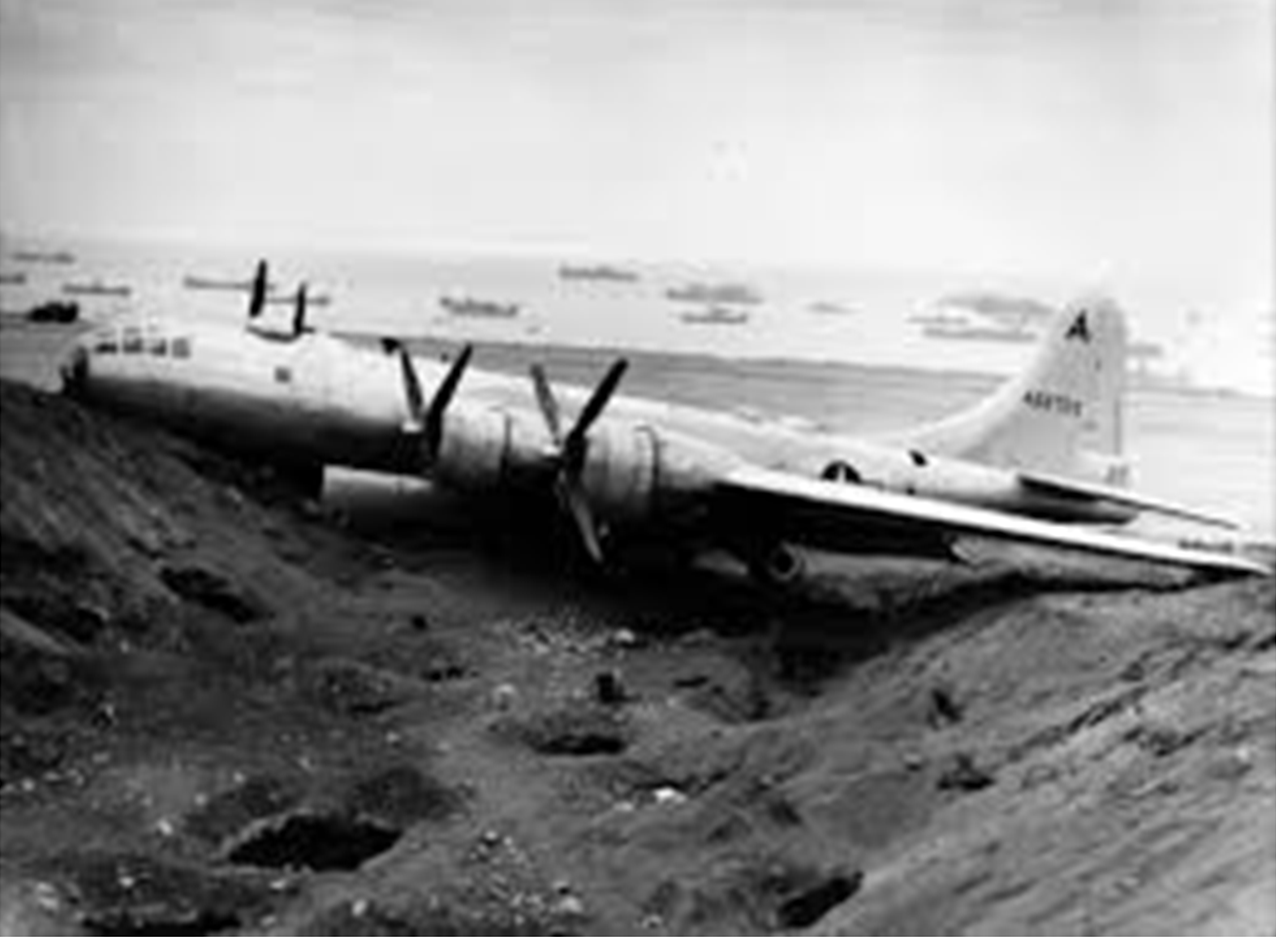
Meanwhile, the U.S. Air Force kept pounding away at Japan. This was the era of 400, 500, even 600 plane bombing raids on Tokyo, Yokohama, Osaka and other major Japanese cities and industrial centers. During these big raids, The B29s going to Japan from bases on Guam, Tinian and Saipan often would pass directly over Iwo. Hours later, outbound B29s would still be passing over…even as the earlier flights were returning from the targets. And the return flights had some very interesting aspects. During the afternoon of a big raid, everyone not on watch would go to the beach to see the ditchings… the shot-up B29s who, unable to make it back to the Marianas, would head for Iwo Jima. Iwo Jima, after all was not attacked and taken by the U.S. Marines just to give FRUPAC another compass-rose plot. It was taken to serve as a U.S. Air Force fighter escort base only 660 miles from mainland Japan…and as a midway landing platform which would give damaged B29s and their crews a chance to live, to fly, and fight again.
If a shot up B29 made it back to Iwo Jima and wasn’t too damaged, it would come in and land on the airstrip, located on a low plateau in the middle of the island. It was sometimes the case, the B29 was severely damaged and thus might crash and tear up the landing strip, the pilot would make his “final” over a lagoon formed by our section of beach and the offshore Kangoku Reef on our southwest side of the island.
He would then land his B29 in the water. Easier said than done. It was something to see, let me tell you. And we had a front row seat as FRUPAC was on a section of the beach parallel to the “final” leg of the landing pattern of last resort.
Sometimes if a plane had very severe control problems or was literally falling apart, the entire crew would parachute out and just let the plane head out to sea. Sometimes, especially if there were wounded aboard, everyone would stick with the plane and ride it down. I can still see some of those wheels-up water landings…with the pilot trying to keep the nose up as long as possible…and still maintain flying speed. Putting a crippled B29 gently down on water is a damned hard thing to do. Some pilots succeeded. Most didn’t do it very gently. We would stand on the beach near our DAB-3 D/F … a couple of hundred yards away from the action…and cheer emerging survivors as crash boats sped in to pick them up.
Incredibly enough, some of the downed airmen retained remarkable aplomb about the ditching. As an acknowledgment of our presence and our cheers, I remember one pilot actually taking a theatrical bow while standing on the wing of his sinking B29, awaiting pickup.
During the summer of 1945 there were 2,400 emergency landings at Iwo Jima, almost all B29s returning, damaged, from air strikes on mainland Japan. The B29 crews who flew those missions were brave men who had a difficult and dangerous job…which they performed with great skill and courage.
During the evening after a big raid, the island Armed Forces Radio station news program would report that 600 of our planes attacked Tokyo and Osaka today. Three of our aircraft were lost. All others returned safely”. Everyone would, of course, hoot at that, since in addition to all the “wing-and-a-prayer” landings at the airstrip, we would personally have seen three or four planes go into the drink…and God knows how many hadn’t made it back to Iwo Jima. On the other hand, we all knew about any of our losses unknown to the enemy.
Yes, the first casualty of war is truth.
 Station HYPO
Leave a comment