
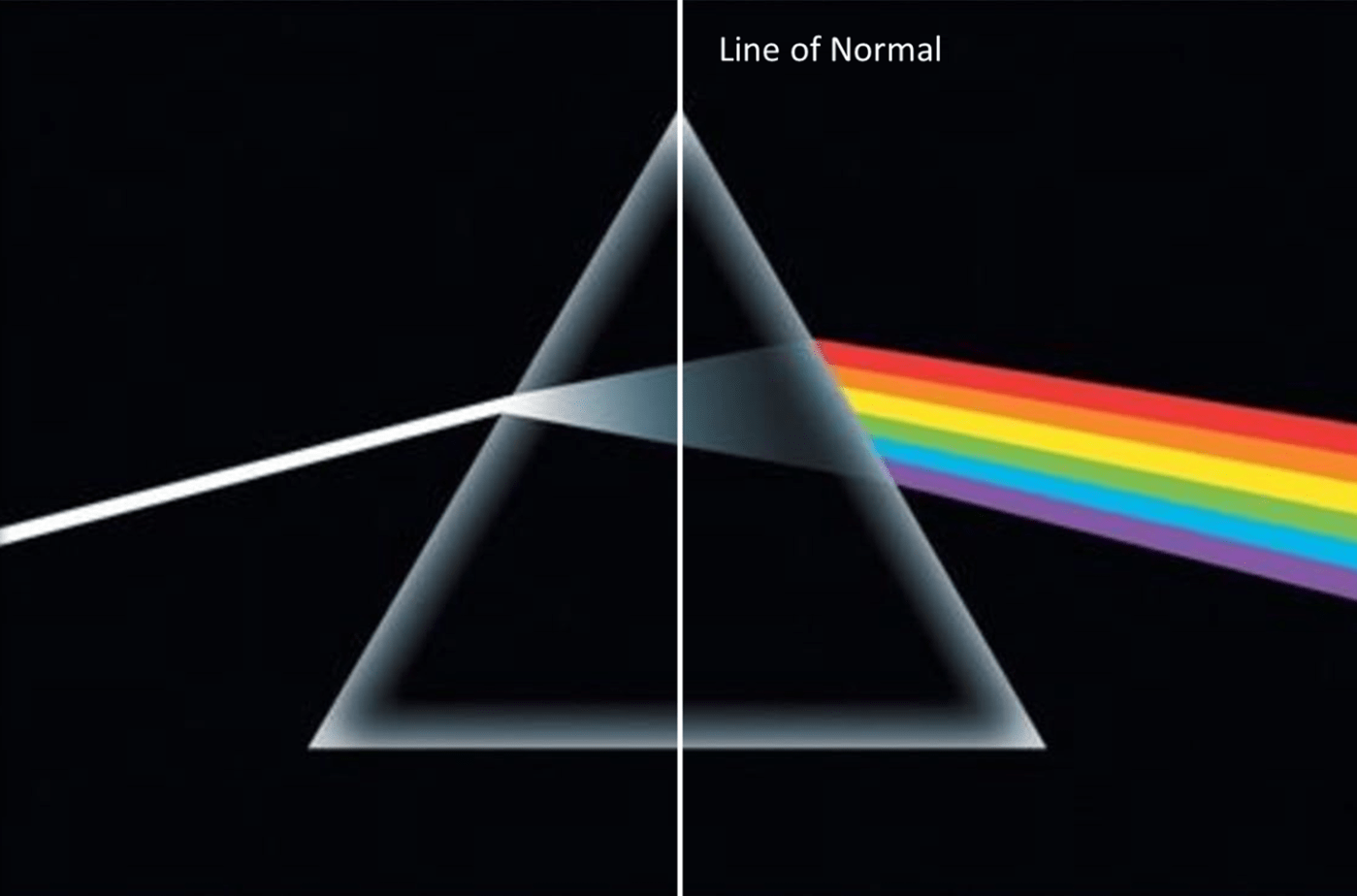
Snell’s Law, also known as the law of refraction, describes how light rays change direction when they pass through the boundary between two different transparent media, such as air and glass. The law is named after the Dutch scientist Willebrord Snellius, who first formulated it in 1621.
The mathematical expression of Snell’s Law is:
n1 ⋅ sin (θ1) = n2 ⋅ sin
where:
- n1 and n2 are the refractive indices of the two media, respectively.
- θ1 is the angle of incidence, which is the angle between the incident ray and the normal (a line perpendicular to the surface) at the point of incidence.
- θ2 is the angle of refraction, which is the angle between the refracted ray and the normal.
The law states that the ratio of the sine of the angle of incidence to the sine of the angle of refraction is constant for a given pair of media. In other words, the product of the refractive index and the sine of the angle is the same on both sides of the boundary.
Key points to note:
- If light is going from a medium with a lower refractive index to a medium with a higher refractive index, the angle of refraction will be smaller than the angle of incidence.
- If light is going from a medium with a higher refractive index to a medium with a lower refractive index, the angle of refraction will be larger than the angle of incidence.
- When light passes from one medium to another with the same refractive index, there is no change in direction (no refraction).
Snell’s Law is crucial in understanding the behavior of light (and radio frequency) at interfaces between different materials and is commonly used in optics, including the design of lenses and the analysis of phenomena like rainbows.
 Station HYPO
Leave a comment