
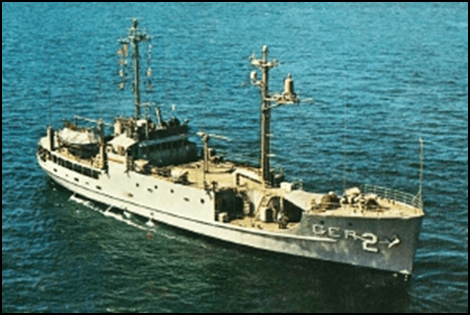
On December 22, 1968, North Korean officers entered CDR Bucher’s cell and ordered him to strip. A third officer—nicknamed Major Rectum—joined them and subjected Bucher to a body-cavity search that was “not entirely medical in character.” Once they were satisfied that he carried no contraband, the captors gave Bucher a new, lightweight uniform: a gray cotton jacket and trousers, a white shirt, and black sneakers—utterly inadequate for the Korean winter.
Since Hell Week had ended three days early, the North Koreans had been unpredictable, swinging suddenly from cruelty to something resembling concern for the prisoners’ welfare. The food improved, the sailors were allowed to eat together again, and limited exercise privileges returned. A camp medic applied hard-boiled eggs and hot-paraffin poultices to the worst facial injuries in an effort to reduce black eyes and bruises.
Dressed in the fresh uniform, Bucher was escorted to an all-crew meeting in the ship’s movie room—and was surprised to find every man wearing the same outfit. The uniform change had to mean something. Freedom? A show trial?
Glorious General, the chief guard, strode in with a self-satisfied expression. “As I knew and told you from the beginning of this shameful imperialist intrigue against our peace-loving Korean people,” he said, “it has ended with the warmongering United States on its knees apologizing to us and assuring that no such provocation and intrusions into our sovereign territorial water shall occur again!” Then he announced the true purpose of the theatrics: in exchange for Washington’s contrition, the crew would be freed the next day.
Bucher’s head spun. Had the United States really capitulated to Kim Il Sung? Could he and his men actually be repatriated after months of captivity? Hope warred with suspicion; a final ruse could not be ruled out.
First, of course, a press conference had to be staged. Roughly a dozen North Korean correspondents appeared, and their questions focused on how the Americans felt about going home. The crew answered with unguarded sincerity: they could not wait to leave.
That evening, the men ate an early supper. Glorious General was quieter than usual; he said he was glad they were going home and even, oddly, gave a finger in apparent jest. Bucher stood and thanked him. Though he had little use for socialism, he felt obliged to acknowledge a competent officer who had done his job. G.G. made no reply; he merely glanced at his watch. “Come,” he said. “I don’t want you to miss the train.”
The prisoners were issued quilted blue overcoats and Mao-style caps. At about eleven p.m. they boarded buses and were driven to the Pyongyang railroad station, where a comfortable, well-heated train awaited. Duty officers from the Country Club prison accompanied them; Glorious General stayed behind.
The train rolled south through the night, but few could sleep. Murphy thought of his wife and children. Steve Harris tried to stretch on his bunk, but his legs—stiff from malnutrition—ached. Bucher worried that the communists might cancel the repatriation on a whim. Each stop sent a fresh jolt of anxiety through him, a “terrible sinking feeling” in his chest.
Despite the lingering pain from Hell Week, LT Schumacher felt a measure of satisfaction. After eleven months of brutal treatment, he believed he and his shipmates had held firm. The North Koreans had forced phony confessions, but little of real value had been surrendered. Though the men had quarreled at times—more from boredom and the friction of confinement than from betrayal—their bonds had endured. Forged under extreme hardship, their loyalty to one another, to their leaders, and to their country remained intact. They had preserved their identities and their humanity, and in the process had exposed their captors’ propaganda as hollow.
Near dawn the train stopped on an empty siding. Windows covered, the men ate a last breakfast of turnips. Around eight a.m. they climbed onto three antiquated green-and-yellow buses. Even wearing three pairs of socks, LT Murphy shivered.
The buses crested snow-dusted hills. Bucher and the lowest-ranking enlisted men rode in the lead vehicle; officers and petty officers followed in the rear bus. Feeling ridiculous in Mao caps and padded jackets, the Americans kept mostly to themselves. Murphy felt as if he were trapped in a dream where “to speak was to risk waking.” To break the tension, someone joked, “Maybe we’ll all get medals when we get back.” QM1 Law dismissed the idea wearily: “No, you get medals for charging machine-gun nests,” he said. “You don’t get medals for this.”
After about fifteen minutes the convoy stopped near the Bridge of No Return. Duty officers gave explicit instructions: they must not run. The must not talk or look back. Above all, they must not make “gestures.” Anyone who did would be shot.
Huddled against the cold, the men waited, tense and uncertain. The eleven a.m. deadline for their release came and went. Ralph McClintock, a communications technician from Massachusetts, sat sweating despite the cold; his heart pounded and he felt on the verge of collapsing into tears. If the communists reversed course now, he believed, the Americans would surely be killed.
Major General Woodward, U.S. Army, took his seat across the narrow table from Major General Pak, Korean People’s Army, at precisely nine a.m. In front of him were two copies of the apology—one in English, the other in Korean. Before putting his signature to them, the American general read a prepared statement making it clear that the documents’ contents were pure nonsense.
From the beginning, the U.S. government had steadfastly maintained that the Pueblo was conducting legitimate operations.
Source “Act of War”, by Jack Cheevers
 Station HYPO
Leave a comment