
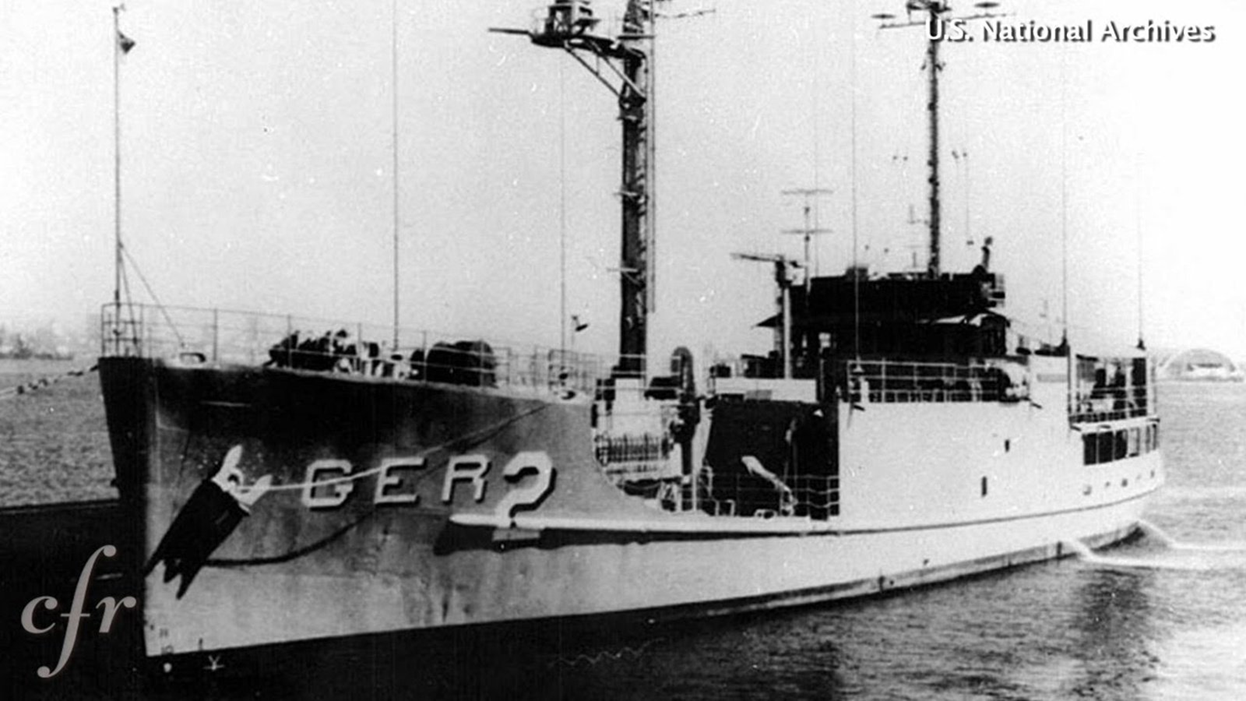
By the end of March 1968, the North Koreans appeared to believe their prisoners were becoming too defiant. When two sailors accused a guard of stealing their cigarettes, Super C decided to make an example of them.
On April 1, the colonel assembled the entire crew in the room where the Friday-night movies were shown. Enraged, he shouted that his guards never stole and that the two sailors had insulted all Koreans. They were liars, he said, guilty of a grave violation of the “rules of Life,” and they deserved severe punishment.
“What should we do with these men who have lied and brought disgrace on themselves and their benefactor?” he demanded, his tone low and threatening.
Understanding how Super C’s (guard) mind worked, CDR Bucher quickly stood up. “I think these men have realized they are wrong,” he said. “And I think you should give them one more chance.” The crew, following their captain’s lead, murmured agreement.
Super C remained unmoved and ordered the two accused to speak.
Communication technician Charles Sterling rose, bowed his head, and retracted his story, now claiming that he had taken the cigarettes himself. He begged forgiveness. The second sailor, fireman Michael O’Bannon, also reversed his statement, insisting he must have lost his cigarettes while exercising outdoors. He too bowed and asked for absolution.
Their shipmates played along with mock condemnation.
“You rats,” one said.
“How awful,” added another.
“You ought to be beaten,” chimed a third.
The act failed. The next day, the Americans found themselves caught in what they later called the “April Purge.”
Guards attacked sailors in the latrine, punching and kicking them without restraint. LTJG Schumacher was beaten unconscious for a loose button on his jacket. CTTC Jim Kell, who supervised the CTs, was struck hard in the head with a rifle butt after a guard accused him of hiding rice in his cheek.
“I’d never been hit like that in my life,” Kell recalled. “The whole side of my head just exploded.”
The purge ended as abruptly as it began. Acting as though nothing had happened, Super C asked Bucher whether any American holidays were approaching. The captain mentioned Easter. On Sunday, April 7, each crewman received a single egg and a bit of rice pastry in observance. Seizing the moment, Bucher submitted a list of more than thirty “American holidays” in hopes of improving the men’s rations—most of them completely fabricated, like Sadie Hawkins Day, Alf Landon Concession Day, and Max Goolis Day. The colonel ignored them all.
Nevertheless, Super C did ease restrictions. He lifted the ban on talking and allowed the officers to play cards at night. Bucher and Schumacher began spending evenings in the captain’s room, playing chess. Bucher, a skilled player since his youth, usually trounced his young lieutenant. Afterward, the two men would talk late into the night—Bucher recounting stories from his boyhood, his time as an enlisted sailor, his family, and the books he loved. Schumacher treasured the conversations and listened intently. Their discussions deepened the bond between them, and Bucher soon regarded Schumacher as his most trusted confidant, often consulting him before issuing any orders to the crew.
On April 20, Super C called another meeting. With Silver Lips (guard) translating, he announced the shocking news that Dr. Martin Luther King Jr., America’s foremost civil rights leader, had been assassinated. Riots, he said, were spreading across the United States as oppressed blacks rose against their “capitalist rulers.”
Then came another revelation: the United States was negotiating at Panmunjom for the crew’s release. But Super C sneered at Washington’s refusal to apologize for its “crimes.” Many sailors felt a spark of hope, but Bucher remained skeptical. He was certain the U.S. government would never admit to something it had not done.
As April faded into May, spring softened the North Korean landscape. From his window, Bucher watched peasants planting in the green fields, listened to meadowlarks and lapwings, and breathed in the faint scent of wildflowers. But these peaceful scenes were often interrupted by the thunder of artillery and the roar of aircraft as military activity increased with the warmer weather.
The captain feared that some of his men might soon face a sham trial and execution—if they survived their starvation diet that long. The meager portions could not have sustained a child, let alone grown men, and the food was frequently contaminated with revolting debris. One sailor found a tooth in his bowl; others discovered nails, stones, insects, even animal eyeballs.
“Five minutes after you ate the meal, you’d be so hungry you’d be asking,” remembered Kell. The worst moments came in the mornings when the smell of frying bacon drifted up from where the communist officers ate.
Their only occasional protein came in the form of “sewer trout,” a foul black-skinned fish with horn-like fins. “It was a two-handed meal,” one CT said. “You had to pick it up by a horn with one hand while holding your nose with the other.” The best method, he joked, was to swallow it whole without chewing. Some men simply couldn’t stomach it.
As malnutrition set in, the sailors grew lethargic. They tried to exercise in the mild spring air, but jumping jacks and jogging soon drained their strength. Schumacher once watched Charlie Law, the sturdy quartermaster, lead a slow, stumbling march around the track. Despite everything—the beatings, starvation, and humiliation—they endured together. Schumacher realized their shared suffering had forged a quiet resilience. “No matter what happened,” he thought, “these Americans would endure.”
Health problems multiplied. Boils and sores covered their wasted bodies. Worms and food poisoning spread. Bucher’s vision blurred, and his legs went numb. LT Murphy developed a painful foot infection.
The camp physician—a plump, cheerful man the sailors nicknamed “Witch Doctor”—treated nearly every ailment with acupuncture or mud packs. His two nurses, “Flo” (short for Florence Nightingale) and “Little Iodine,” offered little comfort or distraction. Most of the crew stopped seeking treatment altogether, convinced the doctor’s remedies were useless.
Though the mass beatings had ended, violence was never far away. A guard nicknamed Sweet Pea karate-chopped a sailor in the throat for dropping a basin. Another aimed his rifle at Stu Russell’s head simply for giving him a bored look.
Nighttime trips to the latrine were perilous. Prisoners had to call for a guard escort—and were beaten along the way.
“They’d beat you all the way to the bathroom,” Kell recalled. “Knocking you in the head, knocking you down, hitting you with the rifle butt. And while you’re trying to take a leak, they’d be hitting you, too. You’d come back with all kinds of bruises. It scared the hell out of you. You never knew what they were going to do.”
At the May 29 meeting, Bucher, hoping to secure another small kindness for his men, mentioned that the next day was Memorial Day—a holiday honoring America’s war dead. The colonel exploded.
“How dare you bring that up!” Super C screamed. “You would honor the U.S. imperialist aggressors who came to kill Koreans. You insult us with the suggestion!”
Realizing his mistake, Bucher quickly tried to withdraw his request, but it was too late. Super C ranted on and declared that there would be no more holidays of any kind for the Americans.
Soon after, the prisoners were issued new summer uniforms—tan Chinese-style suits with wide lapels for officers, gray ones for enlisted men, along with Mao caps and black sneakers.
The meaning was unmistakable: the Americans were not going home anytime soon.
Source “Act of War”, by Jack Cheevers
 Station HYPO
Leave a comment