

Captain Brad “A-Z” Abramowitz
Deputy Director of Operations
National Security Agency, Georgia
Captain Abramowitz was born at Wright-Patterson AFB, Ohio, but spent most of his youth in Spring, Texas. He is an Information Warfare Officer with a Cryptologic Warfare designation specialty. He enlisted in the Navy in 1995 as a Cryptologic Technician (CTR). He attended Texas Tech University and American Military University, holding a bachelor’s degree in Computer Information Systems and a Master’s in Military History. He was commissioned in 2003 in the U.S. Navy Reserve.
While enlisted, he served at Naval Security Group Activity (NSGA), Kunia Hawaii. He deployed aboard USS STETHEM (DDG 63) and completed seven Pacific Fleet subsurface missions. Following completion of active service in 2000 he entered college full-time but continued to serve as an enlisted member of the Navy Reserve with NSGA San Antonio, Texas.
Following commissioning in 2003, he volunteered for mobilization service with Naval Security Group HQ, Naval Forces Europe/U.S. SIXTH Fleet, and Navy Information Operations Command, Texas. He was permanently recalled to active duty in 2008.
Prior to joining NSA Georgia his tours include Information Warfare Officer for USS ABRAHAM LINCOLN (CVN 72), Cryptologic Officer Training Department Head for the Center for Information Dominance Corry Station, Cryptologic Resource Coordinator (CRC) & Deputy Information Warfare Commander (DIWC) for Amphibious Squadron FIVE, CRC for U.S. THIRD Fleet, Executive Aide to the Deputy Chief of the Central Security Service at National Security Agency/Central Security Service (NSA/CSS), Assistant Chief of Staff for Integrated Fires & DIWC for Carrier Strike Group ONE, and Senior Mentor for Non-Kinetic Integrated Fires at Tactical Training Group, Pacific.
His awards and decorations include the Information Warfare Officer Pin, Surface Warfare Officer Pin, Enlisted Submarine Warfare Pin, Royal Australian Navy Silver Commendation, plus other personal and unit awards.
Captain Abramowitz enjoys his free time doing activities with his family. He has been married to the former Erika Marron of Lima, Peru for 24 years. They have two adult children, a son Blake (22), who works with the San Diego Superior Court while preparing for law school and a daughter Camila (19), who majors in Biopsychology as pre-med student at the University of California, Santa Barbara.
Thirty Years of Service Leadership in Four Principles
By CAPT Brad “A-Z” Abramowitz
I want to be clear upfront: These viewpoints and ideas are mine alone. They are what I have learned in my thirty years of naval service. Feel free to challenge them, as this is a sign of a thoughtful leader.
I will spare you the full details of my biography and career story; however, I have shared my biography with the Station Hypo team to share with anyone who cares to know it. Also, I am happy to engage directly if you desire it. You can reach me at bradley.h.abramowitz.mil@us.navy.mil. I will reply soonest and request all communication remain professional.
Now, let’s get to it.
Whenever I first meet with a junior officer, Chief Petty Officer, Leading Petty Officer, or whenever I assume a new position of leadership, I publish a list of guiding principles, advice, and axioms. I have collected these pieces of wisdom over thirty years as an enlisted Sailor and commissioned Naval Officer. I place them all within four overarching principles.
Principle number one: Do not bring problems to the boss to solve. Rather, bring well thought out possible solutions (aka COAs) for the boss to evaluate and then make an informed decision.
We owe it to our decision makers to provide them the best information available. When a subordinate comes to me with a problem, the first thing I ask is, “What are your thoughts on what we should do?” Regardless of where we place in the chain-of-command, our charge as leaders is to make decisions and take decisive actions. This is especially true for officers. You can start shaping yourself into the leader of the future by being an effective decision maker today. Never assume the boss already has a plan. It is our responsibility as leaders to develop possible Courses of Action (COAs) that are well considered, evaluated, and effective. They do not need to be perfect, but they do need to be thought through to logical choices and conclusions. Hope should not be relied upon as a COA. In the words of General George S. Patton, “A good plan, violently executed now, is better than a perfect plan next week.” In other words, make the best decisions you can with the information available, explore all options and alternatives to present informed choices, and do not become bogged down in seeking perfection when good will suffice; especially if a delay in action has critical consequences.
Principle number two: When dealing with people always start from a position of compassion. Never forget we are all fighting battles no one else knows about.
I have been around long enough to remember the days of seeking self-help being perceived as weakness. I am telling you this is incorrect: IT IS STRENGTH, IT TAKES COURAGE. If you sense a teammate is struggling, encourage them to seek help. Offer to be their outlet if it is appropriate. Sometimes simply listening is all it takes to help someone get to the place they need to be. This is about resiliency and readiness; that I believe are key ingredients in successful mission work. To be clear, I am not suggesting to roll over and be overly and unnecessarily sympathetic – if you do that you will struggle as a leader. I am simply restating the golden rule of treating others as you wish to be treated. Be demanding, expect quality work and results, but always be aware you are dealing with human beings. You cannot surge trust. Respect does not have rank.
Principle number three: Never be afraid to ask a question. Someone else will be glad you did.
We all witness it at some point: there is a presentation, it is obvious at least one person in the audience does not understand something, yet they remain silent. This is a missed opportunity for professional development. People assume there are things which are generally understood or common knowledge. This is a poor assumption. It is always better to ask a question and have clarity rather than continue on a path of willful ignorance. I promise it will come back to bite you if choose to be silent. Just ask the question! No one will think less of you for it; probably the opposite, and you may find others appreciate your initiative. The underlying issue is communication; or rather, a lack thereof. I do not understand why people prefer to remain silent when they need to know something, or worse, have a critical piece of information to share. The old standard of watch-standing is to continuously ask yourself, “What do I know? Who else needs to know it? Have I told them?” I like to add, “Did they acknowledge and understand?” This is how effective teams run effective operations. They ask questions, they share knowledge, they maintain an edge by adopting a questioning attitude.
Principle number four: Learn how to prioritize.
You must know the difference between urgent and important. You must learn what to delegate, what to task, and when you should take a direct interest in an action. I borrowed this graph from Dwight D. Eisenhower and I think it is one of the simplest and best tools for how to approach prioritization.
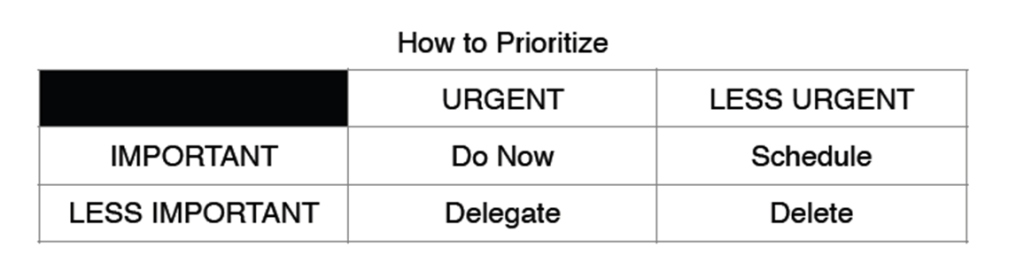
I am realistic and realize you cannot always delete a task or assignment which is less urgent and less important. However, when you determine an action falls into this quadrant it may be the time to ask yourself “Do I understand the requirement and its importance?”, “Should I request additional guidance?” Chances are if you are asking yourself these types of questions you should seek clarity and intent. Refer back to principle three and ask questions.
I will conclude by saying again these are my viewpoints developed over many years. I am open to other views and ideas, and if anything, I have come to learn there is no single magic formula which we all must follow. That is the key. I am still willing to learn and grow. There is always a better idea out there and we should constantly seek it rather than stagnate. Yet, I firmly believe the tenets and principles above are at the core of what leaders must have in their tradecraft. Thank you for reading and considering my ideas. I welcome any and all feedback or discussion.
 Station HYPO
8 December 2025 at 09:14
thanks for sharing. I was dying to know what his kids are up to
LikeLike
8 December 2025 at 09:36
I often wonder how these articles come about. Do these guys write to the blog and say “hey I’m retiring, wanna honor me?”
LikeLike
8 December 2025 at 16:39
I’m the person responsible for Station hypo. Email me at Mario.Vulcano62@gmail.
Mario
LikeLike
8 December 2025 at 12:47
Thanks “A-Z”…if more in command would read this, it may result in some unprecedented acknowledgement of what needs to be accomplished over “ego” overreaching value in doing so. I’ve always thought to come to the “event” with a “plan” not just a complaint…found it to be appreciated as well. Maybe not “thee plan” approved, but a start to the thinking process to ameliorate what was cloggin’ up the system…
LikeLike
8 December 2025 at 18:41
Brad is a great person and leader. Proud to have worked with him.
LikeLike
8 December 2025 at 22:05
Thank you for taking the time to write these down.
LikeLike
10 December 2025 at 08:21
Well done A-Z. Great career.
Paul wilkes
LikeLike