
By Admiral Charles Richard, U.S. Navy (Retired)
“Man Battle Stations! Dong Dong
Dong Dong! Man Battle Stations!”
Everyone who has served on board a ship, submarine, or squadron can remember being jolted out of the rack by that announcement, knowing almost instinctively what to do. For most, that knowledge never leaves. More than 20 years later, I am still pretty confident I could execute the Battle-stations Firing Point Litany in Control on board a submarine, at least as it was at the time, from any watch station in the room. I don’t think I’m unusual.
Why is that? Sets and reps. Seemingly endless sets and reps, under as many conditions as possible. While the sets and reps took many forms—exercises, table-tops, wargames, certifications, drills, etc.—the best had one thing in common: simulated combat against a thinking opponent in which you and your team had to make decisions under uncertain conditions with consequences for those decisions. You could lose. You could die (simulated, of course).
And there was feedback: debriefs in which the certification team or immediate superior in command noted in great detail the errors you made, particularly if you were in command, which sometimes led to an exercise sea story that ended “. . . and we all died.” Not fun. It was even worse when you lost head-to-head against the boat across the pier and knew you were going to hear about it for the next several months.
This stress was important, purposefully so. We were uncomfortable because the exercises were competitive and judgmental. The idea was to compete in training and exercises to prepare for competing later, in battle. The old adage holds: He who sweats more in training bleeds less in war. Conversely, if the training is deficient, so will be the fighting.
The training motivated us to get better. Training against a thinking opponent when there are consequences for your decisions is one of the most effective ways to prepare for battle.
Unfortunately, in my experience, training like this peaks in O-5 command. The more senior you get, particularly at flag rank, the less often you, your staff, and your forces are placed in a simulated combat environment against a thinking opponent against whom you could lose. The opportunities are less frequent and harder to set up and simulate, and there is always something else on the calendar that is thought to be more urgent, often for good reason. Frequently, it devolves to just the certification events, and even for those, major portions often are delegated to staff or subordinate commanders to allow you to attend to “other important matters.”
This was true in my case. I probably did more competitive training in one or two quarters as an O-5 submarine commanding officer than I did in all my O-7 and O-9 command tours combined. Seldom did I see really competitive Navy exercises at the task force, battle group, or fleet level—until I got to U.S. Strategic Command (StratCom), especially during my tour as commander.
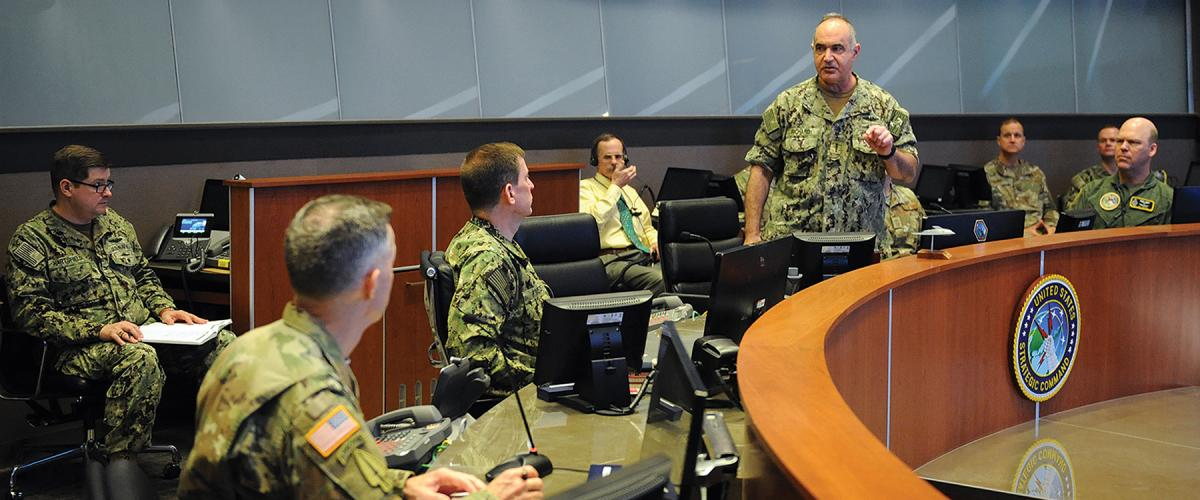
StratCom conducts more than 400 exercises annually, ranging from short watch section events, to no-notice full command battle staff events, tabletops, and wargames, to multiweek, multiple combatant command, tier one exercises. StratCom’s staff and components go all in for the annual Global Lightning and Global Thunder exercises in a 24/7 battle rhythm for close to two weeks that leaves little time for anything else.
StratCom is fortunate to have a capable Joint Exercises, Training, and Assessments (J7) staff. Basically an in-house opposing force, they are deeply steeped in Red strategic doctrine and how to present it, as well as in testing the command’s plans and the procedures used to conduct the command’s mission. Many in J7 have decades of experience, both in uniform as operators and as civilian trainers and evaluators. Every event is critiqued in detail, and they are quite happy to hand you your ass in the debrief if warranted, regardless of rank. They are respectful and polite but would still remind you of the old adage, “To err is human; to forgive is not SAC policy.”
But even with all this, as a four-star, I did not do anywhere near the amount of exercising against a thinking opponent, at battle speed, with consequences for my decisions, to test the plan and procedures that the battle staff, subordinate commanders, and I needed. This despite a personal commitment to do at least two per quarter on top of the scheduled and required events.
The reasons are illustrative. Yes, there were other important things to be done. But being too busy with the daily crush of routine-but-important business means not only not doing the drills, but, more important, also forgetting much of what you had learned from the previous ones.
But three other reasons are more subtle. First, exercises like this are not just hard to schedule, conduct, and internalize, but also hard personally. I was uncomfortable. Even having done several hundred exercises at StratCom and being pretty good at them, I could fail if not at my best. Proficiency in battle decays much faster than you think. You can walk onto the battle deck supposedly the smartest person in the room and nevertheless show you are the least qualified because you were not prepared or proficient—no matter how good you were last year for the certification or back in O-5 command. It is easy to push off an event for “more important things” when the only person making you do it is you.
The second subtle reason is that, where training is concerned, seniority is a vicious circle: There is less time and opportunity for training the commander, who then becomes less involved in personal and command preparation. The commander then becomes further removed from new command and Red factors, which therefore are neither taken into account nor exercised. A commander thus out of touch results in an out-of-step command.
Thinking about command responsibilities and dynamic warfighting should be a thorough, continual process, but it is by no means a routine function. And it must be driven by the commander. This is a commander’s responsibility, not something that can be usefully delegated, which is why assessing this predilection prior to selection is so consequential. Further, preparing for effective warfighting is difficult enough when taking into account developments already on the table. But unless pending and potential changes in the character of war are considered thoughtfully by the commander in advance—a key command responsibility—these changes are going to result in unnecessary battlefield surprises. Participating in the command’s planning processes only partially mitigates this effect. Nothing replaces simulated combat operations against a thinking opponent.
The third reason is that there are many more variables the more senior you are, and those new considerations are not a large part of a commander’s earlier professional preparation. There is coordinating with and mutual warfighting support of other functional and regional commanders, the National Command Authority, the Joint Staff, the Office of the Secretary of Defense, Congress, the media, etc., not to mention the political-military and national strategic factors at this level. And these are in peacetime. In wartime, there are considerations such as definitions of victory; which regional and functional commands are supported and which are supporting and when (it changes depending on circumstances); the primacy of political considerations and civilian control; and many more that are infrequently exercised but are essential considerations.
There is little foundation to build on for considering these factors in decision-making. I have long advocated that one of the best things the Department of Defense could do to better prepare for major power conflict is a multiday exercise for all 11 combatant commanders, with principals participating. This observation raises two key questions:
How can senior commanders be judged in advance of selection on operational and command suitability? Community and service reputation and staff achievements can provide only a first approximation. At lower ranks, qualifications are generally quite specific—and difficult. Qualifying for command in the submarine force entails more than a thousand specific knowledge and practical factor check-outs over the course of a career, as well as months under instruction in prospective command courses that culminate in a series of battle problems that must be passed to take command. Other communities have similar rigor in their pipelines. We have the technology and insight to develop similar significant qualification courses for two-, three-, and four-star officers. Otherwise, how can we know in advance an officer’s real suitability?
Once in the job, how can senior commanders best prepare for their new and varied command responsibilities, so as to “sweat more in training”? We have the simulation and wargaming technologies to run in-place commanders through their respective hoops.
Current “once over lightly” practices will not serve us well in battle. Senior commanders should be asking themselves how often they practice fighting against a thinking opponent, with real consequences resulting from their decisions. How often do they test the plans, exercise the staffs, and lead their subordinate commanders? This includes the supporting commands, which should frequently exercise their ability to surge to combat conditions.
It is one thing to support day-to-day operations, but quite another to support a wartime surge when most of the fleet is getting underway. The lessons we learned as O-5 commanders are just as applicable to senior commanders. How will history judge you when your forces are tested in battle?
Admiral Charles Richard, U.S. Navy (Retired)
Admiral Richard was the 11th Commander, U.S. Strategic Command, from 2019 to 2022.
Source: Proceedings | USNI
 Station HYPO
6 December 2025 at 23:20
It appears, to become both prepared and dangerous (to the opponent) in battle, one will then risk being “passed over” by NOT doing the…face it…”boot licking” considered necessary to rise in rank (yes, I’m explicitly pointing out what Admiral Richard only alludes to…I’ve neither a pension nor political favor to lose in doing so). If in the course of a military career, a road eventually branches…one leading to increased rank and one leading to increased experience in combat (actual or in “practice against a thinking opponent”), I’d easily choose to follow the latter. Unfortunately, those attributes, though thought necessary in military experience, isn’t what leads to rank and retirement opportunities.
I don’t have to hold my breath to believe this will ever change and my only consolation is that it’s got to be even more dysfunctional in a military society under Marxist rule…therein lies the lowering of the “bar” needed for us to possibly survive in the next conflict.
LikeLike