
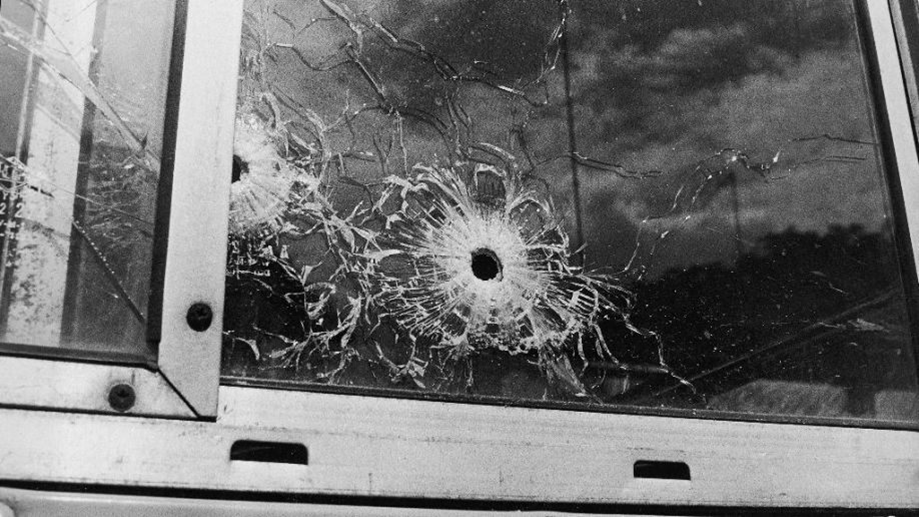
On December 3, 1979, a tragic attack occurred at the Naval Ground Surveillance Aviation (NGSA) Sabana Seca facility in Puerto Rico, leaving a lasting impact on the United States Navy and the local community. This article aims to recount the events of that fateful day, honor the victims, and shed light on the consequences and aftermath of the attack.
CTO1 John Ball, the Communications Supervisor the driver the Navy bus and RM3 Emil White seated directly behind him were killed by gunfire when the bus was attacked by terrorists. Several other sailors on board the bus were injured.
Below are those on the bus:
RM3 Cottie Allen (wounded)
CTO1 John Ball (killed) Driver
CTRSN Allen Bush (wounded)
CTRSN Brad Clark (wounded)
CTT2 Cindy Edwards (wounded)
CTM3 Joe Key (wounded)
CTRSN Clifton Looney
CTM2 Robert Minnick
RM3 Drusilla Penderghest
CTRSA Monique Ritter (wounded)
CTOSN Rich Sauter (wounded)
CTO3 Sandy Seaton (wounded)
CTRC Warren C. Smith (wounded)
CTTSN Ken Toman
RM3 Emil White (killed) Behind the Driver
RM3 Debra Whitehurst (wounded)
CTM3 Gil Zuback
************
The following was taken in part from The San Juan Star – Friday December 3, 1999
By Manny Suarez
The article is titled: Attack on Navy bus unsolved after 20 years – FBI closed the books on the case.
“At dawn 20 years ago today, a big yellow bus turned left on leaving the U.S. Naval Base at Sabana Seca and left again onto Route 867, a narrow road lined with discarded refrigerators, stoves and other debris. The road was filled with potholes and led to an off-base communications station peculiar for it huge circular antenna imbedded on the ground.
Behin the wheel of the bus was CTO1 John Ball. Setting directly behind him was RM3 Emil White.
The bus was carrying the technicians who made up the morning shift at the station.
While trying to maneuver around the holes, Ball blew his horn at a green pick-up truck that drove erratically in from of him. The pick-up stopped, and then started again.
As the bus pulled up alongside a white van parked on the appositive lane, the pick-up blocked the road, causing the bus to stop only two or three feet from the side of the van.
The driver of the pickup jumped out and ran into the van. Two automatic weapons sticking out of the partially open windows of the van opened fire, filling the Navy bus with the of automatic weapons fire, shattering glass and the scrams of those in the bus.
The shooting was over in the seconds it takes to empty clips from an M-16 and a Soviet designed AK-47 assault rifle, the weapons used by the opposing side in the Vietnam War.
The white van pulled way.
In the bus, Ball was stumped over the wheel dead.
CTM3 Key and Chief Petty Officer Warren C. Smith pushed Ball’s body aside. Smith took the wheel, turned the bus around and drove back to the base as the wounded mound in pain.
In addition to Ball, Petty Officer Emil White was killed. Ten others were wounded, two critically.
Quickly assuming responsibility for the act was a little known organization calling itself the Buricua Popular Army, Las Macheteros.
In a communique, the organization said it had taken the action in response for what it said was the “murder” of a Vietnam War veteran, Angel Rodrigues Cristobal, who was arrested May 19, 1997, for violating a court injection against trespassing on Vie… Rodrigues was a militant member of the Socialist League.
Rodrigues had been sentenced to 90 days in prison and was found hanging from the cell in a federal prison in Tallahassee, Florida. The prison authorities said Rodrigues had committed suicide.
The Socialist League and other pro-independence organization insisted to this day that he had been lynched by the guards.”
************
2015 Update:
SAN JUAN, Puerto Rico – Juan Galloza Acevedo was living a quiet retirement near the suburbs of Puerto Rico’s capital when his radical past finally caught up with him.
Galloza got a call from local police, telling him his car had been in an accident and he needed to come to the station. When he got there, he was met by federal agents investigating a 1979 attack by Puerto Rican independence militants that killed two U.S. sailors and wounded 10.
“He obviously didn’t expect to see us,” said Special Agent Tim Quick of the Naval Criminal Investigative Service.
With the recent sentencing of the 78-year-old Galloza, NCIS officials say they will be back in the U.S. territory soon to work with local authorities in hopes of surprising some more militants as they seek to unravel the long-unresolved case from a violent phase of Puerto Rico’s national movement.
“We see potential for additional arrests,” Quick said.
Galloza, who was sentenced May 8 to five years in prison, played a minor role in the attack, which the group known as Los Macheteros staged in reaction to the death of an activist in a U.S. prison. Attackers fired assault rifles and a machine gun at a bus carrying 17 sailors from a Navy base at Sabana Seca, a coastal area several miles from the house where Galloza was living when authorities found him in 2006.
At one point, 13 people were suspected of involvement. Four of those have since died, including one suspected gunman who authorities say died in a drug-related shooting.
NCIS officials declined to provide further details on the hunt because the investigation might be jeopardized.
Federal authorities reopened the case after the Sept. 11 terror attack on the U.S. revived Washington’s interest in suspected terrorists. Still, as the investigation dragged on, many people questioned whether it was worth the time and money, said Lou Eliopulos, director of NCIS’s Office of Forensic Support.
“It was an incredible task to try to put it together,” he said, adding that agents were lucky a retired Puerto Rico police detective had preserved the evidence. “We were faced with individuals who asked why we were doing this, that we would never make it to the courtroom.”
Galloza is one of those wondering why authorities are still pursuing suspects.
“God imparts justice,” he said in a brief phone interview with The Associated Press from the Metropolitan Detention Center in New York City. “What do people gain from catching someone else and making them pay for something after so many years?”
A widow of one of the sailors killed in the attack has a different view. Patty Ball acknowledged that Galloza expressed remorse and apologized to the families of victims at his sentencing hearing in New York, but said that wasn’t enough.
“This was not about forgiveness. This was about justice and responsibility,” she said in a phone interview. “I think that people need to be held responsible for their actions. I don’t care how old a case this is.”
She was living in Puerto Rico with her husband, Petty Officer John Ball, and their two children as part of his three-year assignment when the attack occurred. She moved her family back home to Wisconsin the next day.
Galloza became a supporter of Los Macheteros around 1969 but didn’t become active until about 1978, according to court documents. Three weeks after the attack, Galloza left the group because of his objections to its tactics and later found a job in a purse factory, officials said.
The group, which is listed by the U.S. government as a terrorist organization, claimed responsibility for killings, bombings and robberies in the 1970s and ’80s, including a $7 million holdup of a Wells Fargo depot in 1983. Its visibility diminished after a flurry of arrests in 1985.
Galloza says he didn’t know authorities were looking for him. “The only thing I said was, ‘If I made a mistake, I will pay for it,'” he said. “I want to make things right.”
Recently put in a prison hospital in Massachusetts for treatment of heart problems, Galloza would like to be transferred to Puerto Rico because of his health troubles, which also include rheumatoid arthritis and diabetes.
“They sentenced me to die,” he said. “They knew I was not going to last five years. I’m more dead than alive.”
Published August 7, 2014
Last Update December 10, 2015
Source: Foxnews.com
 Station HYPO
3 December 2025 at 18:16
This article is wrong, the author has no idea what happened and should retract this entirely. Please contact any of the numerous veterans who were there so the public knows the truth.
sad day made worse by an ill informed “journalist “
CTM2 Steven Bissell
steve@stevebissell. Com
LikeLike
3 December 2025 at 20:37
This article was published in error, and the correction has been made. Thank you, Mr. Bissell, for bringing it to my attention.
Regard,
Mario
LikeLike