
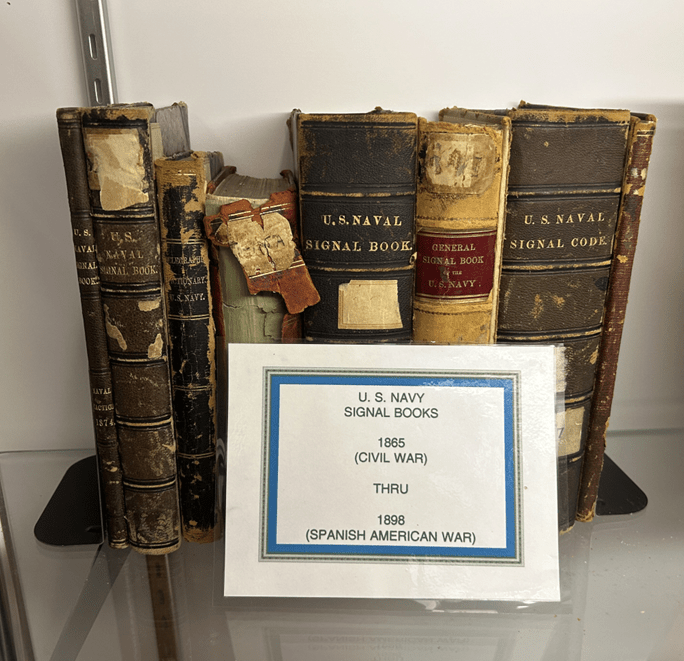
Featured image: Navy Code books at the Command Display, Corry Station, Pensacola
How the Navy’s First Secret Code Laid the Foundation for Modern Information Warfare
When the U.S. Navy introduced its first standardized cryptographic system on 1 December 1887, the event passed quietly—just a set of printed books issued to ships and shore stations. Yet this unassuming “U.S. Navy Secret Code” marked a transformational milestone: the moment the Navy began treating secure communication as a core warfighting requirement. In an era when telegraphy made long-distance communication possible but dangerously exposed, the 1887 system provided the first serious defense against interception, espionage, and foreign intelligence gathering.
More than a codebook, it was the starting point of a cryptologic tradition that now underpins the Navy’s entire information warfare enterprise.
A Navy Facing New Realities
A Post–Civil War Decline
In the decades after the Civil War, the Navy slipped into obsolescence. Budgets tightened, the fleet atrophied, and wooden ships outnumbered modern vessels. Communications were inconsistent, unregulated, and—crucially—completely unprotected. Anyone with access to commercial telegraph lines could read Navy messages in plain language.
By the early 1880s, the United States found itself with a fleet unsuited for global operations and far behind European naval powers.
The Rise of the “New Steel Navy”
The 1880s sparked a dramatic shift. Congress funded steel-hulled cruisers such as USS Boston, USS Atlanta, and USS Chicago, marking the birth of the modern Navy. With these advanced ships came new demands:
- Faster long-range coordination
- More reliable command and control
- Protection of intelligence and operational messages
The reborn fleet required a secure way to communicate. Encryption was no longer a luxury—it was essential.
Intelligence and Strategy Begin to Mature
Two major developments also drove the need for a formal cryptographic system:
- Office of Naval Intelligence (1882), America’s first permanent military intelligence agency
- Naval War College (1884), which professionalized strategy, planning, and wargaming
Both organizations relied heavily on secure information flow, pushing the Navy toward a standardized code system.
Inside the 1887 Secret Code System
The Secret Code System of 1887 represented a surprisingly sophisticated approach for its time. It combined multiple layers of protection and standardized procedures to secure naval communication.
1. The Primary Codebook
This large volume—roughly the size of a modern atlas—contained:
- Five-letter or alphanumeric code groups
- Encoded terms for operations, logistics, and personnel
- Substitutions for ship names and standard naval expressions
Intercepted messages appeared as meaningless groups of characters, dramatically increasing the security of naval traffic.
2. The “Book of Key Words”
A separate volume added a second layer of encryption. Operators applied keywords to further encipher message groups, creating an early form of superencipherment. Even if an adversary obtained the main codebook, the message remained indecipherable without these keyword tables.
This concept—today known as defense in depth—was decades ahead of its time.
3. Geographical Coding Tables
To reduce errors and standardize global communication, geographic locations were encoded as well. Ports, straits, islands, and coastal regions all received assigned code groups. This helped commanders interpret communications accurately even when operating far from home waters.
The Evolution of Navy Cryptology
The 1887 system was just the beginning. Its introduction fits into a broader historical progression:
Pre-1880s – Reliance on flags, lights, and unsecured telegraphy
1882 – Office of Naval Intelligence created
1 December 1887 – First formal Navy cryptographic system adopted
1898 – Used operationally during the Spanish–American War
World War I – Expansion into more advanced War Code systems
1930s–1945 – OP-20-G, FRUPAC, and FRUMEL lead global cryptologic efforts during WWII
Post-1945 – Cryptology merges with SIGINT, electronic warfare, and later cyber operations
Present Day – Modern information warfare integrates encryption, cyber defense, and global communications security
Each stage built on the foundation laid in 1887.
Why the 1887 System Mattered
It Institutionalized Communications Security
For the first time, the Navy standardized:
- Encryption procedures
- Codebook distribution and safeguarding
- Training for communications personnel
- Operational security practices
This shift marked the beginning of professional naval cryptology.
It Supported a Growing Maritime Power
As the United States expanded its naval presence across the Pacific and around the world, secure communication enabled global command and control. Encrypted messaging ensured effective:
- Fleet maneuvering
- Overseas deployments
- Intelligence sharing
- Coordinated operations
America’s emerging role on the world stage depended heavily on secure information flow.
It Set the Stage for Future Cryptologic Success
Core principles introduced in 1887 still shape naval communication today:
- Layered encryption
- Standardized code practices
- Geographic encoding
- Operational security culture
From WWII codebreaking triumphs to modern cyber defense, the logic of the 1887 system echoes throughout the Navy’s information warfare capabilities.
Conclusion
The introduction of the U.S. Navy Secret Code on 1 December 1887 signaled a profound shift in how the Navy viewed information. No longer an afterthought, communications security became an essential element of maritime power. Emerging alongside the Steel Navy, the Office of Naval Intelligence, and the Naval War College, the 1887 code system marked the Navy’s first step into a world where information could be as decisive as firepower.
Its legacy lives on in every encrypted message sent across today’s secure networks, every SIGINT operation, and every cyber defense action taken by the fleet. The 1887 codebook may have been simple—but it opened the door to the modern era of naval cryptology and information warfare.
 Station HYPO
Leave a comment