
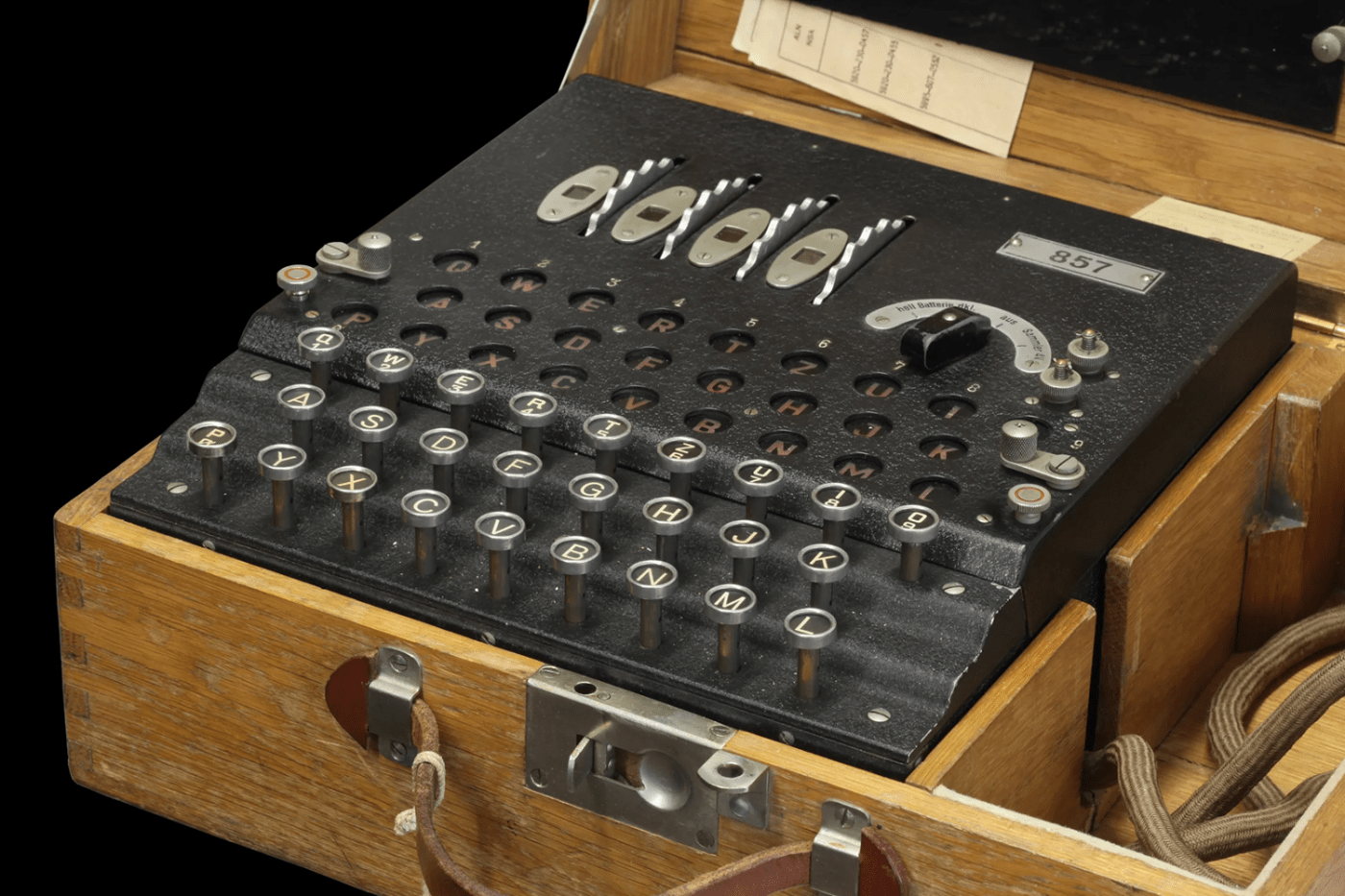
After hearing the many intriguing success stories about the exploitation of Enigma communications (shortening WWII by at least a year successes in the battle of the North Atlantic, support to the battle in Europe), did you ever wonder how it all ended?
Use of the Enigma started modestly in the late 1920s and early 1930s with the machine being applied to commercial uses. Only the Poles, however, who were more keenly aware than most of the German threat, saw the potential dangers of Enigma being used for military purposes. They acquired a machine and started working on ways to exploit the problem. In 1939 with the German invasion of Poland, the Poles passed their knowledge to the British and French. The British made great progress advancing the art of breaking Enigma, and continued developing the “bombe” used in breaking the Enigma messages. The bombe was a huge electromechanical device, which could
Analyze assumed text and determine the validity of the proposed solution. The Poles conceived and built the device, and the British developed its application. The British in tum involved the U.S., which refined the bombe’s use in decrypting the Enigma messages.
Volumes have been written about the value of the Enigma decrypts during WWII and the extreme measures taken to protect the successes. Movies have been made depicting the extraordinary efforts taken to acquire new Enigma machines and the keys used. The most popular undertakings were the efforts to capture German submarines in order to get the cryptographic materials.
At the end of WW II, contrary to what one might believe, the use of Enigma did not cease in a bunker in Berlin in 1945. It lingered on to an insignificant demise in 1955.
The East Germans continued to use the Enigma equipment, but its role diminished, until by the early 1950s they were using it only in Berlin.
Case notations were used to identify discrete communications entities (links, nodes and networks) so that one could follow and maintain continuity on a given set of communications. These designators were assigned according to a prescribed system. For instance, in GCPB 00101, the “GC” denoted East German, the “P” indicated Police, and the “B” meant that the mode of communications was Manual Morse. The “001” and “01” signify the number of the network and the net within the network. In this case we have only one net and that was the East German police in Berlin. GCPB 00101 was the last communications network to carry Enigma traffic, which the U.S. exploited.
The content of the communications carried on GCPB 00101 could be described as mundane at best. It contained fire damage reports, state of readiness of various fire stations and police reports, mostly regarding insignificant arrests. This was not the exciting content produced during WWII, yet the priority given to intercepting this traffic was extremely high. People working on the traffic analytic aspects of the problem and those continuing the efforts to read the messages could not understand why the mundane content of the messages would warrant the high priority afforded this target in the mid-1950s. Obviously those in the hierarchy at that time knew, but the rest could only speculate.
In retrospect it would appear that, with the famous “Berlin Tunnel” operation under way, the U.S. was most interested in knowing about any reflection or knowledge on the part of the East Germans of the tunnels construction and activities.(1) Police and fire reports might just provide such information and hence the high priority given to GCPB 00101. Little did we know at that time that the noted British traitor, George Blake from MI-6, in all probability had already had compromised the tunnel operation.
Then one day in 1956 Ellie Carmen Klitzke, chief of the East German cryptanalytic section located in A Building at Arlington Hall Station, notified Preston Welch that the effort on Enigma was to be terminated. Preston was the cryptanalyst in charge of developing “menus” to be run on the bombe. These menus were short passages of text, which he suspected were in the encrypted message. The menus were run on the bombe and, if the guess were correct, the bombe would yield the setting for that message so that it and other messages could be read.
With a modest degree of fanfare, Preston held up a package and announced that it contained the last menus to be run on the bombe. He handed the package to a cryptanalytic intern who caught the shuttle bus from Arlington Hall Station to the Naval Security Station and delivered the menus to the Navy Waves who ran the bombe. They in turn ran the machine for the last time. By way of footnote, one of the last bombes used is on display at the National Cryptologic Museum.
(1) The Berlin tunnel scheme was an elaborate undertaking to dig a tunnel from West Berlin to East Berlin and tap communications cables. Construction began in 1954 and was completed in 1955. It yielded enormous amounts of traffic before it was terminated in 1956 upon discovery by the East Germans.
Source: William T. Kvetkas, Center for Cryptologic History
Approved for Released by NSA on 02-20-2007, FOIA Case #51630
 Station HYPO
23 November 2025 at 05:29
How many and which countries continued to utilize the Enigma for secure communications after 1950?
LikeLike
23 November 2025 at 13:14
Intelligence Derived From A “Colossus” Mistake
It all began in 1941 when a Wehrmacht communicator requested retransmission of what was identified as a radioteleprinter message and his distant compatriot obliged him by resending that message without re-encrypting it. What was the ultimate value of this to Allied cryptanalysis?
“The high-level, strategic nature of the intelligence obtained from Tutte’s crucial breakthrough, in the bulk decrypting of Lorenz-enciphered messages specifically, contributed greatly, and perhaps even decisively, to the defeat of Nazi Germany.”
The Germans used the Lorenz machine to encipher strategic communications transmitted across what Allied cryptologists named TUNNY networks between OKW/OKH and senior field commanders using radioteleprinter traffic.
Tutte’s analysis provided the statistical-mathematical method for successful exploitation of TUNNY traffic. Thomas Flowers, a General Post Office Telephone Branch engineer, built the machine, COLOSSUS, that processed TUNNY data and converted it to usable plain text. COLOSSUS was the first programmable digital computer. (There were two COLOSSUS variants – I and II. How effective was the exploitation of TUNNY?
“Since the early months of 1944, Colossus I had been providing an unparalleled window on German preparations for the Allied invasion. Decrypts also revealed German appreciations of Allied intentions. Tunny messages supplied vital confirmation that the German planners were being taken in by Operation Fortitude, the extensive programme of deceptive measures designed to suggest that the invasion would come further north, in the Pas de Calais. In the weeks following the start of the invasion the Germans tightened Tunny security, instructing operators to change the patterns of the chi- and psi-wheels daily instead of monthly. Hand methods for discovering the new patterns were overwhelmed. With impeccable timing Colossus II’s device for breaking wheel patterns came to the rescue.”
Sources:
I read Winterbotthom’s “The Ultra Secret” shortly after it was published in 1974. Winterbotthom briefly and almost passively mentions “COLOSSUS” but doesn’t describe the machine or its value to Allied SIGINT in World War II. That’s because Winterbottom was a lawyer by training and an RAF intelligence analyst in practice. He was not a mathematician-crytanalyst in the mold or experience of a William T. Tutte or Alan M. Turing.
LikeLike
23 November 2025 at 19:11
Dear Anonymous,
Would you be interested writing an article about the subject of you comments?
Best,
Mario
LikeLike
23 November 2025 at 22:20
Not sure if your reply was meant for me. I was doing instrumented TEMPEST tests of the U.S. version AN/KLB-47, HL-1 and HL-2 that we were able to break in the late 1960’s. NSA then stopped using the U.S. version for double encryption.
; akluvo@gmail.com. Nov 2025.
LikeLike
23 November 2025 at 15:54
I was on the USNS Valdez 1964 – 1965 , we used the American version for private and personal messages concerning crew members. I remember decoding messages hoping that they did not apply to my family.
LikeLike