
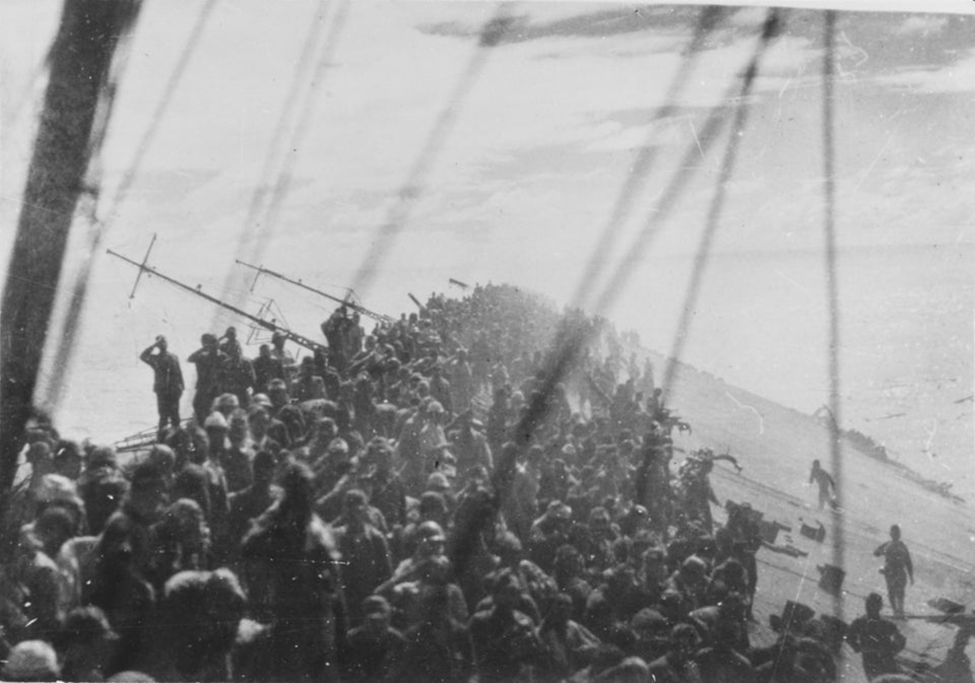
On October 25, 1944, the Imperial Japanese Navy suffered one of its most symbolic losses of the Pacific War. That day, the aircraft carrier Zuikaku, the final surviving Japanese carrier that had taken part in the attack on Pearl Harbor, was sent to the bottom of the sea by U.S. Navy aircraft during the Battle of Cape Engaño, a major phase of the Battle of Leyte Gulf.
Zuikaku’s Role in the Pacific War
Commissioned in 1941, Zuikaku was the sister ship of Shōkaku and one of the most advanced fleet carriers of her time. Along with Akagi, Kaga, Sōryū, Hiryū, and Shōkaku, she formed part of the Kido Butai—Japan’s elite carrier strike force. On December 7, 1941, her aircraft roared off the flight deck to participate in the surprise attack on Pearl Harbor, an event that propelled the United States into World War II.
Over the next three years, Zuikaku fought in nearly every major carrier battle of the Pacific: the Indian Ocean raid, the Coral Sea (where her aircraft helped sink the carrier USS Lexington), Santa Cruz, and Philippine Sea. Each engagement whittled down the Japanese carrier force until Zuikaku stood as the last survivor of the original Pearl Harbor strike fleet.
The Battle of Cape Engaño
By October 1944, Japan’s carrier force was a shadow of its former self. Many of its finest pilots had been lost in earlier battles, and fuel shortages severely limited operations. Nevertheless, the Japanese sought to use their remaining carriers as bait during the Battle of Leyte Gulf, hoping to lure Admiral William F. Halsey’s Third Fleet northward and away from the amphibious landings at Leyte.
Zuikaku, under the command of Vice Admiral Jisaburō Ozawa, led this decoy force. On October 25, she came under heavy attack by waves of U.S. Navy carrier aircraft. Torpedoes and bombs tore into her hull, igniting fires and causing severe flooding. Listing heavily to port and unable to launch or recover aircraft, the proud carrier was doomed.
The Final Moments
As the Zuikaku settled lower in the water, her crew prepared for the inevitable. In a display of discipline and tradition, sailors gathered on deck and rendered honors as the Rising Sun naval ensign was lowered for the last time. Survivors later recounted the somber scene: men saluting as their ship rolled over, caps held aloft in a final gesture of respect to their vessel and to Japan’s naval heritage.
At approximately 14:14, Zuikaku capsized and sank stern-first beneath the waves, carrying with her more than 800 officers and men. Vice Admiral Ozawa, along with many crew members, was rescued by accompanying destroyers.
The sinking of Zuikaku marked the end of an era. With her loss, the last carrier that had struck Pearl Harbor was gone. Japan’s once-mighty carrier fleet, which had stunned the world in 1941, was effectively destroyed by 1944. From that point forward, the Imperial Japanese Navy would never again mount a serious carrier offensive.
Zuikaku’s final salute remains one of the most poignant images of the Pacific War—a symbol of both the professionalism of her crew and the twilight of Japan’s carrier arm.
Featured Image: With the Zuikaku listing heavily to port just before rolling over and sinking, the crew salutes the Japanese naval ensign as it is lowered.
 Station HYPO
Leave a comment