
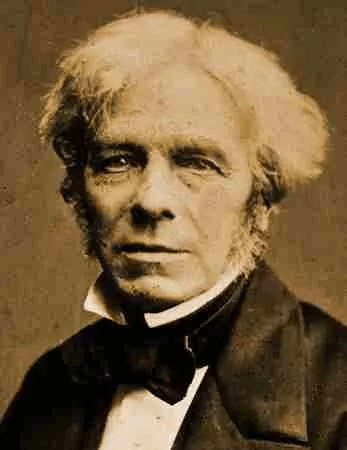
Michael Faraday (1791–1867) is remembered as one of the most influential scientists in history, particularly in the fields of electromagnetism and electrochemistry. His discoveries not only laid the foundation for modern electrical engineering and physics, but they also demonstrated the power of scientific curiosity driven by observation and experimentation rather than formal education. Faraday’s life and work continue to inspire scientists and engineers more than 150 years after his death.
Early Life and Humble Beginnings
Michael Faraday was born on September 22, 1791, in Newington Butts, Surrey, England, into a poor family. His father was a blacksmith, and young Faraday received only a basic education before being apprenticed to a local bookbinder at the age of 14. Surrounded by books, Faraday educated himself, developing a keen interest in science, particularly chemistry and electricity.
His big break came when he attended a series of lectures by the renowned chemist Sir Humphry Davy at the Royal Institution. Faraday took meticulous notes and later sent them to Davy along with a request for employment. Davy, impressed by Faraday’s enthusiasm and intellect, hired him as a laboratory assistant in 1813.
Revolutionizing Electromagnetism
Faraday’s most celebrated contributions were in the field of electromagnetism. In 1821, shortly after Danish physicist Hans Christian Ørsted discovered that an electric current produces a magnetic field, Faraday created the first experimental evidence of electromagnetism in motion. He constructed a device that converted electrical energy into mechanical motion, essentially the first electric motor.
A decade later, in 1831, Faraday discovered electromagnetic induction—the principle that a changing magnetic field can induce an electric current in a nearby conductor. This breakthrough led to the development of the first electric generator and laid the groundwork for the practical use of electricity in the modern world.
Faraday’s law of induction, describing how voltage is induced in a conductor in a changing magnetic field, remains a fundamental principle in physics and electrical engineering today.
Advancing Electrochemistry
Faraday also made significant contributions to electrochemistry. He introduced several concepts and terms still in use, such as electrode, anode, cathode, ion, and electrolyte. His laws of electrolysis, established through meticulous experimentation, quantified the relationship between the amount of electric charge passed through a substance and the amount of substance altered or deposited at the electrodes.
These discoveries provided a systematic understanding of electrochemical reactions and helped refine the emerging field of physical chemistry.
Science for the People
Faraday believed passionately in science education. He gave hundreds of public lectures, many of them aimed at young people and non-specialists. His “Christmas Lectures” at the Royal Institution became a cherished tradition in Britain, and they continue to this day.
Despite receiving many honors during his life, including election to the Royal Society and offers of knighthood, Faraday remained modest and declined titles and accolades. He preferred to be known simply as “Mr. Faraday.”
Legacy
Michael Faraday died on August 25, 1867, at the age of 75. He left behind a scientific legacy that transformed humanity’s understanding of electricity and magnetism. His work directly influenced later scientists such as James Clerk Maxwell, whose equations further unified the theory of electromagnetism.
Faraday’s name lives on in numerous scientific terms and institutions. The unit of capacitance, the farad (F), is named in his honor, as are numerous awards, streets, and institutions around the world.
Michael Faraday’s story is one of brilliance born from perseverance, self-education, and insatiable curiosity. With no formal academic training, he became a giant of science—proving that passion and dedication can illuminate even the darkest corners of nature’s secrets. His pioneering work in electromagnetism and electrochemistry continues to power the modern world.
 Station HYPO
22 September 2025 at 14:01
Michael Faraday was a childhood hero of mine, and remains so today. Post-Sputnik provoked a very intense public interest in Science.
Faraday’s contributions to Science, Education, Electromagnetism, Chemistry, and even the Electromagnetic Wave Theory are among the highest achievements in human history. All without a formal education. Inspiring. Thanks for the tribute.
Sincerely, Bruce Dybvik
LikeLike