
TORII MEMORIAL GATE – UPDATED
By Jay R. Browne
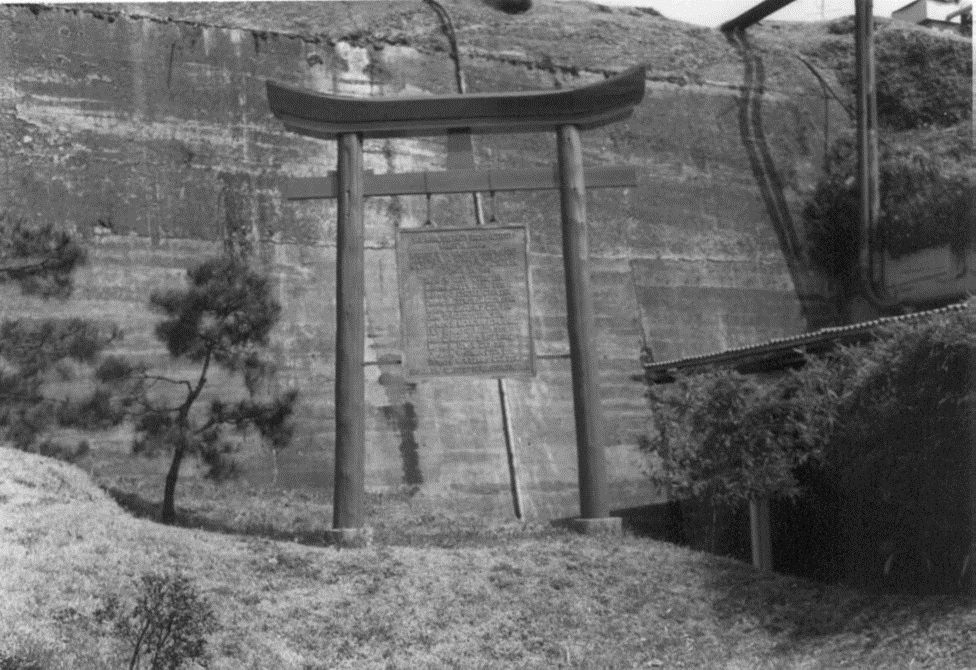
Featured image: 1981 photograph showing the memorial plaque hanging in the original wooden torii. The location has became known as the “Torii Memorial Area” and is adjacent to the “tunnel” (seen as the back drop) and the tunnel entrance. Note the bike shed to the right.
There hasn’t always been a torii. After the fire on 24 September 1965, a bronze plaque was cast commemorating the event and listing the names of the Sailors and Marines who were lost. Earliest references to this plaque are in the command history file for calendar year 1966, signed by Commander Thomas J. Quick, the executive officer and the base publication the KAMISEYAN, edition of 21 October 1966. According to the article, the plaque was cast in early 1966 with funds raised, in part, by the men of Naval Security Group Activity Edzell, Scotland and Naval Security Group Detachment Midway Island. On September 24, 1966 the first anniversary, a memorial service was conducted in front of the base flagpole. The plaque can be seen in the photos accompanying that KAMISEYAN article (see page 107).
For many years this plaque hung in the foyer of the ‘Operations Building’. As late as September 1975, the 10th anniversary of the fire, the plaque hung in the foyer. In Japan the torii is the symbol of a shrine, a place of sanctity – a fitting part of the memorial for the victims of the 1965 fire. Sometime between September 1975 and June of 1976 a wooden torii was constructed and the plaque was moved out of the operations building to hang outside under the torii next to the main entrance.
This new location became a focal point for countless reenlistments and other formal occasions. Photos from the time – and right up to the closing of the activity in 1995 – attest to the popularity of the site.
According the CWO3 Greg Gayhart, (who was at Kamiseya on his first tour from November 1985 to November 1989), plans were already underway to move the wooden torii from the original tunnel entrance location to the fire site “memorial” area when he arrived (during Commander Barnett’s tour). The actual move occurred during Commander Walton’s (Commanding Officer from September 1986 – July 1989) tour. As the Chief Warrant remembers it, “the Skipper wanted it to be in a more ‘prominent’ location.” As best as can be recalled, the original idea was to move the existing wooden Torii but it was found to be rotting. While a new metal one was constructed or purchased the old torii was temporarily placed in the memorial location. The Warrant also mentioned that Commander Walton had the brass plaque shined up after years of neglect.
In a letter from CTTCM (Ret) Larry Peterson, he mentioned that in 1968, when he was there, the plaque was also there. Master Chief James Lollis who was there from May of 1970 to 1974 confirmed there were no special activities relating to the fire during his first tour – the torii was just there. Still later, Chief Richard O’Neil (first tour 1975-1976) related the Torii was also “just there.” In fact he didn’t realize that the Torii had been replaced until it was pointed out from the pictures while researching the torii’s history.
The butler hut, Building 106, at the Operations Complex is only a portion of the original building. Prior to the fire in 1965, Building 106 was a dual building. The first part was a long Quonset hut (20 x 84 feet) and the second part a ‘butler’ style building also 20 x 84 feet. The two were connected roughly in the center. Originally, Building 106 was attached to Building 25 (the fire destroyed structure). Following the fire, Building 106 was separate from the new Building 176, the new Naval Communications Station receiver building. Existing photos show Building 106 as well as Bus Shelter (Building 185) adjacent to the newly constructed building 176. Prior to 1 September 1985, Building 185 was demolished and still later the Quonset hut portion of 106 was torn down. With the absence of the Quonset hut, command signs (with colored logos of Naval Security Group (NSG) and Fleet Ocean Surveillance Information Facility, Western Pacific (FOSIF WESTPAC) were erected. FOSIF’s Building 230, another butler hut (960 square feet), was finished on the site of the old Quonset hut by 9 October 1986. This new hut caused the command signs/logos to migrate closer to Building 176.
This led to the creation of the Fire Memorial Area and the tug-of-war about the location of the memorial plaque. CWO3 Gayhart mentioned that Commander Walton’s relief, Captain Bartholomew, had the plaque painted and conducted the “first annual” memorial service at the fire site location.
The word is that Captain Bartholomew did not like the new (fire site) location. He had been stationed at Kami Seya before (he departed Kami Seya as a Lieutenant on 30 June 1976) and liked the original (tunnel entrance) location. He decided that before he transferred he would see the torii and plaque back in their original position.
Captain Bartholomew instigated several significant self-help and beautification projects which, when completed, resulted in improved command facilities and were tied (indirectly) to the Memorial. Further, the command saved approximately $141,000 in material and labor costs through these efforts. One of the projects was a shed.
The Bicycle/Motorcycle Shed at the Operations Complex has been in two locations. Originally a Public Works Department project, as of 4 February 1977, it was located to the left of the main entrance to the tunnel complex. Over the years, drainage problems, due to rain water runoff from the tunnel itself, caused numerous “flooding” problems inside the tunnel entrance. By early 1991, it was decided to relocate the shed to the side of Butler Hut 106 facing the tunnel. A new Bike Shed was constructed with assistance from Public Works. The project was started on 4 February 1991 and completed on the 25th as a self help project at a cost of $150.00 (vs a contracted cost of $4000.00). During its removal, the original Bike Shed roof was found to contain asbestos and additional help was requested from the Navy Hospital at Yokosuka. By 20 April, the old Bike Shed had been demolished. To alleviate the drainage problem, the area (to the left of the main entrance) was filled in and graded, which allowed for the creation of a new memorial area.
The expanded memorial area was started 21 October 1991. The project took until 15 November to complete. Cost savings, as a self help vs contracted project was $8000. Now that the area was completed, it was time to move the Torii.
Accordingly, in March 1992 a working party was formed which included CTO2 James Rounds, CTO3 David Wright and CTOSN Daniel Anderson, and Public Works Japanese Nationals (as needed) to move the Torii yet again. As of June 1993 the all-metal Memorial Torii was back in almost the original position – adjacent to the tunnel itself and the tunnel entrance. At it stood, circa 1994, the torii was 9’6″ wide (at the top) and stood 8’5″ above ground level. The upright pipes were 1’9″ in circumference. The plaque was 2’10” wide by 3’4″ tall.
With the impending closure of the Naval Security Group Activity Kamiseya, a question was raised as to what to do with the torii/plaque. The decision was made to send the plaque to the NSG Headquarters museum at the Security Station, Nebraska Ave. Washington, DC (now at Fort George G. Meade, Maryland). Also, it was decided to give the torii to the Detachment at Yokosuka – which officially became an activity coincident with the stand down of Kami Seya. Another working party was formed, this time it included: CTM2 William A. Kerstiens, CTO3 Rickey L. Winfield, CTO3 Daniel M. Fair and CTOSA Timothy M. Harrison along with several Public Works personnel operating a hoist. The plaque was removed and boxed for shipment to the States. On the afternoon of 28 April 1995 the torii came down and was taken to the Public Works Department to await transportation to Yokosuka. The torii was trucked to Yokosuka on 30 May. The Detachment designed a new logo and included a torii (for the first time) in their new design. This will be a fitting way to keep alive the memory of Kami Seya and those who served there.
The inscription on the plaque reads:
U.S. NAVAL SECURITY GROUPACTIVITY KAMISEYA, JAPAN
DEDICATED TO THE MEMORY OF THOSE WHO LOST
THEIR LIVES IN THE SERVICE OF THEIR COUNTRY
IN A DISASTROUS FIRE AT THIS ACTIVITY ON
SEPTEMBER 24, 1965
RogerW. ALEX, CTSA, USN
Wilford D. CORDILL, CTSN, USN
William E. BRILEY, CTSA, USN
Dennis E. ETZWELLER, CTSN, USN
Archie R. GAROFALO, CT3, USN
John D. HOUSE, CTSA, USN
Richard E. MCKOWN, LCPL, USMC
LTJG Ernest D. MOODY, USN
Paul C. RODRIGUES, SGT, USMC
James K. WHITMAN, CTSN, USN
Wayne E. TOWER, CT3, USN
Gregory S. WILLIAMS, CT3, USN
SAYONARA IS NOT GOODBYE, BUT A PROMISE TO MEET AGAIN
Postscript: The plaque did not stay at headquarters. Arrangements were made and the plaque was delivered to the Command Display onboard Corry Station, Pensacola, Florida. Today (early 2025) the plaque, sans torii, is in a prominent location on the outside wall next to the Command Display entrance. Other plaques on the outside wall commemorate the USS LIBERTY and members of the “On-the-Roof” Gang on the north side of building 503.
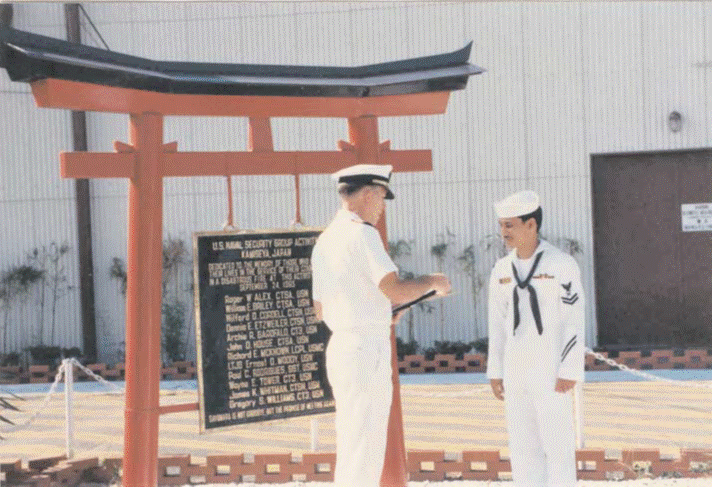
Kamiseya, Japan, with CTR2 Anthony Cruz at his reenlistment
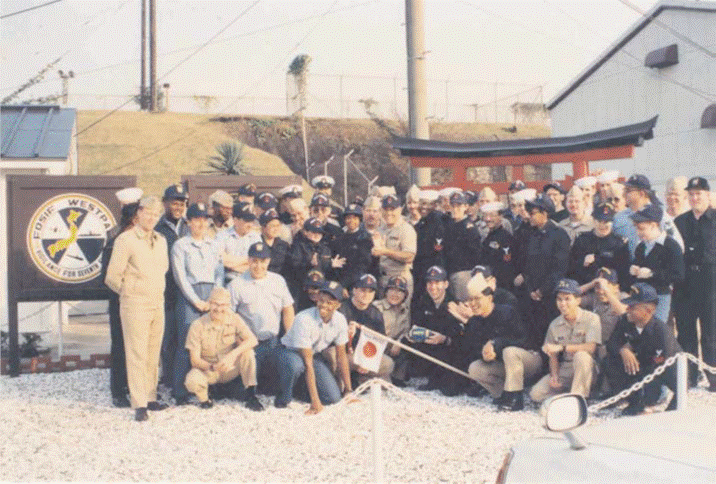
forward memorial area for a “Good Morning America” segment in
late 1991
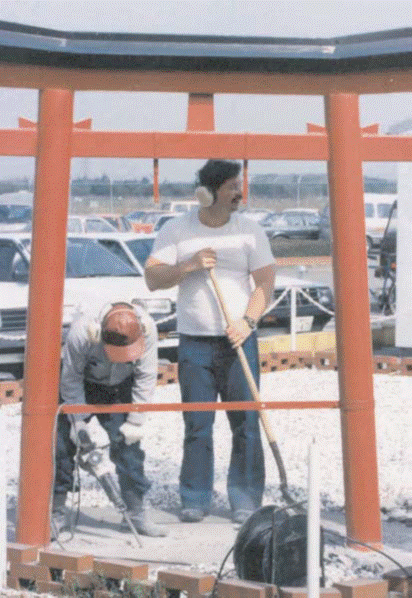
ear protection) begins the process of
moving the Torii and Memorial plaque
back to its original location with help
from Japanese Public Works (holding
drill).

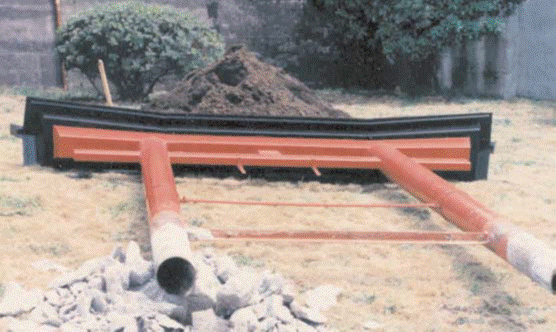
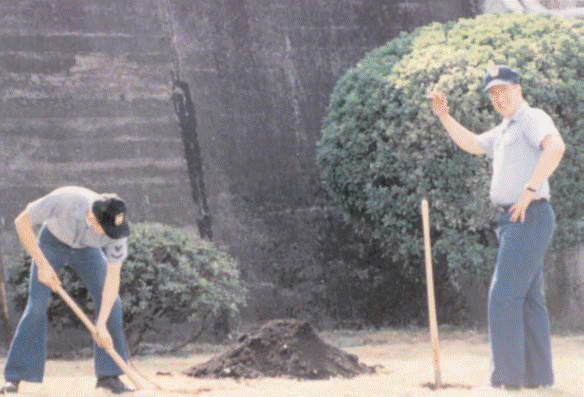
and CTOSN Daniel Anderson (waving
prepare the new (original) site.
Photos are from March 1992
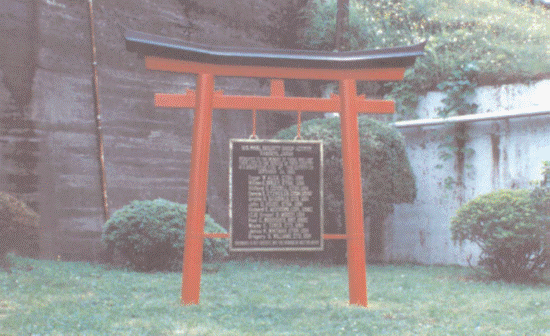
The “new” metal Torii and Memorial Plaque in the original location.
A place of solemnity and respect. Photo taken 22 June 1993.
Source: US NCVA Special Publication, Kamiseya 40th Anniversary Fire Memorial
 Station HYPO
Leave a comment