

From the Shore Fire Management Report on the fire:
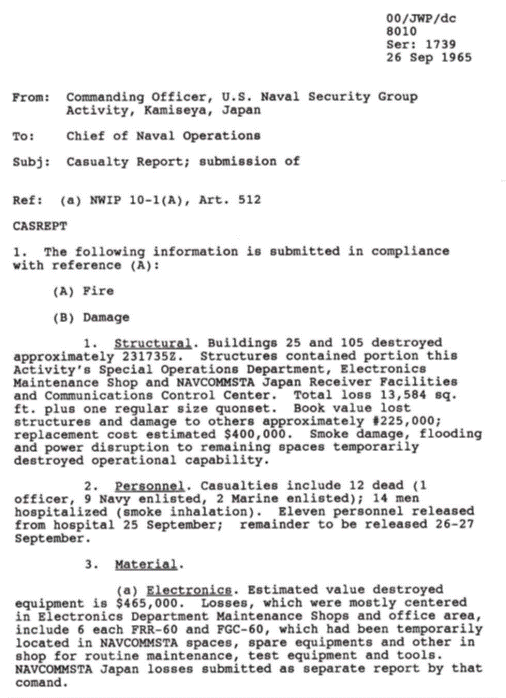
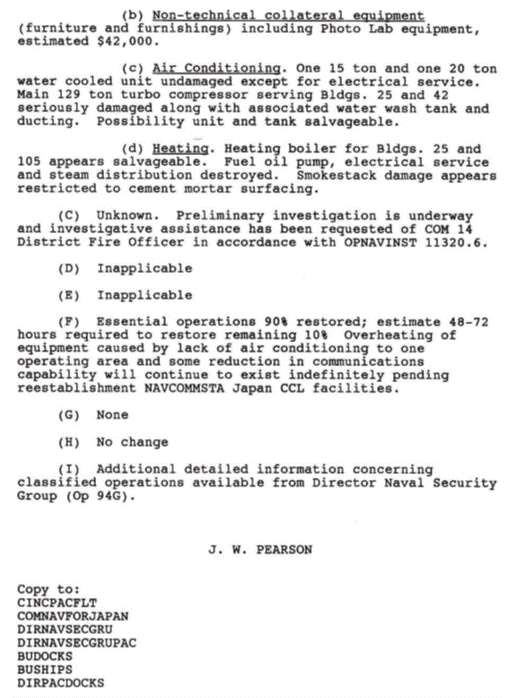
24 September 1965 – Security Communications Facility, 11 enlisted men, 1 officer died – $1,307,800 property loss. At 0235, smoke was noted in operations area by watchstander. A search for the source of the fire revealed fire in combustible undivided 1st floor concealed space. Smoke quickly spread as Fire Department was called and occupants attempted to fight the fire. Two 500-gpm pumpers responded manned by military and Japanese Nationals. Realizing the seriousness of the fire outside aid was called.
Overall attack was hindered as fire personnel were not permitted in security area. Fire cause was believed to be electrical malfunction at high amperage circuits in concealed spaces. Two buildings were destroyed and twelve military personnel were killed as a result of the fire. Ten were found behind a security gate apparently trying to exit area. {Bodies found at the bottom of the center stairwell of Building 25. Officer body found in adjacent room. Twelfth victim died en route hospital}.
Major factors in this loss were:
1. Highly combustible interior
2. No automatic sprinkler protection
3. Delayed alarm
4. Failure to evacuate, attempting to fight fire
5. Air conditioning spread smoke
6. Power cut off put building in total darkness
7. Ceiling concealed spread of fire
8. No evacuation plan & high security
loss: building & contents @ $1,307,800;
12 deaths;
15 injuries
The Navy listed the fire as having been electrical in nature. This is not universally accepted. As George Morton mentioned earlier in his recollections, a number of Sailors blamed the fire on the incinerator. Several people interviewed who were on station in September 1965 tell a similar story as to the fire’s origin. The site incinerator was located in the single story portion of Building 25 and at the time it was notorious for being HOT in there. The last thing any CT wanted to have happen was to be assigned ‘burn detail.’ The incinerator was a real “hellhole.”
Most people who came off ‘burn’ had themselves been burned. Most were minor in nature but still enough to generate considerable talk wherever Sailors gathered. Having ‘burn detail’ automatically meant that a new shirt would be needed – the heat was that intense.
The people interviewed generally accept that, despite what the official report says, the fire started in the Incinerator Room and spread from there. There is some collateral evidence to that effect.
From the NCS Japan log of 24 September 1965 @ 0425:
Kamiseya now reports entire receiver building completely destroyed by fire. Cause of fire appears to have been an explosion in the incinerator which occurred during a scheduled burn of classified material.
Speculation, yes. Fact, maybe – maybe not. Like other debatable questions of our time, the definitive answer will probably never be known. But whichever reason the reader subscribes to: electrical – as the official reports states or the incinerator – as several first hand people believe the outcome remains the same. Fine Sailors and Marines lost in the line of duty.
Source: US NCVA Special Publication, Kamiseya 40th Anniversary Fire Memorial
 Station HYPO
Leave a comment